
A Battle for Azeroth: Bringing it All Together

On August 13th (or 14th depending on where you were in the world) at 6pm EDT, Blizzard Entertainment released the latest expansion to World of Warcraft–the seventh expansion to be released for the nearly fourteen-year-old game. While WoW may be nearly thirteen, the Warcraft franchise itself is nearly twenty-four, as Warcraft: Orcs & Humans was released in 1994. As one of the longest-running MMOs, WoW and its universe clearly has to be doing something right.

In order to tie everything we’ve talked about so far together, I’m going to end by looking at the success of World of Warcraft not only as a game, but the ways in which they engage with their players in order to ensure success and account for the possibility of failure. Rather than only doing one or two things right, World of Warcraft is in fact, doing a lot of smaller things right, so that when failures come (*cough* Warlords of Draenor *cough*), the game continues to survive.

As I mentioned in the second content post of this series, I’ve been playing World of Warcraft since the early months of 2007. Eleven years of content, of characters, and of social situations, and yet, I continue to come back, why? Probably for the same reasons everyone else does–Blizzard has gotten me successfully engaged.

One of the first areas I noticed the depth of my emotional and psychological investment in Azeroth was when I was faced with having to switch factions last year. While I have played both sides of the faction divide over the years, I’ve always only played seriously on the Alliance. My first characters were Alliance, and most importantly, my now-main character was Alliance.
WoWScrnShot_021016_201536
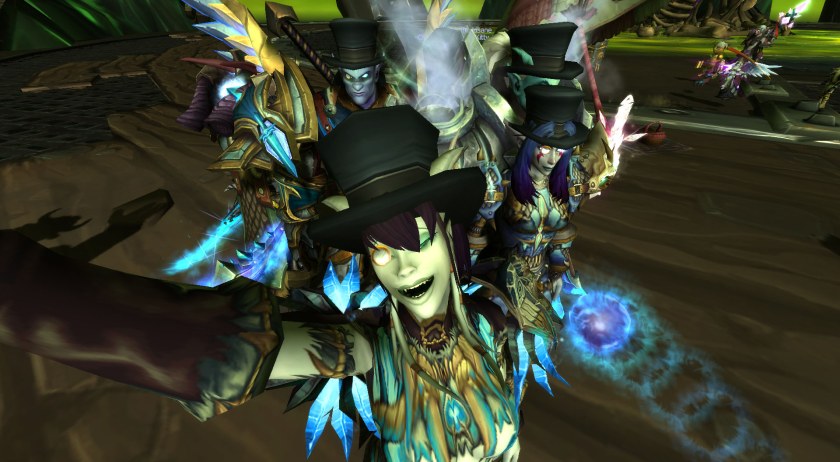
A Draenei restoration shaman, to be exact. 

I swapped to my Draenei shaman not too long after learning the ropes of the game. By the time Patch 2.3.0 launched in November of 2007, I had gotten my bearings and was actively clearing raid content with my original guild. After we eventually got into Zul’Aman, the raid launched with 2.3.0, it became apparent that we would need a specific kind of class in order to complete it. That class was a restoration shaman. I offered to swap classes from warrior and never looked back. Suffice to say, my main character Shebalo and I have been through a lot, and she’s become an an extension of myself more than I had realized.

After re-rolling to a healer class, my ambitions soared. I got involved with more difficult content, and eventually joined Hello Kitty Club, who I’m still with today, after a lot of on-and-off periods. During one of those off-periods last year, I was part of a splinter group from HKC. We were comprised of the most ambitious and skilled of our raiders, who ultimately decided that the only way we could continue to progress through current Mythic (the highest difficulty) raid content was to swap to Horde on Akama, where there would be more bodies to recruit. Many of my peers easily made the change, quickly swapping to whatever Horde race they decided fit them best.

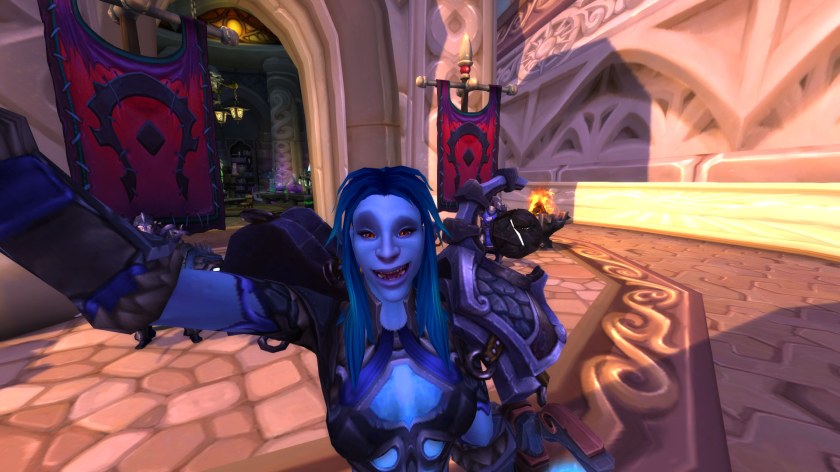
I, on the other hand, struggled. And naturally, thanks to running my Twitch, I recorded it. And so, for a very brief period of time, I was a Troll restoration shaman.
WoWScrnShot_031517_190328

It never quite felt right, and the emotional turmoil I went through to swap sides, is visible throughout the two-hour plus highlight video. I felt my emotions welling up as I tried to transfer, bought the wrong transfer, ticketed Blizzard to get the right transfer–all the while dreading what I was about to do. It wasn’t just about leaving my guild home, it was going against my very in-game identity to become the opposite side.

In that moment, Azeroth was a very real place (Ruch 2009). It was not simply a place filled with pixels where I passed through. It was a place I “lived” in, a place I experienced the passing of time through, it was very real.

While I never really participated in roleplay within the game on Shebalo, over time, I built a headcannon about her movements through Azeroth, about her place, my place,in the community and the world. We were one in the same, and much like my aversion to playing Renegade Sheppard in Mass Effect, so too was I against playing something I didn’t feel to be me.

Despite a lack of active roleplay, I did (and continue) to consider how my character might react given in-game situations. In particular, during the last expansion Legion, players were finally able to visit Argus, the former Draenei homeworld. Naturally, when this first launched, I was still playing on the Horde and it felt as though something was missing. When Argus had been announced at a previous BlizzCon, I had already started to think about what it would be to “return home” as my character. As a Troll, this no longer applied.

What this suggests is that the avatar is neither entirely “me,” nor entirely “not me,” but a version of me that only exists in a particular mediated context. When that context, and with it the avatar, ceases to be, that part of the self dies as well. That part of the self, expressed and projected through the avatar in a shared virtual world, is as much a creation of the group as the group is a creation of the individuals within it (Pearce 119).

I went through many crises of identity while playing Horde side on my main character that truly demonstrated to me just how much I had invested not only in the game, but also who I was in the game. When I finally switched back to Alliance, everything just felt right. I quickly was able to re-select the face and attributes of the model I had used for so many years (with backup screenshots just in case).

Heading into Battle for Azeroth, I don’t think I could have had it any other way.
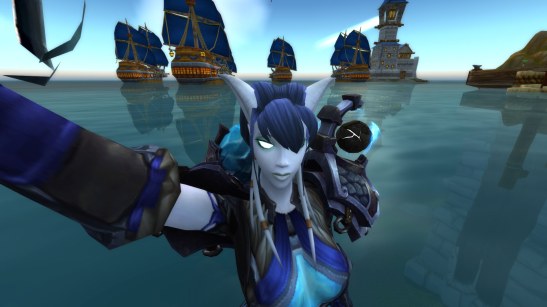
WoWScrnShot_080718_160101
For the Alliance!

My time spent on Shebalo wasn’t just about my own relationship with my character, but also with my community. As I discussed in the previous post, I was lucky to find such long-standing friendships through Hello Kitty Club. Not only did we experience the rise and fall of our raiding progression (Juul 2013), we also spent extensive time exploring the virtual-physical world of Azeroth together, well into the late hours of the morning. Blizzard is well-known for including reclusive Easter Eggs, abandoned content, and memorials throughout their games (Gibbs et al. 2012), WoW being no exception. While we explored the world, we learned about the game and each other. We were able to interact without the chaos of raid combat, and friendships increased.

Over time, people have come and gone from our guild, but there’s a large core that’s remained the same. We interact on various social medias, and over time, have repeatedly brought each other back into the game. Beyond the itch to play, the promise of social interaction with a known group of engaged individuals, helps to keep us engaged in the content.

Our stories are not unique, and in truth, it’s probably one of the biggest features that keeps World of Warcraft so popular over time. So long as your social group stays, so too are you likely to as well. Combined with guild meetups and bringing virtual friendships into the tangible space, things become even more real and engaging. Conversely, if you only play alone, or have lost touch with the friends you used to play with, the draw to stay in Azeroth is likely lessened. The “massively multiplayer” component is not only important from a gameplay perspective, but also affects our engagement with the world. When the novelty wears off, when you can’t possibly fathom running your face into the same boss for another week in a row, friends and social experiences keep you engaged. Because of this, over the years, even in the recent Battle for Azeroth expansion, Blizzard continues to strive to increase friendship and community engagement.

subscription

World of Warcraft also succeeds at keeping players invested in line with the Sunk Cost Fallacy. After nearly fourteen years of running, it’s hard for players to turn away from their digital investments. Astonishingly, it’s also probably how World of Warcraft has retained their subscription fee, while other MMOs continue to drop theirs. Like an un-used gym membership, I have known countless people over the years who retain their WoW subscriptions, even when they play rarely-to-never, “Just in case” they want to return. It’s not even just subscription fees, the cost of accumulated expansion costs, in-game services (server transfer, faction transfer, race change, etc.), memorabilia, paratexts (novels, table books), and virtual goods (pets, mounts, etc.) are compounded into the real-world costs and fears of value loss.

To further encourage people to invest in their time with the game, Blizzard has also offered alternative sources of funding like the WoW token, which can be bought and sold with real money, for in-game currency, and vice versa. This has allowed people to invest more time into the game, by accumulating digital wealth, so that they can spend it on “real-life” costs, like subscription fees and Battle.Net currency for other Blizzard games.

Blizzard also continues to update the base value of the game, so that it is affordable for new and returning players. In July, they announced that new and returning accounts would be able to play all the way through Legion content with just a subscription. No longer are players required to buy-in to the game, or its previous expansions. Instead, the entire world of Azeroth is available to players up and until the most recent content, Battle for Azeroth. In this way, Blizzard capitalizes on existing players’ social capital, as well as WoW’s reputation as an MMO, to encourage new players or returning players to re-invest in the virtual landscape.

Finally, one of the ways in which Blizzard continues to enrapture their audience is through their extensive worldbuilding and storytelling. Not only are there the narratives which occur within the Warcraft games, but Blizzard also releases paratextual books, audiodramas, cinematics, and comics to expand their world.

World creation has become a core feature of many recent digital games, and this fits hand-in-glove with the generic features of fantasy; the carefully crafted, extensive worlds found in massively multiplayer role-playing online games such as Guild Wars, EverQuest II, and World of Warcraft offer players the opportunity to inhabit such worlds wherein they play and interact with others in the guise of heroic adventurers. It can be said that most popular cultural artifacts are reliant on intertextual features for the generation of meaning and recognition…these [contribute] to the high-fantasy ambience of the game, even if at times more quotidian aspects come to the fore, and provides in different ways the means of locating players meaningfully in the game world (Krzywinska 123-124).

Alongside the game’s paratexts, the world itself is filled with extensive quest-text, cut-scenes, cinematics, flavour text, lost pages, monuments, memorials, and Easter Eggs to discover. The cities are busy with NPCs (and ideally players as well), and increasingly lively, as Blizzard continues to make NPCs more immersive, including models, postures, and voice acting.

Further still, painstaking detail is put into not only the textural features of the world’s story, but also in its audio-visual aspects as well. Vast sweeping landscapes, digital sunsets, fanciful festivals, and haunting melodies encourage players to explore and to stay a while. There’s always the suggestion that there’s just a little bit more below the surface–some rare secret you might just get the chance to discover. There’s even an entire discord community devoted to just that prospect.

All of these contributing factors combine to keep World of Warcraft not only afloat, but sailing through the vast sea of other MMO efforts. In a genre that’s largely perceived of as dying, or at least who’s future survival is constantly questioned, Blizzard continues moving forward. In addition to the areas covered here, they also continue to innovate and improve upon game mechanics, player quality of life features, and storytelling ability. It raises the question, if all of this is not only the reason for their success, but also demanded by our current video game marketplace. The ability to hook and maintain investment of such a large segment of the globe for nearly fourteen straight years is an impressive feat.

Blizzard’s ability to continually engage with and emblaze their World of Warcraft community members is readily demonstrated through their cosplayers, Role-Players, fan-writers, community leaders, and gaming participants. How many other games do you know of that start real-life virtual protests of a fictional characters’ actions, thanks to another fictional character’s rebellious actions? Further still that the #NoHonorNoPauldron movement even charged-up players who don’t play anymore?
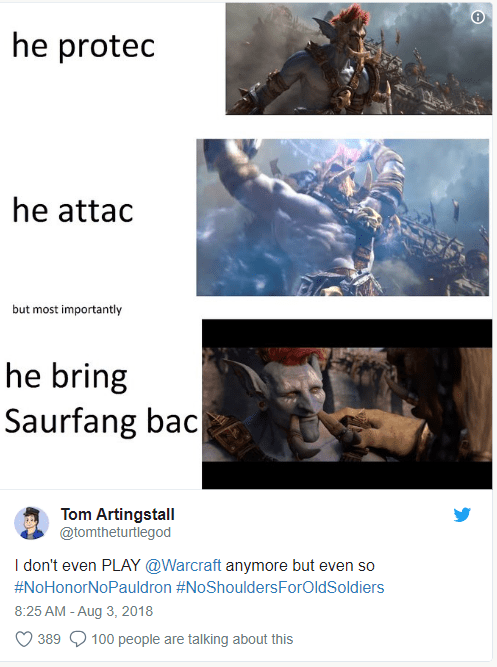
nohonornopauldron.PNG

Whether it be a calculated advertising tactic, brilliant storytelling, or just dumb-luck side effects of a highly effective gameplay experience, Blizzard’s ongoing development of World of Warcraft and it’s virtual universe shows no signs of slowing down anytime soon. They’ve survived a number of setbacks, but they continue to push forward and to learn from their mistakes, thanks to their successes in encouraging multi-faceted levels of player interest and emotional investment in Azeroth.

Essentially…
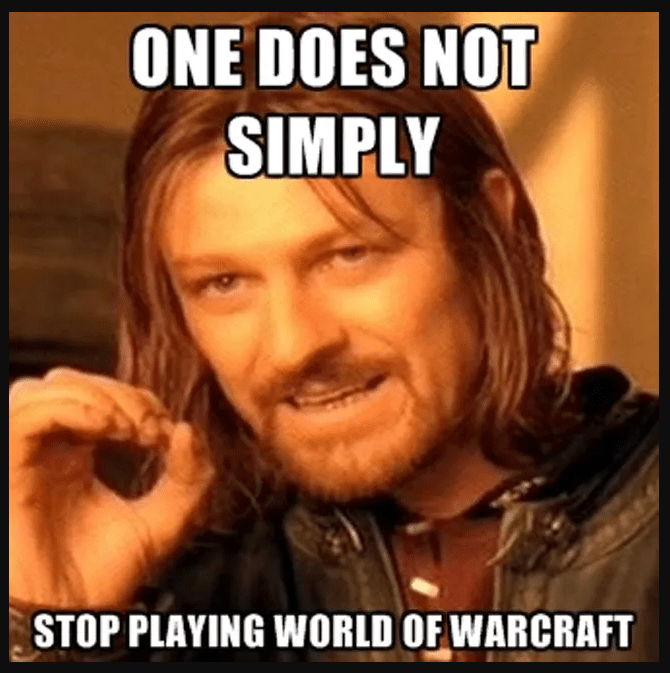
meme


– Gibbs, Martin et al. (2012) Tomestones, Uncanny Monuments and Epic Quests: Memorials in World of Warcraft
– Juul, Jesper. (2013) The Art of Failure
Krzywinska, Tanya (2008) World Creation and Lore: World of Warcraft as Rich Text in Digital Culture, Play, and Identity: A World of Warcraft Reader, Hilde G. Corneliussen and Jill Walker Rettberg eds.
Pearce, Celia (2009) Communities of Play: Emergent Cultures in Multiplayer Games and Virtual Worlds
– Ruch, Adam (2009) World of Warcraft: Service or Space?

Social Creatures

As much as our identities are bound up in the games we chose to play (or not to play), so much of the gaming world is tied to gaming culture and identity. As I quoted Flanagan in the previous post, the current gaming norm of “white dude” bro culture is a very intimidating one for interested parties to try and break into, if they don’t speak the language. Even when you do know the lingo, and are accepted in, there are more things at work than just social inclusion.

Given the fact that playing Ultima Online is very time-consuming and also requires a degree of financial investment, the users must assume they will benefit in some way. A recurrent theme in our interviews with the players, as well as in several items of the questionnaire, was the social experience of gaming. About two-thirds of the players mentioned the potential to interact with several thousand fellow players or participating via ones’ character in a virtual “society” as an essential motive to log onto Ultima Online. Compared to this, motives related to the individual such as mastering “quests” or the improvement of skills play a subordinate role. Surprisingly, only a quarter of those surveyed regarded climbing up the hierarchy of players as a very important incentive (Kolo and Baur 2004).

Despite their study being over ten years old, many of their findings still hold up strongly in the current online gaming landscape. Alongside social interaction within video games, particularly MMOs like World of Warcraft or web-based shooters like Fortnite or Overwatch, there’s also vast fan communities online, user-created content development, and an explosion of live-streaming. In this way, we become invested in the games we play not only because we like them, but because we like the people who like them.

Isolated individuals are given access to people that help them not feel alone. Isbister sums up the importance of sociality and gaming it up well:

The isolated gamer sits alone, face illuminated by the blue glow of the screen, lost in a solitary trance. It’s a familiar image from movies, TV, and popular culture in general. But the stereotype of the pasty-faced, antisocial game addict belies what we actually know about gamers. In fact, the majority of people who play digital games play them with others. 1 This shouldn’t be surprising: from playground tag to chess, card games, and board games to Minecraft and Call of Duty , the long history of games is primarily a story of rules and equipment created to engage people together socially. When we humans play (aside from the occasional game of solitaire), we usually play together. So before we can grasp the emotional impact of digital games, we need to understand what happens in social games more broadly (44).

WoWScrnShot_112409_200050
A contest, a guild, a dream.

I started playing World of Warcraft sometime before the launch of Patch 2.1.0, which included the infamous Black Temple. It was my first MMO and I knew pretty much nothing about them. I had previously dabbled in Champions of Norrath online play on my PS2, and played countless single-player RPGs beforehand, but I had next to no bearings heading into Azeroth. I started playing because of my friend, and a free week trial. I got addicted, they didn’t. I learned the ropes the hard way, in a “git gud” environment. My original character was a warrior who didn’t know how to tank, and occasionally wore leather when I should have been wearing all plate. I was a mess. Eventually through coaxing, meeting good people, and joining a helpful community, I grew and became a better player. Eventually, through social networks on Akama-US, and after re-rolling to a restoration Shaman, I joined one of the top-3 raiding guilds on the server, just in time to see Black Temple and The Sunwell while they were still current. And the rest is history…well Hello Kitty Club history.

I’ve been with the same guild, more or less, ever since. Late night Ventrilo chats were replaced with late night Discord chats, but a large portion of our core remains. The guild has fallen apart in the virtual space, only to be bound back together again an expansion or two later, all the while our social ties went on through Facebook and other social media. Many people in the guild, myself included, stay in the game, and keep returning to the game, because of this community we’ve built. Many of us have met in person, or created lasting bonds outside of the game. Some of us have been friends longer than some of my friends in my “real” life. We’ve been through things together and the game wouldn’t be the same without them. “There is something deeply satisfying and bonding about over-coming a challenging mental and physical situation with someone else, especially if it requires close coordination” (Isbister 45).

MVIMG_20171102_213348
HKC at BlizzCon 2017

Our friendships have come a long way, as all internet friendships have. In the early days of WoW and other online gaming communities, it was not unheard of to be scorned or cautioned for having web-based friends. It didn’t matter that people were connecting across the globe or with mutual interests–they were unknowns and scary. “Ubiquitous connection has dramatically changed how we communicate with one another on a day-to-day basis, shaping how we understand community and copresence. Texting, Twitter, and Facebook, email, and blogs offer countless ways to check in on someone–or on many someones. Game developers have interwoven networked communication and the sense of copresence it creates deep in the experiences that they offer players today” (109). Beyond simple communication tools, developers are including gifts for friends, friend bonuses, and other incentives to bring the social into the gaming space–to become even more invested in their worlds.  Pokemon Go recently added these kinds of friendship-incentivizing features and might have helped to re-invigorate the game as a result.

super-smash-ultimate

Internet-based games are not the only place where the importance of social play occurs of course. Franchises like Super Smash Bros. persist in a world of web-ready content, pushing the importance of split-screen or same-room play. “When players in a room together laugh, jump, and tease each other, the power of games to drive connection, empathy, and closeness appears right before your eyes” (109). While our views of web-based communities may be shifting, the importance of an in-person all out brawl has not changed. Arguably, it’s also at the root of attending e-sports championships. There’s something to be said for the energy of cooperative or competitive gaming, that just can’t be conveyed through digital media–at least not yet.

What’s more, is that in-person gaming is something which ties itself into nostalgic memory. Four kids surrounding a singular tube-screen, facing off in Goldeneye; a group of high schoolers creating a local LAN party for a Quake tournament; a controller smashed in anger after getting run off the course in Mario Kart 64; another group huddled around a single player, waiting for their chance to hold the controller, as they progress through Final Fantasy 7. These group displays of cultural bonding and belonging are very much a byproduct of the tangible world. As much as players can join each other in the virtual space, the visceral reactions can only be fully felt alongside on another in person.

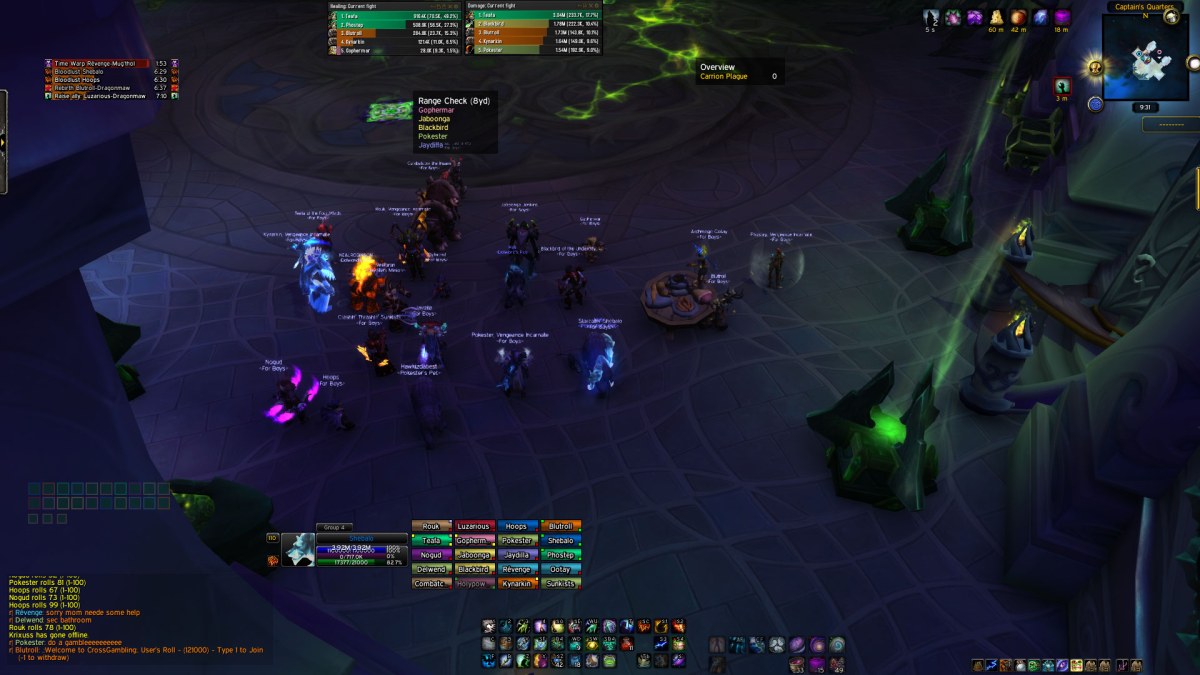
twitch.PNG

However, that doesn’t stop people from trying to catch a glimpse into other people’s gameplay habits or experiences. One of the last ways I want to consider the social realm in this series, is to consider the case of live-streams. The rise of bandwidth availability and video prevalence on the internet has helped to facilitate a surge in video game streaming. However, while videos of “talking” cats and falling toddlers, ala America’s Funniest Home Videos makes sense as a translation to the internet, live-streaming is a curious social engagement.

What distinguishes Twitch.tv from other video hosting and streaming websites with videogame content, including YouTube.com, is the presence and participation of the players and viewers…With its strong reliance on participative engagement, even single-player games become a social activity. It is difficult to find streams on Twitch.tv without, at bare minimum, an audio feed of the player, and the chat box is constantly updated with messages from eager viewers. In a mass medium most often considered inhuman, robotic, or purely digital such as videogaming, Twitch.tv has foregrounded the human element (LaRell Anderson 2017).

As LaRell Anderson discusses, Twitch.tv provides videos of games, but (and most importantly) also of players. Countless games are being played simultaneously on Twitch, and it’s a graball of personality and popularity as to who gets the most viewers for that game. From the outset, there’s a lot of potential to draw connections between live-streaming and spectator sports. However, the primary difference in Twitch streaming is the interactivity. According to LaRell Anderson, “while the chat box supplies plentiful opportunities for viewers to address the streamer/player, it does not inevitably signify an interaction between the two…[instead] the physical feedback provided by the streamer through the video stream transforms the interaction into something human and recognizably physical. The eye movements to read chat messages, the head shakes, the hand gestures, and the various non-verbal communication cues present in face-to-face communication all denote that the interaction is between people instead of from a content creator to a nameless, anonymous audience.”

While Twitch (and now YouTube) live-gaming streams do not fully replace the living room experience, it seems to help facilitate the kind of participatory nature that those experiences provided. While some streams may be as simple as helping a streamer get through a difficult puzzle, ala the group surrounding the Final Fantasy VII player, some streams even encourage playing with viewers. In this way, the boundary between virtual and real is again blended, and the engagement is intensified. A potential gamer may have no interest in playing Dead by Daylight on their own, but when faced with the possibility of earning a place to play alongside one of their favourite streamers, their opinion may altogether change.

Much like the group huddled around a single copy of Final Fantasy VII, live streaming also helps provide access to game content for those who might not otherwise be able to afford it. Living vicariously through the engagement of another player’s entertainment, may be the only way that individual can experience the content.

To this end, we must then consider the importance of monetary investment and gaming engagement [Part 4].


– Isbister, Katherine (2016) How Games Move Us
– Kolo, Castulus and Timo Baur (2004) Living a Virtual Life: Social Dynamics of Online Gaming (Game Studies)
– LaRell Anderson, Sky (2017) Watching People is Not a Game: Interactive Online Corporeality, Twitch.tv and Videogame Streams (Game Studies)

Hitting the “Motherlode”: Cheating/Modding in The Sims & World of Warcraft

I guarantee that no two User Interfaces in World of Warcraft will be quite the same. Both WoW and The Sims have notoriously supported modification to their videogames over the years, even going so far as to convert existing addons or mods into actual features of later gameplay. Where they differ greatly however, is their stance on cheating.

Screenshot 2018-07-09 at 1.45.33 AM
Straight from EA’s official The Sims 4 website.

While it might be front and centre on their website now, The Sims franchise used to have its own share of community shared and pseudo-mythological cheating console commands in circulation. While they were never so obviously discussed by the developers, the existence of easy-to-remember codes like “rosebud,” “kaching,” or “motherlode” for more money, always seemed to suggest that they were ‘in the know’ in giving these tools to players. Further still, there are plenty of things that the early entries to the franchise required you to do via console command, such as stopping aging, that are now features in the normal ‘settings’ of The Sims 4.

Cheating is a big part of the game. Not only is it easy to access, but it’s even something we kinda, sorta, actually encourage. Strap in as we show you not only how to cheat in The Sims 4, but tell you a few of our favorites The Sims 4 cheat codes (EA, The Sims 4)

Can these kinds of cheat codes even be considered “cheating” if they’re considered an endorsed part of the gameplay? Rather than allowing for extra lives or level skips through an implicit playtesting model, EA has gone one step further and condoned the use of their cheats as an active alternative to play. By so doing, they are acknowledging a number of ways for players to consume their content, and allowing people to use it as a building or design sim, rather than just for playing house. Further still, the game doesn’t penalize you for using cheats of any kind, and achievements in the game continue to record as they would if you never typed the [`] key at all.

the-simse284a2-4-02-feb-16-1_22_08-pm-1024x576

Their endorsement of cheating comes alongside their in-game promotion of modified Sims and Lots (houses/businesses/community, etc.) through the Community Gallery. Practically since its inception, The Sims generated a very active modding community. They’ve been the source of providing new hairstyles, clothing options, furniture, houses, meshes, and a whole load of features before the game developers themselves included them. For example, the modding community already had versions of cat and dog companions (within a very limited vein) before an official expansion was ever released to include them. What we have to consider alongside this seeming embracing of “cheating” and “mods” within the native client of The Sims 4, is that the company is attempting to exert control over its modding community.

When a mod system is detached from the game itself, any number of issues can arise, both for the company and for the player. The players could run themselves the risk of downloading harmful files or corrupting their game beyond repair. The developers on the other hand, may risk financial loss over user-created content that mimics things they’d otherwise charge you for. In the end, by including a community gallery within the game itself, EA encourages its players to pay for the game itself, and its expansions (the gallery is not available through pirated versions), as well as discouraging players from reaching beyond their borders for content, via sites like ModTheSims or TheSimsResource. Despite efforts to contain the modification of The Sims, sites like these continue to prosper, providing content to the community where EA and the gallery cannot.

If we go way back, this design philosophy has almost been with The Sims from the beginning, and it seems to me that these kinds of cheats are not really cheats at all. User driven content and world-spontaneity has always been a desired feature on The Sims‘ horizon. Back in 2001, the Game Studies journal conducted an interview with Will Wright at Maxis, aka the mind behind The SimsSimCitySimAnt, and more.

14079
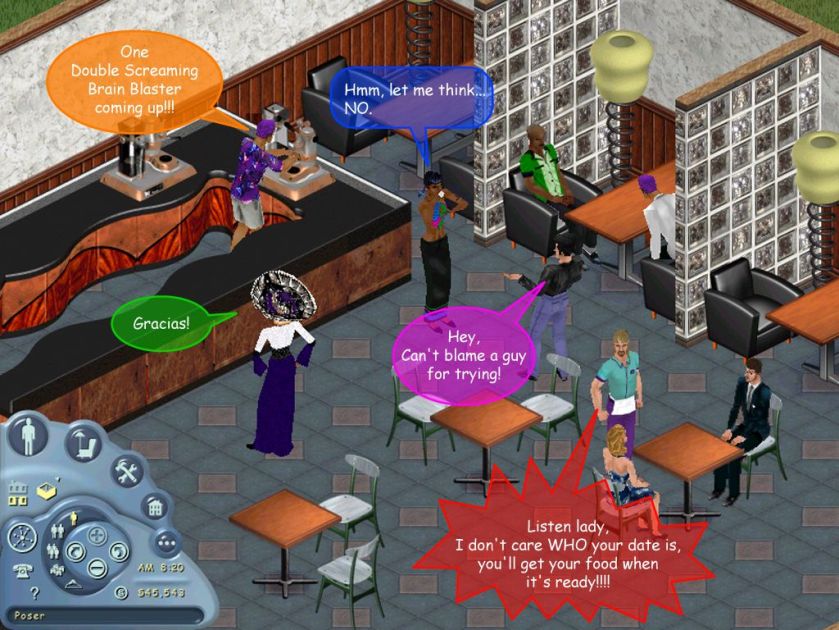
Only in 2002 could The Sims Online be taken seriously with Comic Sans as a default chat font.

While this interview was conducted before the failure that would-be The Sims Online, a sim-universe MMO, Wright shared some interesting insight into what his view of the future of the franchise would be.

I would much rather build a system where the players are in more in control of the story and the story possibilities are much wider. For me the size of the space is paramount. Even if it was between the player controlling it or it being random, I still would want larger space in either case…Because I think you could always make the possibility space larger at the expense of the plausibility or the dramatic potential, or the quality of the experience. There’s probably some relationship between the quality of the experience and the size of the possibility space. So we can make the possibility space huge, just by giving the player a thousand numbers. And “Here, you can make any one of these thousand numbers whatever you want it to be.” That’s a big space. It’s just not a very high quality experience. So we start wrapping graphics, sounds scenarios and events around those numbers, and we’re increasing the quality of the experience you have. It has more meaning to you. In some sense it becomes more evocative. You can start wrapping a mental model around that, as opposed to this pile of numbers (Pearce).

The Sims was never supposed to be just about what stories Maxis (and later EA) could tell you, but rather the stories you could tell yourself. Part of this meant allowing for as broad of a ‘possibility space’ as the code could provide, and where those borders could no longer contain the possibility, the community took over instead. In this way, The Sims in principle can never be modded or “cheated” too much to be considered failure. The inclusion of these things from the game’s very design philosophy presupposes that we might not even have a word for their use within the game’s system. As much as it’s hard to call endorsed “cheating” cheating, it can be equally hard to call inclusion of hairstyles, clothing, or furniture mods, when they fulfill the game’s ‘prime directive’ as it were: enhancing, or even ‘extending,’ the possibility space and user experience. Perhaps “extensions” is more appropriate in this case. “Players of The Sims 2, like players of the first version, have found that one of the most gratifying aspects of play is sharing unique objects with other players. For example, in just under four months (September 2004– February 2005), Sims 2 players created and uploaded more than 125,000 characters and houses to share with others” (Flanagan 50). If The Sims is just about playing house (Flanagan), the only limits ought to be those of your imagination, and as long as the community is willing and able to push those limits, all extensions and cheats are effectively working as intended.

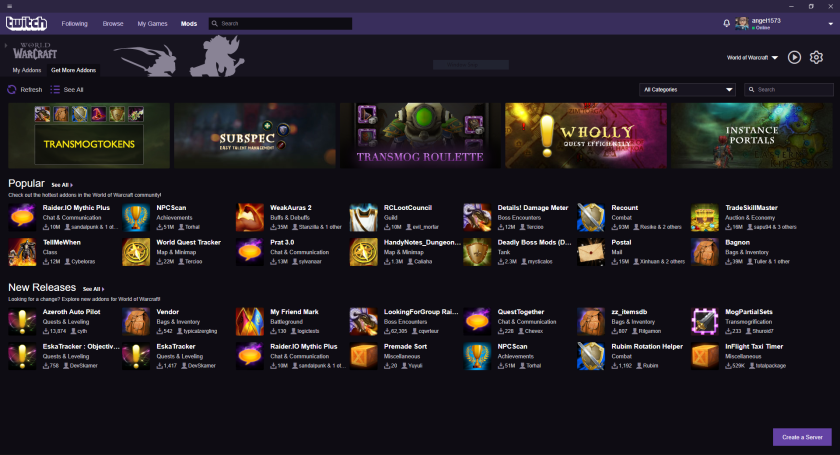
mods

In contrast to The Sims’ stance on cheating and modification, World of Warcraft and other similar MMOs have a much heavier hand. Mods in WoW toe a very fine line between acceptable usage and bannable offence. Generally over time, Blizzard Entertainment, developers of WoW, have taken strides to limit what mods can and cannot do to their game in order to limit how mods can help (or hinder) player experience. Where The Sims is about expanding one’s possibility space via cheats and community content, WoW is about delivering their content through a myriad of lenses, so long as it doesn’t give any one player any significant advantage.

As WoW is a web-based always-online game, with achievements, the need to control cheating is paramount and judged accordingly. Even if a mod ‘arguably’ only affects your experience, like hacking the visual skins of your characters on your game files alone, could be deemed a bannable offence (as happened to a guild member of mine back in The Burning Crusade expansion). Along these same lines, however, while there are no mods allowed that give a significant advantage to one player or another, the community (particularly in high-end raiding or PVP situations) has deemed a number of mods indispensible or effectively required in order to proceed through the “stock” client. Many of these ‘essential’ mods are aimed at modifying and improving user-experience for more difficult content. Mods like “Deadly Boss Mods” (DBM) or “BigWigs” give players access to boss timers, debuff and ability announcements, and often even player cooldown notifications while facing difficult foes in large groups. This kind of information is argued to be indispensable, and yet, is not something ‘truly’ included in the base files of the game. While bosses tend to give visual or audio clues to when they’re about to slam in front of them in a frontal cone, the average player believes they benefit from having DBM on their side to give them a 10 second heads-up.

WoWScrnShot_121416_232125
Guild screenshot of “Hello Kitty Club” 10-year anniversary brawl.

Like The SimsWoW‘s mods are user and community driven. But unlike The Sims, it is not the existence of the mods where the community ends its say, but rather in WoW, it is only the start. Alongside DBM, other mods for average user experience are often touted as being essential, features that change your action bars, your bag space, your interaction with Mission Tables, your party information panels…even your outfit management. While many of these mods have worked in concordance with WoW’s stock user interface, I have heard many player say that they struggle to play the native client without their mods. Even when Blizzard has incorporated a version of the mods “Outfitter” or “Grid” into the basic UI, there’s always something “off” about them, and it can be hard to acclimatize. When hearing that some players play with the stock UI, aside from ‘essentials’ like DBM, players often scoff and ask “if they still have auto-attack keybound as well.”

Installing mods in this way is observed by the community almost as a rite of passage, essential not only in what needs to be downloaded, but that something has to be downloaded at all. And unlike The Sims, all mods are governed outside of the Blizzard umbrella, currently governed primarily through Twitch (formerly Curse).

What the WoW example asks us, however, is how much of a game has to change before it ceases to be the original game? In this example, Blizzard limits what can be done with mods enough that the game is required to stay more or less the same in terms of narrative and basic interaction on the live client. What changes is how people interact with that world. It remains to be seen whether or not that qualifies as a different game for every version of a UI that players look into Azeroth with. Whereas The Sims retains its identity not by being scrutinous of how the game is changed, but rather that the game is changed at all. Although both modding and cheating exist within both games, neither one changes what the game is at its core, and thus, arguably, the game is “preserved” despite them.

As we will soon see however, this is not the case for all games and modifications. Onward to Bethesda, and the modvolution.


Academic References/Further Reading:

Flanagan, Mary. Critical Play (2009).
Pearce, Celia. “Sims, BattleBots, Cellular Automata God and Go: A Conversation with Will Wright.” Game Studies (2001)

Taking the Plunge: Leveling Up to the Silver Screen

Whether they’ve cleaned up at the box office or crashed and burned into the side of the building, video game adaptations are here to stay. What makes or breaks these adaptations?

Whether they’ve cleaned up at the box office or crashed and burned into the side of the building, video game adaptations are here to stay. What makes or breaks these adaptations?

Doom. Angry Birds, Super Mario Bros. …

https://www.youtube.com/watch?v=wtMZKYnLg5c

It’s likely you just cringed a bit…and it’s no wonder. Video game movies often get a bad rep. While the inspiration for movies and TV shows come from books at a steady pace, video game adaptations are, well…a different animal altogether. While you can have some more “faithful” versions, like Warcraft, most of the time gamers will shy away from any mention of a video game getting picked up by the non-interactive screen. Why are we so protective over our video games?

If you google most of the more well-known video game movies, you’ll come up with a relatively low bar in terms of ratings. Quite often ranging from a low 5/10 to barely stretching towards a 7/10, video games adaptations are often not rated well. Is this because video games do not easily translate well to a restricted time setting? Do we inherently expect more from video game movies than we do of book adaptations? Are video game enthusiasts just more vocal than avid book-lovers about their adaptation woes? Do the non-gamers just not take as readily to our stories?

It’s been 17 years since the original Tomb Raider films, are you ready for the new one next year?

There are countless potential questions to ask oneself about gaming movies when there has yet to be a truly breakaway success. Sure, titles like Resident Evil have made for a horse-beating franchise, but is that what governs success? It would seem to me that part of the problem with a poorer reception of video game adaptations is anticipation, and subsequently, delivery. Clearly, there’s something about these stories that television and movie producers think will yet turn a profit. With a Tomb Raider reboot on the way, alongside a The Witcher TV series in the works from Netflix, it’s hard to believe that producers are just trying to capitalize on gamer’s desires to see their games on the big screen.

Many of the video game adaptations we see made into movies are action or horror narratives. Silent HillAssassin’s CreedHitmanPrince of Persia, etc. While it may seem like the big explosion or horrific titles would garner the best reaction from audiences. Unfortunately, this has not been the case. It’s not to say that these games don’t possess the storylines to carry forward to the big screen, but perhaps it’s because their narratives are actually too big for films.

Picture this, you’ve spent 35+ hours dedicated to piecing together a video game’s storyline. Through blood, sweat, and controller-throwing tears, you’ve been an active agent in the narrative. When translated to the big screen, anticipation for this kind of experience runs too high to actually be met by any director. While some may argue that books suffer the same fate, I would suggest that while in terms of stories that are too large to be told properly on screen is true, the fact remains that there’s just something that’s missing when you’ve effectively “lived” through a game and come to see it flat on a film screen. Excited gamers often leave theaters upset that the film did not deliver the same experience in a 1.5hr timeframe that they had previously experienced in five times that at home.

Are creepy nurses as creepy when you see them on the big screen? Or more so when you have to navigate through them yourself?

Another problem often felt by video game adaptations over their literary counterparts, is that video game movies are often not judged as their own interpretation of the original storyline inspiration, but are rather criticized for their narrative liberties. Silent Hill butchered the video game’s storyline when it came to the big screen. Melding narrative elements from the first three games, and completely changing established elements in order to fit the silver screen’s demands, it was not well received by series fans.

While on its own it was not the best horror movie of the year, however, it was better than many other horror movies which were better received. The first Resident Evil was saved this critical fate either. If taken on their own without associating them to their original media sources, would they have taken less of a hit by critics? Conversely, like in Warcraft, some video game movies are criticized for assuming the audience knows too much about the video game and neglects to explain things for those who entered the theater unwittingly.

Whether writers/directors are too faithful to the original narrative, or not faithful enough, it seems as though video game adaptations just can’t catch a break. There’s some sort of je ne sais quoi that video games seem to possess that just can’t quite translate to the big screen, even when they seem as though they should. Perhaps, in the end, the timeframe is all that’s holding back adaptations from their true glory. We passionately play through our narratives for hours on end, is it any wonder that the intricacies of these stories don’t translate well to a shorter and non-interactive media?

Does The Witcher have what it takes to break the “bad video game live action” stereotype?

As The Witcher is due to be released as a series on Netflix, perhaps this will change. While many have tried to reproduce games on the big screen, fewer still have attempted live-action small screen productions. If The Witcher succeeds as a TV show, I would suspect we will see many other attempts at small screen adaptations take place. But perhaps that’s a good thing? More time to develop a narrative, and the ability to show the nuances of a game’s environment. Rather than running their heads into the same wall and hoping for different results, this time, things might actually be different.

I’m a glutton for video game movies myself, good or bad. While I don’t think many of the adaptations have been the best movies ever, I do think that they’re often not given as much credit as they deserve. I would love to see more movies cast on the big screen to see the worlds in new ways, not only to see what I already know shown in a new way. Much like what Marvel did for superhero movies, perhaps we just need someone to do it right for once, and maybe The Witcher will do just that.

If not, I’m holding out hope for a great BioShock or Mass Effect trilogy.


What do you think about video games on the live-action screen? Love them or hate them, we want to know! Join us on Discord, on our Facebook page, or Twitter and tell us your opinion.

Why I Timewalk

Sure, the gear and vendor goods are great for a while, but what’s the real reason to keep coming back to Timewalking?

World of Warcraft has changed a lot over the past thirteen years. While some of you have been with the brand since the beginning, others have only recently come into the fold. I’ve been playing WoW since Burning Crusade, specifically, right before the “Black Temple” raid patch dropped. For a long time, I felt as though my WoW-cred was lessened for having not played since Vanilla, like so many of my compatriots, but I have increasingly been feeling my in-game age for a while, particularly thanks to Timewalking.

Longtime Azeroth citizens will likely understand this scenario. You’re going through an old raid showing a new friend your favorite encounters. While the graphics may be a little more dull, and the encounters a lot faster, you find yourself constantly spouting things like: “Well we used to have to pull the boss this way…”, “We needed four tanks for this…”, “Back in the day, you’d never get away with…”, and so on. Even running through leveling dungeons before Timewalking, I found myself making these kinds of statements, or at least conveying how much more “difficult” things used to be, be it due to player strength, gear level, or boss tuning.

Among many other things in WoW, raiding, used to feel more epic, and likely some of that was due to exclusivity. While I am all for the advancements in LFR raiding, there was something to be said for the very first time I stepped into Black Temple and stared Illidan in his blindfolded eyes. The music was building, the tensions were high, and I had no other way of seeing it than with 24 of my soon-to-be closest WoW friends. I’m glad that raiding reaches more people nowadays than it ever did, but at the same time, I can’t help but feel as though something epic about those old encounters has been lost.

Enter Timewalking. When it was released back in the expansion-that-nearly-not-be-named Warlords of Draenor during June of 2016, people were psyched. The ability to go back to old dungeons and clear them out as though we were back at level 70/80 again? Nostalgia abounded left and right, and people were lining up to get their new-old trinkets from the Timewalking vendors. As Timewalking has progressed, we’ve received the addition of Mists of Pandaria dungeons, in addition to the promise of more dungeons as the game progresses. Most recently we heard that Patch 7.2.5 will contain a new addition, Timewalking Raids, namely, Black Temple.

As fun as walking down memory lane with 4 potentially random individuals was, the prospect of Timewalking raiding is all the more enticing. While the current system allows you to queue as you would any other dungeon, Timewalking raids will behave a little differently and require a pre-formed group in order to be tackled. While I’m incredibly excited to waltz into the darkened halls of Karabor once again as my level-70 resto-shaman self, I can’t help but fear that the pre-grouping requirement will reduce the number of people running the raid during the Timewalking period, and with Timewalking only being around a limited time per month (and even more limited to get back to Burning Crusade content), it remains to be seen how Blizzard will handle the accessibility of the revisited content.

Timewalking is a unique experience unto itself in Azeroth. At once, those of us who have been a part of the story since the dawn (or nearly) of the title get to experience a wave of nostalgia through mimicked past experiences. Comparatively, new players bear witness to content long gone and yet experienced anew. Many newer players I’ve spoken with about Timewalking love the system and thoroughly enjoy being able to experience the older content at a relative difficulty, after missing it when it was “current”.

While I play for the nostalgia, and the ability to use all of my pre-Legion legendaries again, I also Timewalk to show my newer friends the “old” days, rather than just talk about it. New experiences and old memories collide in the “Halls of Stone.” I watch my group members perform old mechanics (because in Timewalking they kinda matter) in “The Shattered Halls”. I remember how much I hated doing the challenge mode version of “Shadowpan Monastery” all over again. Awash with emotion when they’re here, and all the more grateful they’re not around all the time, Timewalking dungeons are straight out of the Timeless Isle. Something ephemeral that drifts in and out of view. Shifting faces and eras as it guides us to look back and remember.

While some people run them for their normal-current raid tier box, I’m sure there are plenty of others who play like me, who relive the past through these encounters, and queue with bittersweet thoughts in mind. While the shiny loot is great, it’s the experiences that keep us coming back. Black Temple Timewalking will likely not bring me back to my bright-eyed days as a young shaman, but I can dream, and I can remember.


Why do you Timewalk? Or do you not participate at all? Let us know in the comments below, or join in the conversation on Facebook, Twitter, or Discord.

Heroines of Warcraft: Magical Maidens Edition

This week, In honor of Women’s History month, we conclude our heroines series with two of the most powerful mages Azeroth has ever known.

This week, In honor of Women’s History month, we conclude our Heroines series with two of the most powerful mages Azeroth has ever known.

MAGNA AEGWYNN, GUARDIAN OF TIRISFAL

“I was facing dangers far worse than that little twerp of a demon when your great-grandparents were infants.” – Cycle of Hatred, 209

Aegwynn was one of five human apprentices under Guardian Magna Scavell, and was the only woman. They often goaded her, trying to dissuade her from her studies to be a wizard. She persevered, despite their antics, and went on to master the Meitre scrolls, great ancient Highborne magic documents left behind nine thousand years before Aegwynn’s classes. These scrolls were often left for human mages at the end of their training, and even most elven mages didn’t even look at the scrolls until their tenth year. This accomplishment ensured her place in line as the next Guardian of Tirisfall, following Scavell. Her peers complained, but the council insisted that she was best suited for the job. She spared no time in getting started as Azeroth’s next Guardian once she was given the powers of the Tirisfalen.

For 500 years she stood steadfast against demons and ill turns of fate for the globe before she came to meet Sargeras, or at least his avatar. In Northrend, she battled a group of demons which were attacking dragons there. Near the ashes of the burned demons, arose the avatar of Sargeras. The dragons rose to her aid, and combined, they defeated the avatar, or so she thought. Unbeknownst to her, Sargeras’ essence had sealed itself within her. This battle would come to set the many paths of Azeroth and Draenor’s denizens into the events which would ultimately comprise the Warcraft titles, as well as World of Warcraft today.

Current Legion model for the Avatar of Sargeras

Unknowingly imbued with the Dark Titan’s powers, Aegwynn grew arrogant following the historic battle. She turned her back on the council and its ways, deciding that it would be she who would determine her successor, not the council. After this decision was made, Aegwynn disappeared and became increasingly distant from human affairs. She used her magic powers to extend her life, and elude various traps and trackers set out by the council, in efforts to reel her in. Eventually, Aegwynn came to Karazhan, a tower of solace she had built and kept secret for a long time. Eventually, the mages found her, and she was forced to escape into the shattered remains of Suramar, where she would remain for over two hundred and fifty years.

About seventy years before the start of the World of Warcraft timeline, Aegwynn emerged from her solitude as she knew she would have to find a successor for her powers. Still determined to prevent the council any say in where those powers went, she ultimately chose to consort with Nielas Aran. This union would result in the birth of Medivh (Keeper of Secrets in Highborne), a well-known figure in the minds of current World of Warcraft players for his association with Karazhan dungeon/raid and the Black Morass dungeon, where players relive the opening of the Dark Portal, which brought Orcs to Azeroth from Draenor. But Medivh’s story is not our focus today.

In giving birth to Medivh, the essence of Sargeras passed into his body, freeing her from its influence alongside the loss of her Guardian abilities. When he reached maturity, Sargeras’ plan for Medivh began to reveal itself. Aegwynn tried to warn King Llane about the impending invasion by the orcs, however, now lacking the powers of a Guardian, she knew there was very little else she could do for Azeroth. She took to her refuge and intended to die away from the peoples of Azeroth – a goal which was frequently interrupted. Once, events caused her to revive her fallen son after his corruption had passed, and two, when Jaina Proudmoore located her and beseeched her help in hunting a herd of thunder lizards. In this quest, Jaina and Aegwynn were sealed away by Aegwynn’s old foe and narrowly escaped. Aegwynn sacrificed most of herself by imbuing Jaina with her essence, in order to escape the demon who trapped them. Afterward, she accepted an advisor position along Jaina’s side, under the premise that her true identity never be revealed. Some players have speculated her presence within World of Warcraft in either the characters of Pained or Tabetha.

LADY JAINA PROUDMOORE

“You can control the winds as a shaman. But the winds of war are blowing, and if we do not stop Garrosh now, many innocents will pay the price for our hesitation.” – Tides of War 

Lady Jaina Proudmoore has been a prominent figure throughout Warcraft and World of Warcraft‘s titles. Jaina is the youngest of Admiral Daelin Proudmoore of Kul Tiras, a human naval empire, and ally to Lordaeron before the First War. Jaina grew up in the ranks of human nobility and after demonstrating significant magical prowess at a young age Jaina edged her way into the student ranks at Dalaran, under Antonidas. Like Aegwynn, she too was one of the few female wizards studying at the time. Throughout her studies, she struggled to maintain focus on magic, alongside her royal responsibilities. Through these responsibilities, she would be ultimately matched with then Prince Arthas. While they maintained a friendship, their impending union was questioned by Arthas, and caused them to go their separate ways in order to focus on themselves first.

As naturally happens in tragic stories, the Third War broke out and Jaina was sent to investigate the Plague in Lordaeron’s kingdom. It is during this time that the events of Warcraft III take place, and where ultimately Arthas would be turned into the Lich King. While she fought alongside Arthas as long as she could, ultimately he was turned and she was forced to abandon his side after the events at Stratholme.

Following the events at Stratholme, Jaina found herself sent by a mysterious prophet (aka Medivh) to Kalimdor, where at first she did battle with the orcs there. When she came upon Thrall and Caine, the three were prevented from fighting upon interference from the prophet/Medivh. Due to this encounter, Thrall and Jaina became allies and would share a mutual respect for many years to come.

Eventually, Jaina would come to found the city of Theramore, one of the only Alliance points on the continent of Kalimdor, outside of the Night Elf zones. Jaina continued to be a force throughout Wrath of the Lich King as we saw her diplomacy after the events of the Wrathgate, throughout the exploration of Ulduar, and finally the battle against the Lich King. When retrieving the item “Jaina’s Locket” following the defeat of the Lich King, Jaina weeps for what was left of Arthas inside the Lich.

“You spit on mercy? Then you will have NONE. You want carnage?! Garrosh will get more blood than EVER he bargained for!” – Jaina, following destruction of Theramore

As events have continued to unfold for Jaina throughout World of Warcraft, she has continued to see defeats and betrayals on behalf of the Horde and the Kirin Tor. Following the destruction of Theramore by Garrosh Hellscream in Mists of Pandaria, Jaina was forever changed. In retaliation, she tried to urge Stormwind onto war, but they refused. The Kirin Tor of Dalaran too remained steadfast in their neutral ambitions. Her last blow was to nearly drowned Orgrimmar with her water elementals. Thrall attempted to stop her but failed and it was Kalcegos who ultimately did. While her rage was ultimately tempered, she purged the Blood Elves from Dalaran after learning that they had helped the Horde, despite the Kirin Tor’s neutrality.

This hatred and feelings of betrayal would only hasten through the events of Warlords of Draenor and early Legion. While Jaina has been missing since the early days of the most recent expansion, there remains a large amount of speculation over what her return to the story will bring alongside her. Will we see the rise of Kul Tiras? Will Jaina return to being a diplomatic figure in our eventual trip to Argus?

After so much pain and struggle in her life, much like Sylvannas, is it any wonder Jaina was finally pushed to her breaking point? It remains to be seen what will come of her in patches to come, however, she remains one of the strongest female figures still active in the game today. Let us hope, she saves herself from the darkness which has swept away Sylvannas.


What do you think about the power and stories of the mages we discussed today? How have you enjoyed our spotlight WoW women spotlight this month? Let us know your insights, theories, and comments in the comments below, on Facebook, Twitter, or our Discord.

Heroines of Warcraft: Around the Well of Eternity Edition

This week, we visit the Well of Eternity…

In honor of Women’s History month, beginning March 8th, we’ll be running a series of editorials surveying the lore and history surrounding some of Azeroth’s most notable heroines and figures. This week, we visit the Well of Eternity…

In World of Warcraft: Chronicle Volume 1, we were told that the night elves came about as a race descendant from dark trolls who found their way to the Well of Eternity. At the Well, they discovered Elune and would be forever changed. Through the twisting powers of the arcane font, the trolls were transformed into Night Elves, or Kal’dorai “Children of the Stars”. From that race would be born many strong leaders and figures who have come to make their mark on World of Warcraft lore, good and evil alike. Their notoriety has reached beyond just Warcraft and has found its way into countless tie-in novels, and other Blizzard titles. Let’s take a closer look.

QUEEN AZSHARA

“It was during this era of unprecedented growth that the night elves’ most prolific leader came to power. Her name was Queen Azshara. Through her unbridled ambition, she would elevate her peolpe to extraordinary new heights…and sow the seeds of their destruction” – World of Warcraft Chronicle: Volume 1, 94

Many people have known and been defeated by the Burning Legion. Queen Azshara, however, is the only one (that we’re aware of) to look at them as an opportunity to find greater power, and an equal in the Dark Titan Sargeras.

It’s not surprising given Queen Azshara’s position within the Kal’dorei world. They adored her—perhaps a little too much to be considered outside the realm of a spell. She was powerful and people fell at her feet. Those who disobeyed were met with exile and steep punishment. She was born with golden eyes, something the Kal’dorei believed would predict greatness in her. While her greatness and ambition brought about the War of the Ancients (and the initial attack of the Burning Legion 10,000 years before the game starts), her fate was not sealed that day.

As the Well of Eternity exploded at the hands of rebellious Night Elves during the Great Sundering and the water rushed around her, the Old Gods whispered to her and offered her more power. More importantly, the power to survive. Azshara accepted and was twisted into a Naga along with her followers. She would continue her efforts for power and domination secretly below the waves of Azeroth’s tremulous seas.

A grand sorceress even before the Old Gods gave her more power, Azshara’s motives remain unknown at this time. She pops up briefly during our trip through Azuna, but we’ve seen little direct contact with their agents since Cataclysm. It raises the question of what she may be up to, now that her would-be consort Sargeras has come knocking on Azeroth’s door?

TYRANDE WHISPERWIND

“For her part, the priestess Tyrande emerged as one of the greatest members of the Sisterhood of Elune…In time, Tyrande would be come the high priestess of Elune, the revered leader of her sacred Sisterhood.” – World of Warcraft Chronicle: Volume 1, 100

Born of the same generation as Azshara, Tyrande remains the modern-day Night Elf faction leader of what remained after the Great Sundering. A former general for the sentinels, she has remained in power ever since Azshara fell below the waves. Along with her mate Malfurion Stormrage, she helped to transform the Night Elf people and their ways, in efforts to repair their civilization, and to purge it from behaviours which they believed had drawn the Burning Legion to Azeroth in the first place: Arcane magics.

As part of this, Tyrande was forced to ban Arcane magics used within the Night Elf civilization. This population of scattered elves was comprised of the victorious rebels under Tyrande’s forces, as well as those who had seen the light after following Azshara, and wished for things to return to normal. Many of Azshara’s former followers had been grand masters of the arcane and struggled with leaving the spell-type behind. They began practicing their arts in secret, but were eventually uncovered. Initially their sentence was death, but Tyrande proved slightly more lenient and instead exiled them. This group would eventually become the High Elves, and later the Blood Elves we know today.

Tyrande has been a major feature in pretty much every major battle since the Great Sundering, including in the original Warcraft III title. She was paramount in the Battle of Mount Hyjal, in helping with the Scourge Invasion, and is an ongoing presence in the struggle for Azeroth’s survival since the launch of World of Warcraft. Most recently, after the events in Val’sharah, Tyrande has aided players in taking back the Nightborne city of Suramar in the questlines leading to the launch of the Nighthold raid.

Despite so much tragedy, Tyrande stands as a beacon for her people—as steadfast as a sentinel, and beaming with the light of Elune. Few characters have seen as much as she in 10,000 years, and further few still who would continue to push forward in faith of a better tomorrow for Azeroth and their people.


GRAND MAGISTRIX ELLISANDE 

“Grand Magistrix Elisande, feared that the Legion did not have the Highborne’s best interests in mind. The monstrous demons had already destryoed much of the night elves’ glorius empire and poisoned the surounding land with their fel magics. Elisande’s distrust of the Legion only deepened…” – World of Warcraft Chronicle: Volume 1 – 103

We see very little of Grand Magistrix Elisande in comparison to the others on this list. While Queen Azshara herself has graced the pixels of World of Warcraft even less than Elisande, her presence and her story were more widely spread. Unsurprising given her legacy. Elisande, on the other hand, has an equally important story to tell.

When we see Elisande in the most recent expansion, she is pushed to the edge. Having rebelled 10,000 years ago in order to save her people, she sealed herself and her followers away in a prison of their own making. Saved from the Legion and the Great Sundering, yet forced to live in a never-ending cycle of what they had already built. No room to expand, no fresh water, or fresh food to sustain themselves, they were forced to live from the Nightwell’s energies alone and changed into the Nightborne. While her initial actions came out of a distrust of Azshara’s motives and the Burning Legion, she ultimately found herself in much the same position she originally rebelled against. After 10,000 years in solitude, Gul’dan breached the barrier surrounding the city with little effort. Shaken, Elisande was given three days to chose whether to allow the Legion in or face destruction. By now, I’m sure you know the rest.

When you face Elisande in the Nighthold raid, however, she is remorseful at the end of the battle. Rather than kill her, she offers us her aid in defeating the Legion. Having taken the only course she believed would save her people, much like she had done before the Great Sundering, Elisande becomes a sympathetic character. She was not out for power, nor for taking the Nightwell for herself. Like Tyrande, she was only interested in saving what she could before the Legion took everything else. She succeeded to some degree, but at what cost? We have an expansion to learn what help Elisande may or may not provide in fighting the Legion as time goes on from our encounter with her.


Do you have any favourite Night Elves, Nightborne, or Highborne? Let us know in the comments below, or join the conversation on Facebook, Twitter, or our forums!

Heroines of Warcraft: They Came Before Edition

In honor of Women’s History month, beginning March 8th, we’ll be running a series of editorials surveying the lore and history surrounding some of Azeroth’s most notable heroines and figures.

In honor of Women’s History month, beginning March 8th, we’ll be running a series of editorials surveying the lore and history surrounding some of Azeroth’s most notable heroines and figures.

EONAR, THE LIFE-BINDER

“No one knows when or why the first titan awoke, but legends hold that his name was Aman’Thul” – World of Warcraft Chronicle: Volume 1, 19

One of the earliest notable female figures in Azeroth’s history comes from a time before history was even known on Azeroth; possibly before even Azeroth itself. Hailing from the race of celestial wanderers, the Titans, Eonar is the only confirmed female titan. While there are some in-game and fan theories suggesting that Azeroth too may be a female, Eonar was at least the first.

Awakened by Aman’Thul, the Highfather, Eonar would become his bronze-skinned consort. She carried an alabaster staff through the cosmos as she stood vigilant as the protector of life, nature, and healing in the universe. She often kept from the field of battle, preferring a supporting role in the great Titan Pantheon. If brought to fight, she remained a fierce force who would confuse and disperse her enemies before engaging them. She stood in opposition to the dark Titan Sargeras, and aided the Pantheon in combating him until her ultimate demise at his hand.

Eonar also spent a great deal of time establishing the titanforged which would one day nurture Azeroth, in addition to empowering the naturally-occurring life which Azeroth itself created, namely, the dragons. While Eonar was defeated, her essence and gifts lived on in the populations of Azeroth. She is worshiped where her memory remains, including both the great red and green Dragonflights, which tasked themselves with combating chaos and destruction, while maintaining nature, healing, and life, within the world.

Some hypothesize a connection between Eonar and Elune, as well as the Tauren’s Earthmother, as all three share many common threads of beliefs and traits; however, at this time, we have no formal notes from Blizzard about how these entities are connected.

ALEXSTRASZA, THE LIFE-BINDER & DRAGONQUEEN

“The nurturing and ever-merciful Freya called upon her creator, Eonar, to empower the proto-dragon Alexstrasza. Known thereafter as the Life-Binder…” World of Warcraft Chronicle: Volume 1, 46

While the Titans would eventually come to create the titanforged to safeguard Azeroth, the planet had already gone about creating its own species of life, one of these were the dragons. While the Pantheon created the Keepers (better known for their appearance in-game in Ulduar) to safeguard the planet and the mechanization they had set in motion, there was nothing let to govern Azeroth’s native entities. Over time, one dragon came to overtake them all and tore about Kalimdor destroying and consuming everything in its path. His name was Galakrond. The Keepers came to decide that they would empower the smartest of the nascent species and help to take the great beast down. These would come to be known as the Dragon Aspects, of which Alexstrasza was one. The Keeper Freya had been created by Eonar and it was she who infused Alexstrasza and her dragonflight with guardianship of all life on Azeroth.

In-game, the Life-Binder can be found in many areas, including atop the Wyrmrest Temple in Dragonblight, and in the Dragon Soul raid. No longer content to step aside and watch the world in its suffering, she brought the Dragon Aspects and their flights together in order to actively defend against evils which would harm life on her beloved planet. Even in light of sacrificing her power to save the world from Deathwing, her fallen brother Neltharion, back in Cataclysm, the Dragon Mother remains the most powerful, if not the eldest dragon alive today. She is also one of the last remaining of the original Dragon Aspects.

YSERA, THE DREAMER

“Freya also beseeched Eonar to bless Alexstrasza’s younger sister, the proto-dragon Ysera, with natures influence. Ysera was charged with keeping watch over the flowering wilds of Azeroth from within the Emerald Dream.” – World of Warcraft Chronicle: Volume 1, 46

While Alexstrasza’s charge was to guard the life of the world, Ysera was in charge of its dream, the Emerald Dream, a place which held the original blueprint for Azeroth’s ordering by the Titans. All creatures would visit the Dream in their rest, but it was Ysera’s domain to watch over. Like her older sister, she would be a part of all lives on Azeroth, and would also take up arms to protect it. She fought alongside her siblings in protecting Azeroth, titanforged and native creatures alike. Ysera spent a great deal of time asleep in order to defend the Emerald Dream, waking only so often when situations were dire enough to warrant it. As a result, in-game, we bore witness to Ysera’s active role in Cataclysm throughout Mount Hyjal, as well as in the Dragon Soul raid, where she used the latent power of Eonar which made her an Aspect of the green dragonflight, in order to help stop Neltharion.

While tragedy befell her this expansion during the campaign in Val’sharah, her spirit lives on in the Emerald Dream and wanders through its purified fields, no longer a creature of both worlds.

Do you have any favourite female characters from the dawn of the world of Azeroth? Let us know in the comments below, or join in the conversation on Facebook, Twitter, or Discord!


Images © Blizzard Entertainment

Famine & Flood: The State of World of Warcraft

Whether you’re raiding, PVPing, or pet battling, Legion offers a lot to do. But is it too much?

Whether you’re raiding, PVPing, or pet battling, Legion offers a lot to do. But is it too much? If you’ve been playing World of Warcraft for a long time, you’ve experienced the content ebbs and flows of Blizzard’s patches. With Legion’s most recent Patch 7.1.5 drop, it’s hard not to feel a little overwhelmed with the amount of content flowing in.

Warlords of Draenor was not a great expansion for content releases. Much of the content originally planned was either scrapped or drastically changed in order to meet ever condensed release schedules. It’s predecessor Mists of Pandaria however boasted a great start to the expansion, dropping content patches like hotcakes. Unfortunately for MoP, content stretched to a famine after the release of the Siege of Orgrimmar raid, a patch which left players wanting for over a year before Warlords finally dropped.

wow-gold-buy-wow-gold-wotlk-timewalking-dungeon-1

So far Legion appears to be following a similar release schedule to MoP. From the outset of Legion’s release, there has been a steady flow of content for players to indulge in… perhaps a little too much content. For hardcore players, at the release of the expansion, it was nearly impossible to even consider focusing on anything but your main character. Between world quests, reputation grinds, and professions, there was a near overwhelming amount of things to keep oneself occupied. As raids opened up, arena seasons started, and new storylines were released, Blizzard has kept the river flowing. While the content may not necessarily be up to your speed, the fact remains that there is a lot to do.

Might there just be a little too much going on? While Blizzard has made efforts to try and help alts and new players catch up to current content levels, it can at times feel like there’s too much to do. However, it might just be in how you look at things. In past expansions, at max level, you pretty much logged in just for raids, dailies, or even your daily dungeon and that was it. Now for many players there is a greater variety of things to do. World quests have given a breath of fresh air to the old daily structure, allowing the freedom to not log in every day with only a minor loss to progression, as emissaries last for up to three days. Weekly events and micro holidays help players interact with the world in new ways, and change up the face of the game. Even if you don’t like what’s going on this week, usually something will be coming along soon to carry you away.

18-emoji_android_exclamation_question_mark

In looking at how much Legion has to offer, it is hard not to draw parallels to MoP. We were fanned with content during Mists, and we were left with a drought in the end. Had Blizzard have paced their content releases a bit more steadily throughout Mists, the content drought would not have lasted nearly as long and might have left people feeling better about the expansion when transitioning into Warlords (which was effectively another drought). It is not surprising then that many fear that Blizzard’s content releases may run out of steam before the next expansion drops, leaving us caught in the content desert as we wait for new things to do.

wow1

While an inter-expansion lull is always expected, one would hope that Blizzard has learned a thing or two about helping ease the transition. While the time between expansions is often a good time to catch up on things you might have let slide (pet battles, Brawler’s Guild, or transmog collections), these are often not the things which keep people subscribed. Legion doesn’t appear to be singing its final swan song anytime soon, and it’s current content trajectory appears to be solid. While players may feel a little overwhelmed with what’s currently on their plates, and the impending menu Blizzard has in store, we can hope that our Warcraft overlords have learned proper content pacing techniques. Not too fast, not too slow, but just right: the Goldilocks schedule. Something we’ll hopefully get to see after our coming trip to Argus.

How do you feel about Blizzard’s content releases so far in Legion? Do you think things are happening too fast? Are you bored already? How did you handle past expansion droughts? Let us know below, or join in the conversation on social media!

4 Games That Should Totally Be Movies

Share Buttons

Share on FacebookTweet about this on TwitterShare on RedditShare on TumblrShare on Google+Email this to someoneShare on LinkedIn

Which Games Should Make the Transition to Film?

With the release of Assassin’s Creed coming to theaters in short order, and following the high of the finally-released Warcraft film, video game movies are here to stay whether you love or hate them.

Continue reading “4 Games That Should Totally Be Movies”