

So over the weekend I ran a PDF version of our pulp magazine Amazing Stories through the Voyant Tools site. I’m a huge fan of word maps and it was pretty cool to see what kinds of words came up most frequently throughout our magazine in a graphic format.
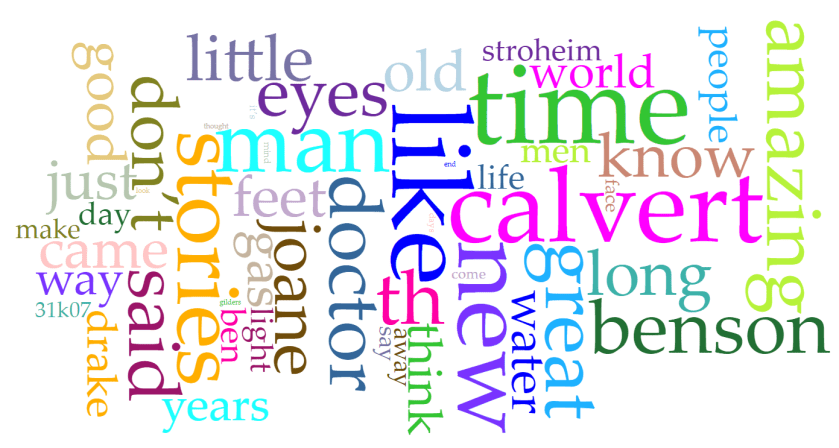
Naturally, the leading character of a story gets a larger representation with “Calvert,” a term that’s used 177 times. That’s a pretty staggering figure, given the fact that the character only appears in one story in the middle. Much like my experiences with The Last Stand, it seems as though using names frequently is a commonplace feature of early 20th Century writing. Though I would be curious as to what a contemporary article or short story might show when run through Voyant.
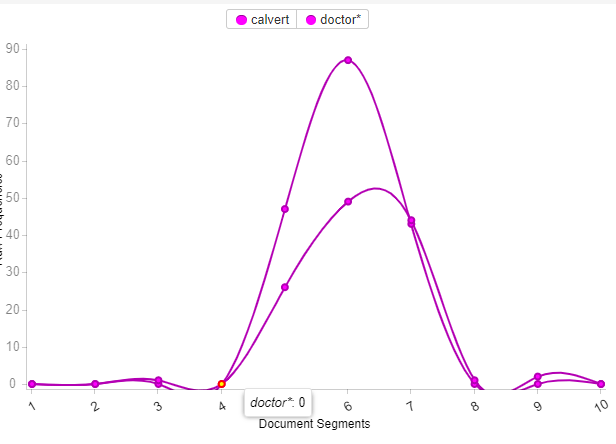
Interestingly enough, “amazing” is only used 114 times vs. “stories” used 142 (next just after “Calvert”). I’m curious how many places amazing and stories appear. I couldn’t get the correlations tab to work to show me, but even still, it seems like a staggering amount of potential self-referential verbiage happening throughout the magazine. Similarly, by looking at this word map I would assume that either there’s a story about a doctor, or that Calvert himself is a doctor. In overlapping the frequencies of the words, this seemed to prove true.
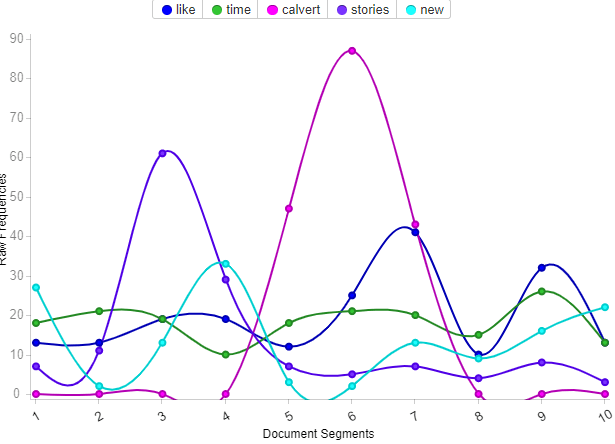
While the frequency of “like” doesn’t surprise me all that much as the number one word, I am curious why “time” is the second most used word in the magazine. Ironically, “new” being the fifth-most used word I find rather hilarious, as it seems to be counter what ‘new’ would stand for. How many things could possibly be new within a single volume? Surely not 140 of them. What’s great is that “new” isn’t even concentrated at the beginning or the end, but rather has a few peaks and valleys throughout the magazine. Similarly, time is a constant (*laugh track*) throughout.
All in all, I think Voyant is a super interesting tool for tracking trends on the quick. If you can get past common words like “like”, and look for interesting ones like “don’t” (honestly, why is that showing up 104 times??), you can extrapolate some intriguing information. Similarly, if you uploaded a number of volumes of the same type of magazine, you might get some interesting linguistic trends across a magazine’s history, perhaps even track the rise and fall of terms. Overall a really neat tool.
It also creates some really entertaining mind poetry if you let your mind wander across the word map. Or perhaps I’m just struggling from too much cold medication.
New stories make amazing little good water;
Come doctor, feet people.
Man came days.
Joane eyes old know time.
 My Life, or Something Like It