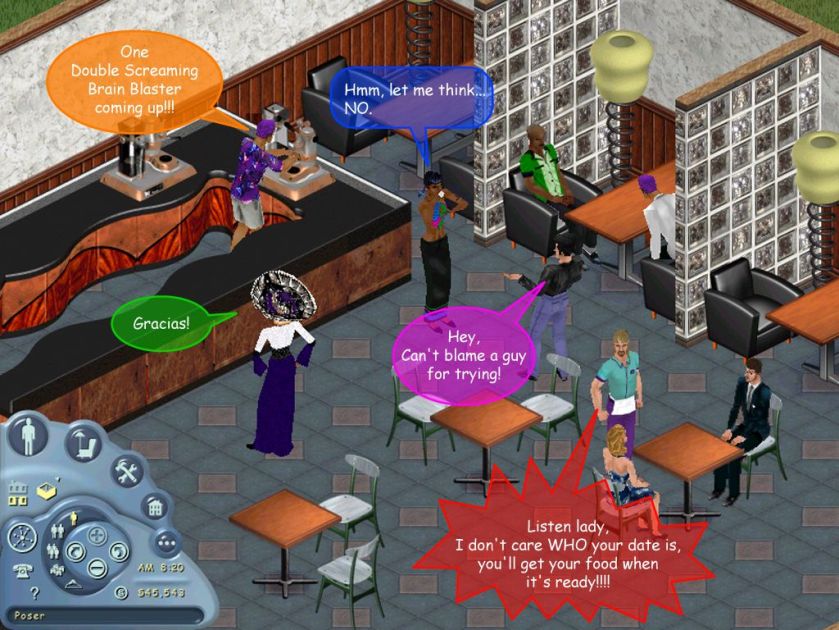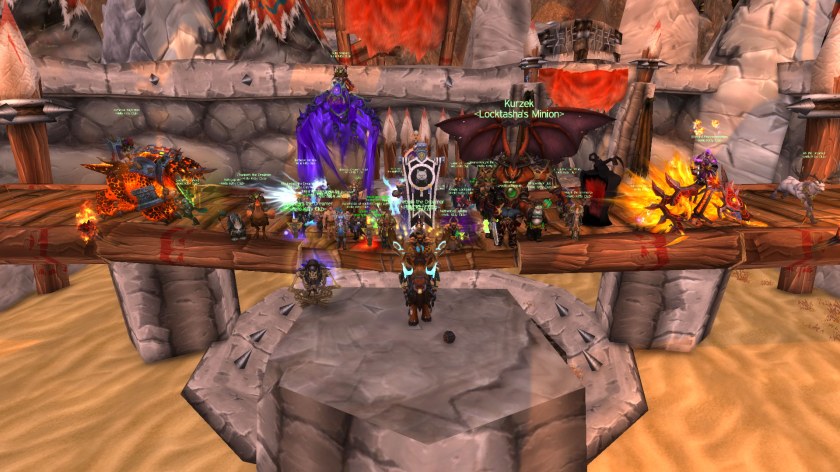


Haecceity: How long can you alter a game, before it ceases to be the same game?

The devices we have at our disposal for keeping a game going tend to become more and more legalistic as the concept of fairness evolves into a prerequisite for playing a game well. They are there to assure that the game is fair.

We establish such devices because we discover that, as we become familiar enough with a game to get totally involved in it, we tend to become a bit untrustworthy.

You know, you get involved in the heat of the game, you want to take the game as seriously and as fully as you can, and, if given the chance, you might in the blind passion of playing find yourself more willing that you normally would be to do something that closely approximates cheating—especially if no one happens to notice.

It’s not that you’re trying to be bad or inhumane or anything like that, it’s just that you’re so deep into the game that everything you do or think tends to become a strategy.

In other words, when you really get involved in a game, you forget yourself. In fact, the fun of the game lies in the fact that you can forget yourself. But what might happen is that you forget yourself too much (Koven 30).

Imagine that you have an axe which over time starts to break down. First, the handle breaks and you replace it, continuing to use it for a while afterwards. Eventually, the head breaks too and you’re forced to switch it out for a new one. No piece of the original axe remains–is it still the same axe?

This paradox, is perhaps better known as The Ship of Theseus paradox, with a variety of different fiction and non-fiction counterparts. Essentially, this paradox questions what happens when you replace all parts of an object (or person, robot, etc.)–does it still retain its original “thisness” or haecceity? It’s precisely the problem we see when looking at the more recent legacy of Bethesda titles: namely Skyrim and Fallout 4. There have been no shortage of mods available for Bethesda games, even as early as Oblivion. In the pre-Skyrim craze era, mods were already available to do just about anything. Recently, on my news feed I saw that Bethesda has basically stated that they’ll continue porting Skyrim “as long as people keep buying it.” My first thoughts after reading that was, which version of Skyrim is that?

Although Bethesda clearly has a good sense of humour about it, the fact remains that one of the biggest parts of what has given Skyrim and many of its other titles such longevity, was thanks to its modding community. A quick search through most-popular-mod-source Nexus Mods reveals the depth and depravity of said community. Hosting mods for a wide-variety of games, including Skyrim and the Fallout series, options are sortable based on community downloads, approvals, and general popularity. The version of Skyrim/Fallout that the ‘community’ wants you to play, is often vastly different than the one originally produced by Bethesda. Mods like these come when you know the game too well, you’re in too deep, and just want to keep that world alive (Koven 30).

In addition to audio-visual overhauls, character model and NPC model updates, and minor UI tweaks, these kinds of mods also offer monumental bug fixes left hanging by Bethesda (I’m looking at you Xbox 360 Skyrim), quest design, loading screens, new user-designed quests, backstories, tutorial skips–you name it, someone probably has designed a mod for it. It’s interesting to note, that while I’m saying ‘mod’ to describe what’s available on Nexus, in truth, some of them can also be classified as cheats, and generally speaking, we’re back to the problematic division of cheats and modification, especially in the mods cycling around for Bethesda titles. How much of the game can we tweak or change before we’ve gone too far and created something altogether different?

Recently my boyfriend encouraged me to return to Fallout 4 after my last dismissal of the title, following a very disgruntled encounter with its Settlement building system. I couldn’t build what I wanted, where or how I wanted, and it all required far more investment into the game than where I was at at the time. The UI was clunky, and I just wanted to build my post-apocalyptic city in peace as a home base before continuing. After facing a critical-fail bug after an hour or two of work, I walked away from the game and never returned. My renewed interest came from the inclusion of mods, following the insistence that it would improve a lot of the issues I had, and it ended up being true. I fell into the Ibister flow and lost track of time within the game, but not for the reason of the game itself, I fell into it, because of the modding experience.

I had dabbled in Skyrim modding when I eventually made my transition from Xbox 360 to PC, predominantly due to mindnumbing bugs at every turn. Most of these mods centred on adding new customization for my character, as well as some audio-visual improvements, and UI tweaks–the usual stuff. One of these important features included adding a “real time” clock to my loading screens, as far too many hours were lost in the “just one more quest” world of Skyrim in my undergrad before that. With Fallout 4, things were different.
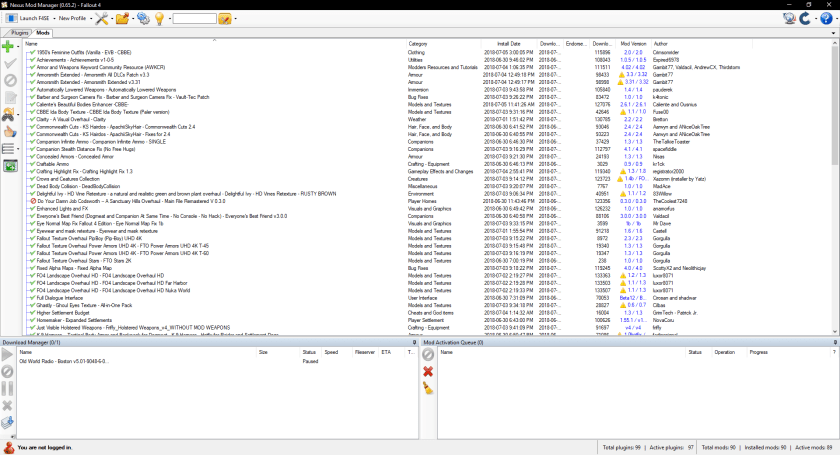
nexus.PNG
With a cap of 255 mods, where is the line between Fallout 4 and Fallout 4 By Jenn & Friends?

I spent an excruciatingly long time trying to get some of these mods to work in game, to work with one another, and to not generally break my ability to play the game. I made the foolish decision to start modding my game part way through an active save. While this was my first time getting this far, I didn’t feel comfortable incorporating mods or cheats that would break my “first” experience beyond the walls of Sanctuary. I would experience the “real” Fallout 4–or so I believed. It quickly became apparent that no matter what I did, I was changing the game beyond what it was “supposed to be.” A character interaction mod here, adapting how I chose my voice lines for chat interfaces, a “place anywhere” mod there, permitting my incessant need to build the perfect Settlements. My modding experience was about perfecting my experience within the Fallout space, all while trying to avoid doing as much damage to the game-as-intended as possible. It wasn’t about making it easier or harder, it was simply about improving the experience as it was–as determined by the community–like I was already so used to doing in WoW.

But I was wrong.

I made the mistake of remembering the existence of the console-command system. Alongside all the texture re-writes, the graphic overhauls, performance tweaks, and hundreds of hairstyles I had installed, I had yet to really “cheat” in my eyes, until I came to the console. Until this point, my boyfriend and I had been on the same page about what we were doing in the modvolution. Instead, I found as I got deeper into the game, that my opinions about cheating changed. I cared about the world, about my settlements, and about learning the story, but I cared less about how I went about building them or progressing through my murder sprees. I started implementing cheats for quick resources, alongside use of “killall” and “unlock” commands to get what I wanted without wasting too much time. I tried to use it sparingly, but it started to make the game feel emptier. If it weren’t for my desire to see the story or to make sprawling vaults and settlements, I don’t know if my heart would be in it. The ability to truly grind, to truly fail, to truly work for what I had given myself was missing (Juul).

2e4fa64f00000578-3312465-video_game_fans_have_rushed_out_to_get_their_hands_on_the_latest-a-31_1447179736453

With Skyrim, I had already beaten the majority of the game by the time I had started to dive into mods, and only ever did I cheat to advance my storyline the one time for my corrupted Xbox 360 save. The rabbit hole of cheating had encapsulated me, and now I was faced with trying to get clean or just commit to the deeds that I have done. Ironically, though his Fallout has the limit of mods, without cheating, my boyfriend’s Fallout may yet be more authentic than mine. A sentiment he shares, and that I might just believe.

It’s no wonder that Bethesda turns off achievements for players with modifications enabled (although with the Fallout 4 Script Editor, you can re-enable them anyway). With any number of mods enabled, even Bethesda seems to believe that having them changes the game enough that achievements are no longer valid when obtained on a modded system.

In looking back at my decisions to change Fallout 4, the how and the why, the community’s answers, and the community’s options–I can’t help but echo the idea of what “thisness” remains in the game after so many changes? Mods label themselves as vanilla or lore-friendly, suggesting that they’re closer to the game’s “thisness” than their counterparts. If the axe’s head you replace comes from the sister of the axe you already owned, does that make it closer to the same axe?

People cheat and modify these games for any number of reasons, primarily in finding new ways to establish their ideal user experience through improving identity (character, environment mods), flow (UI, ease or difficulty changes, performance enhancers), and even modifying what it means to fail. Through these changes, they reinforce community standards, while still toying around with what the developers have allowed them to change. While Fallout 4 and Skyrim allow for much larger changes to their core code than say, The Sims 4World of Warcraft, or Sonic 2, any changes beyond simple interaction with the game-as-design call into question the “thisness” of a game.

We may cheat, modify, and break games for any number of inherent human desires to do so, however, is a game only what it’s produced to be, or should we begin to consider all changes, modifications, cheats, and adaptations to be part of the ephemeral haecceity that surrounds the initial game’s code? If we can adopt house rules as a relatively standard deviation from normal rules, and if Luxury Tax gets paid out to Free Parking on the regular, maybe modding and cheating aren’t so bad. Maybe they find ways to help us make use of our game worlds just a little bit longer. Or maybe, it’s simply a way for a gaming community to participate in the development world, beyond passive engagement.

After all, Skyrim played on Xbox 360, will differ from Xbox One, from the Switch, and from P.C., before mods or cheats are even considered. Why set the limits on user experience? As Koven stated in the quotation at the beginning of this series: “I am aware that the motivation for your sudden intensity stems not as much from your concern that I have broken a rule as from your feeling that I have somehow deprived you of your opportunity to win…” (24). If cheating is just a socially agreed upon  set of rules and conditions of play, then what does it matter if no one is there to see you do it?

https://www.youtube.com/watch?v=GE2BkLqMef4


Academic References/Further Reading:

Isbister, Katherine How Games Move Us (2016)
Juul, Jesper. The Art of Failure (2013)
Koven, Bernard De. The Well-Played Game (2013)
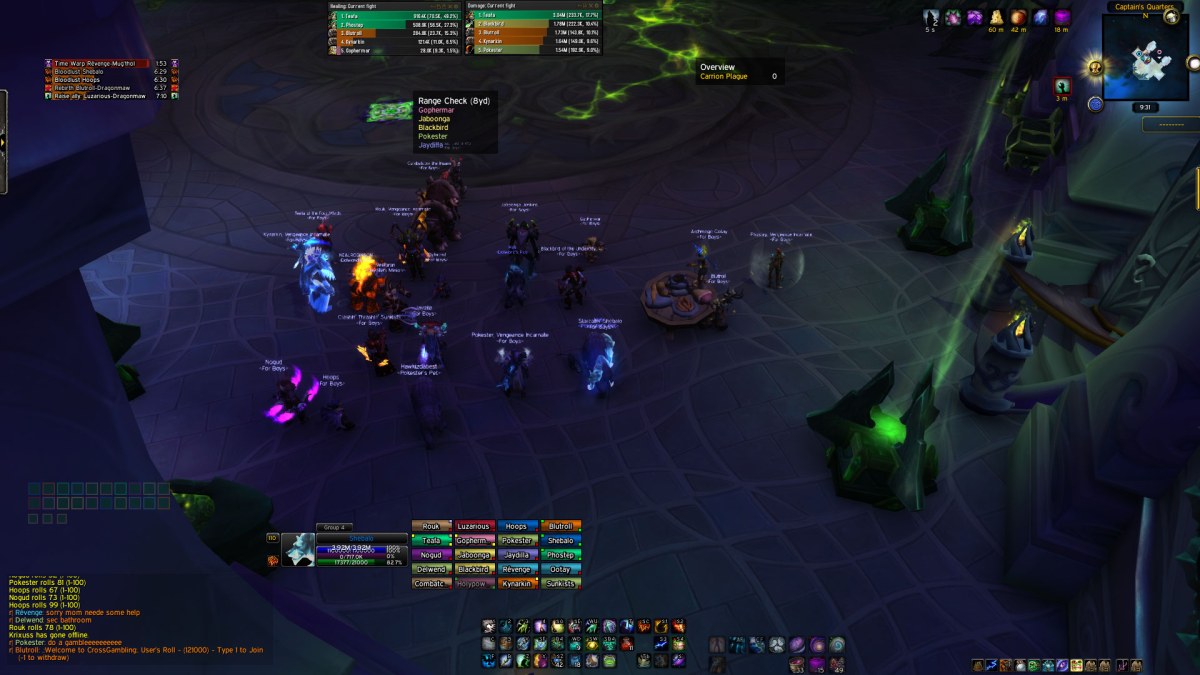
Hitting the “Motherlode”: Cheating/Modding in The Sims & World of Warcraft

I guarantee that no two User Interfaces in World of Warcraft will be quite the same. Both WoW and The Sims have notoriously supported modification to their videogames over the years, even going so far as to convert existing addons or mods into actual features of later gameplay. Where they differ greatly however, is their stance on cheating.

Screenshot 2018-07-09 at 1.45.33 AM
Straight from EA’s official The Sims 4 website.

While it might be front and centre on their website now, The Sims franchise used to have its own share of community shared and pseudo-mythological cheating console commands in circulation. While they were never so obviously discussed by the developers, the existence of easy-to-remember codes like “rosebud,” “kaching,” or “motherlode” for more money, always seemed to suggest that they were ‘in the know’ in giving these tools to players. Further still, there are plenty of things that the early entries to the franchise required you to do via console command, such as stopping aging, that are now features in the normal ‘settings’ of The Sims 4.

Cheating is a big part of the game. Not only is it easy to access, but it’s even something we kinda, sorta, actually encourage. Strap in as we show you not only how to cheat in The Sims 4, but tell you a few of our favorites The Sims 4 cheat codes (EA, The Sims 4)

Can these kinds of cheat codes even be considered “cheating” if they’re considered an endorsed part of the gameplay? Rather than allowing for extra lives or level skips through an implicit playtesting model, EA has gone one step further and condoned the use of their cheats as an active alternative to play. By so doing, they are acknowledging a number of ways for players to consume their content, and allowing people to use it as a building or design sim, rather than just for playing house. Further still, the game doesn’t penalize you for using cheats of any kind, and achievements in the game continue to record as they would if you never typed the [`] key at all.

the-simse284a2-4-02-feb-16-1_22_08-pm-1024x576

Their endorsement of cheating comes alongside their in-game promotion of modified Sims and Lots (houses/businesses/community, etc.) through the Community Gallery. Practically since its inception, The Sims generated a very active modding community. They’ve been the source of providing new hairstyles, clothing options, furniture, houses, meshes, and a whole load of features before the game developers themselves included them. For example, the modding community already had versions of cat and dog companions (within a very limited vein) before an official expansion was ever released to include them. What we have to consider alongside this seeming embracing of “cheating” and “mods” within the native client of The Sims 4, is that the company is attempting to exert control over its modding community.

When a mod system is detached from the game itself, any number of issues can arise, both for the company and for the player. The players could run themselves the risk of downloading harmful files or corrupting their game beyond repair. The developers on the other hand, may risk financial loss over user-created content that mimics things they’d otherwise charge you for. In the end, by including a community gallery within the game itself, EA encourages its players to pay for the game itself, and its expansions (the gallery is not available through pirated versions), as well as discouraging players from reaching beyond their borders for content, via sites like ModTheSims or TheSimsResource. Despite efforts to contain the modification of The Sims, sites like these continue to prosper, providing content to the community where EA and the gallery cannot.

If we go way back, this design philosophy has almost been with The Sims from the beginning, and it seems to me that these kinds of cheats are not really cheats at all. User driven content and world-spontaneity has always been a desired feature on The Sims‘ horizon. Back in 2001, the Game Studies journal conducted an interview with Will Wright at Maxis, aka the mind behind The SimsSimCitySimAnt, and more.

14079
Only in 2002 could The Sims Online be taken seriously with Comic Sans as a default chat font.

While this interview was conducted before the failure that would-be The Sims Online, a sim-universe MMO, Wright shared some interesting insight into what his view of the future of the franchise would be.

I would much rather build a system where the players are in more in control of the story and the story possibilities are much wider. For me the size of the space is paramount. Even if it was between the player controlling it or it being random, I still would want larger space in either case…Because I think you could always make the possibility space larger at the expense of the plausibility or the dramatic potential, or the quality of the experience. There’s probably some relationship between the quality of the experience and the size of the possibility space. So we can make the possibility space huge, just by giving the player a thousand numbers. And “Here, you can make any one of these thousand numbers whatever you want it to be.” That’s a big space. It’s just not a very high quality experience. So we start wrapping graphics, sounds scenarios and events around those numbers, and we’re increasing the quality of the experience you have. It has more meaning to you. In some sense it becomes more evocative. You can start wrapping a mental model around that, as opposed to this pile of numbers (Pearce).

The Sims was never supposed to be just about what stories Maxis (and later EA) could tell you, but rather the stories you could tell yourself. Part of this meant allowing for as broad of a ‘possibility space’ as the code could provide, and where those borders could no longer contain the possibility, the community took over instead. In this way, The Sims in principle can never be modded or “cheated” too much to be considered failure. The inclusion of these things from the game’s very design philosophy presupposes that we might not even have a word for their use within the game’s system. As much as it’s hard to call endorsed “cheating” cheating, it can be equally hard to call inclusion of hairstyles, clothing, or furniture mods, when they fulfill the game’s ‘prime directive’ as it were: enhancing, or even ‘extending,’ the possibility space and user experience. Perhaps “extensions” is more appropriate in this case. “Players of The Sims 2, like players of the first version, have found that one of the most gratifying aspects of play is sharing unique objects with other players. For example, in just under four months (September 2004– February 2005), Sims 2 players created and uploaded more than 125,000 characters and houses to share with others” (Flanagan 50). If The Sims is just about playing house (Flanagan), the only limits ought to be those of your imagination, and as long as the community is willing and able to push those limits, all extensions and cheats are effectively working as intended.

mods

In contrast to The Sims’ stance on cheating and modification, World of Warcraft and other similar MMOs have a much heavier hand. Mods in WoW toe a very fine line between acceptable usage and bannable offence. Generally over time, Blizzard Entertainment, developers of WoW, have taken strides to limit what mods can and cannot do to their game in order to limit how mods can help (or hinder) player experience. Where The Sims is about expanding one’s possibility space via cheats and community content, WoW is about delivering their content through a myriad of lenses, so long as it doesn’t give any one player any significant advantage.

As WoW is a web-based always-online game, with achievements, the need to control cheating is paramount and judged accordingly. Even if a mod ‘arguably’ only affects your experience, like hacking the visual skins of your characters on your game files alone, could be deemed a bannable offence (as happened to a guild member of mine back in The Burning Crusade expansion). Along these same lines, however, while there are no mods allowed that give a significant advantage to one player or another, the community (particularly in high-end raiding or PVP situations) has deemed a number of mods indispensible or effectively required in order to proceed through the “stock” client. Many of these ‘essential’ mods are aimed at modifying and improving user-experience for more difficult content. Mods like “Deadly Boss Mods” (DBM) or “BigWigs” give players access to boss timers, debuff and ability announcements, and often even player cooldown notifications while facing difficult foes in large groups. This kind of information is argued to be indispensable, and yet, is not something ‘truly’ included in the base files of the game. While bosses tend to give visual or audio clues to when they’re about to slam in front of them in a frontal cone, the average player believes they benefit from having DBM on their side to give them a 10 second heads-up.

WoWScrnShot_121416_232125
Guild screenshot of “Hello Kitty Club” 10-year anniversary brawl.

Like The SimsWoW‘s mods are user and community driven. But unlike The Sims, it is not the existence of the mods where the community ends its say, but rather in WoW, it is only the start. Alongside DBM, other mods for average user experience are often touted as being essential, features that change your action bars, your bag space, your interaction with Mission Tables, your party information panels…even your outfit management. While many of these mods have worked in concordance with WoW’s stock user interface, I have heard many player say that they struggle to play the native client without their mods. Even when Blizzard has incorporated a version of the mods “Outfitter” or “Grid” into the basic UI, there’s always something “off” about them, and it can be hard to acclimatize. When hearing that some players play with the stock UI, aside from ‘essentials’ like DBM, players often scoff and ask “if they still have auto-attack keybound as well.”

Installing mods in this way is observed by the community almost as a rite of passage, essential not only in what needs to be downloaded, but that something has to be downloaded at all. And unlike The Sims, all mods are governed outside of the Blizzard umbrella, currently governed primarily through Twitch (formerly Curse).

What the WoW example asks us, however, is how much of a game has to change before it ceases to be the original game? In this example, Blizzard limits what can be done with mods enough that the game is required to stay more or less the same in terms of narrative and basic interaction on the live client. What changes is how people interact with that world. It remains to be seen whether or not that qualifies as a different game for every version of a UI that players look into Azeroth with. Whereas The Sims retains its identity not by being scrutinous of how the game is changed, but rather that the game is changed at all. Although both modding and cheating exist within both games, neither one changes what the game is at its core, and thus, arguably, the game is “preserved” despite them.

As we will soon see however, this is not the case for all games and modifications. Onward to Bethesda, and the modvolution.


Academic References/Further Reading:

Flanagan, Mary. Critical Play (2009).
Pearce, Celia. “Sims, BattleBots, Cellular Automata God and Go: A Conversation with Will Wright.” Game Studies (2001)