


(Video)Games: A Need to Cheat

Along with the idea of fairness comes its necessary complement: cheating. Cheating is what someone does to give him/herself a more than even chance to win. At least, that’s what we most often call cheating.

When I happen to notice you attempting to draw universal attention to my little cheat, I am aware that the motivation for your sudden intensity stems not as much from your concern that I have broken a rule as from your feeling that I have  somehow deprived you of your opportunity to win…

It is obvious that your concern with my cheating is biased in your behalf. If I’m doing something wrong, even if I’m in flagrant violation of the rules of the game, as long as you perceive yourself as winning, everything’s cool (Koven 24-25).

To what lengths will you go to win, to succeed, to overcome the technical rules of whatever game you’re playing to get a little bit of an advantage? Would it make a difference if the game enabled you to accomplish this task via embedded cheat codes? What do we make of sanctioned cheating vs. unsanctioned cheating? What if you don’t even know you’re circumventing the rules-as-intended?

When playing board or card games with friends, we already know the routine. Often “house rules” need to be established alongside “legitimate” ones, because we seem to have a predisposition to change games as they’re presented to us. We demand that our friends and family reveal their house rules before a game even begins, lest we find out mid-way through that people are actually not on the same page. What happens when you land in free parking in Monopoly? I’m sure we’d be very divided on the answer. “Wait, that’s cheating!” we’d be inclined to say, when our peers reveal themselves to be playing an entirely different game than us, while all looking at the same board. Some strange parallel reality where someone jumps up and stops you from buying a house on your second pass of “GO” in Monopoly.

phoenix-wright-objection

It’s not surprising that this was a heated conversation in the board games subreddit, and spawned at least one thread trying to spin the ‘positivity’ of house rules. These are things we usually only find in board and card games, because (without mods or hacking), in video games, the code simply doesn’t allow us these affordances. This is thanks to Procedural Rhetoric, where game philosophy and developer ideological visions are written into the very laws which govern how the game operates. For example, when playing UNO on the Xbox 360 (or other ports), the kinds of house rules faced by this unfortunate redditor would simply not be possible.
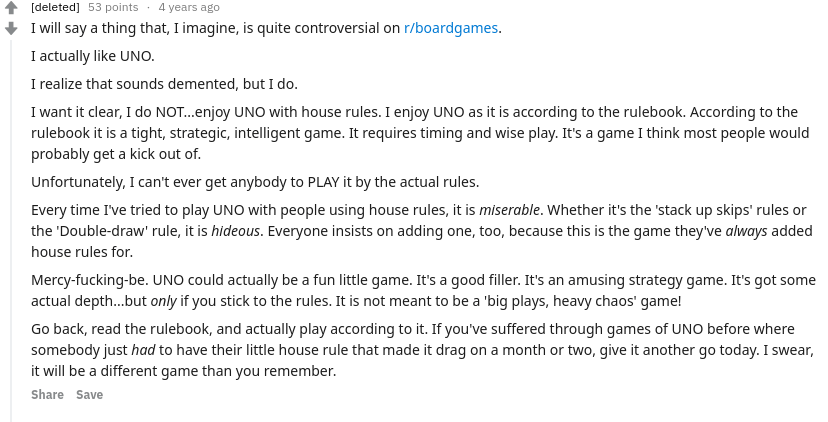
Screenshot 2018-07-08 at 1.10.09 AM

The code would prevent such frustrations from occuring in a the videogame version of this card classic. Even when “house rules” are allowed, they’re usually custom-made and allow only for people to enter into the game acknowledging them in advance, with no room for mid-game shifts in playstyle. Even custom games in more recent first-person shooter titles like Halo or Overwatch, lay all the custom rules upfront–people know what they’re getting into. At all stages of these custom maps or games, players are often required to choose from what the developers have already accepted as “sanctioned” deviations from the norm.

This idea of customizing game rules and house rules within board games and their video game companions brings us closer to the question of what it means to cheat in games. The implementation and adaptability of board and card game house rules are perhaps more complicated than a handful of blog entries can address, but, I think we can safely look at why and how we cheat in our games through looking at some specific videogame history and case-study-style examples via the following series:


Academic References/Further Reading from the Series:

Notified: Alerted or Annoyed?

Information overload is an increasingly difficult thing for contemporary individuals in our connected technologically-driven society. We each deal with this bombardment of information differently – how do you stack up?

Information overload is an increasingly difficult thing for contemporary individuals in our connected technologically-driven society. We each deal with this bombardment of information differently – how do you stack up?

Jane wants to go to the mall, Billy just liked your latest Instagram post, Barrie is going live on Twitch, and your boss just emailed you yet another schedule change. Four notifications pop up on your phone, begging you to click on their strips of information, do you? The latest news on your favorite TV show, more patch notes for World of Warcraft, or rumors of the next Google phone. So many different avenues of notifications to pop up on your phone or computer at any given time, that it stands to reason that they cannot all be equally effective in their goals at gaining our attention.

We all like to stay up to date on what’s most important to us in our daily lives. Our friends, our hobbies, our choice methods of entertainment. Apps and websites know this too. They continually throw information at us left and right, regardless of whether or not it’s something we actually want to see. Comment on that one post from that former group member you kinda became friends with? Now you’re receiving every other message someone posts on the same thread. Sometimes it’s relevant, sometimes it’s not–quite often, it’s just white noise amongst everything else.

How many screens do you need to keep up?

Many people have become adept in sifting through the news they want to hear, or at the very least, grow accustomed to the onslaught of information they receive on a daily basis, enough to figure out what they want from their personal news highway. I know for myself, it’s a constant struggle to dismiss every notification that I can justifiably get rid of. Every little motivational comment from FitBit or news about my favorite band coming to town is pretty much instantly set to automatically be blocked by my phone before I even see them.

Other applications, like Instagram, Snapchat, or Discord, are allowed to (mostly) peek their notifications on to my screen as available. I will usually swipe them away pretty quickly, however, in efforts to keep my screen clear. I never let emails or notifications on Facebook sit too long without being cleared, regardless of how thoroughly I actually read the messages upon initial opening. In the end, it’s more important for me to acknowledge that something wants my attention and file it away than it is to leave it to sit there as a constant reminder that there’s something else I could be doing.

In-game, or out of game, notifications are pretty much everywhere.

It’s not that I don’t want to address everything that comes up on my screen. I want to stay up to date and in communication with as many of the important things and people in my life as possible, but when it comes down to it, I just don’t have the time. And the not-so-surprising fact is, neither do you. I swipe away notification after notification in hopes that I will have more time to go back and treat each one individually with more depth and care than I could in that moment. Leaving it to sit on my screen for hours (days, weeks or even months as some of my friend’s trigger-worthy mailboxes sit), does not help me accomplish that goal.

I’ve spoken to many people on this subject over past few months since this topic has really started to itch itself in the back of my mind – much like that one annoying Facebook thread that you only half need to keep track of, but seems to be the most bumpin’ thing online this week. My friends and family alike have nearly, without fail, fallen into two groups: the annoyed and the alerted.

The annoyed, like myself, will do whatever they can to keep their screens clear of pop-ups and numbers, putting the brunt of the effort onto their brains to remember who to contact, what to go back to, and more. The alerted individuals, on the other hand, keep everything open until they’ve had a chance to deal with it. Most commonly this has to do with text messages, news alerts, etc. that end up showing up throughout the day. If it hasn’t been dealt with yet, it doesn’t go away. People’s inboxes grow and grow to 800+ unread emails in this category, often without blinking an eye. They still need to be looked at, right?

In the end, both camps probably absorb the same amount of information and have the same amount of response rate to those stimuli, when averaged out over large groups. My point is by no means to make one camp stand above the other, but rather to draw attention to the world in which we live, and the different coping mechanisms we have all incorporated to try and reduce the amount of information overload we receive daily.

Is “Reflect and Review” a new app I can install?

We often seek gaming as an escape from the madness of everyday life. The chance to kill something big and reap the benefits, or at the very least, to blow off some steam and chill with friends in an environment that is all our own. It’s easy to forget that these worlds are not devoid of the same information chaos we have in our real lives daily, and to forget the importance of stepping back and reassessing how we manage what information we take in in-game and IRL. Is it more important for you to live in a quieter world where you address things when you have the time, or do you need the reminder staring at you in order to address what’s important?

Where do you stand? Are you annoyed by the notifications you receive daily or are you simply alerted by them?

[poll id=”3″]

Would you have it any other way? Let us know in our discussions and join us on Discord, on our Facebook page, or Twitter!