


As much as our identities are bound up in the games we chose to play (or not to play), so much of the gaming world is tied to gaming culture and identity. As I quoted Flanagan in the previous post, the current gaming norm of “white dude” bro culture is a very intimidating one for interested parties to try and break into, if they don’t speak the language. Even when you do know the lingo, and are accepted in, there are more things at work than just social inclusion.
Given the fact that playing Ultima Online is very time-consuming and also requires a degree of financial investment, the users must assume they will benefit in some way. A recurrent theme in our interviews with the players, as well as in several items of the questionnaire, was the social experience of gaming. About two-thirds of the players mentioned the potential to interact with several thousand fellow players or participating via ones’ character in a virtual “society” as an essential motive to log onto Ultima Online. Compared to this, motives related to the individual such as mastering “quests” or the improvement of skills play a subordinate role. Surprisingly, only a quarter of those surveyed regarded climbing up the hierarchy of players as a very important incentive (Kolo and Baur 2004).
Despite their study being over ten years old, many of their findings still hold up strongly in the current online gaming landscape. Alongside social interaction within video games, particularly MMOs like World of Warcraft or web-based shooters like Fortnite or Overwatch, there’s also vast fan communities online, user-created content development, and an explosion of live-streaming. In this way, we become invested in the games we play not only because we like them, but because we like the people who like them.
Isolated individuals are given access to people that help them not feel alone. Isbister sums up the importance of sociality and gaming it up well:
The isolated gamer sits alone, face illuminated by the blue glow of the screen, lost in a solitary trance. It’s a familiar image from movies, TV, and popular culture in general. But the stereotype of the pasty-faced, antisocial game addict belies what we actually know about gamers. In fact, the majority of people who play digital games play them with others. 1 This shouldn’t be surprising: from playground tag to chess, card games, and board games to Minecraft and Call of Duty , the long history of games is primarily a story of rules and equipment created to engage people together socially. When we humans play (aside from the occasional game of solitaire), we usually play together. So before we can grasp the emotional impact of digital games, we need to understand what happens in social games more broadly (44).

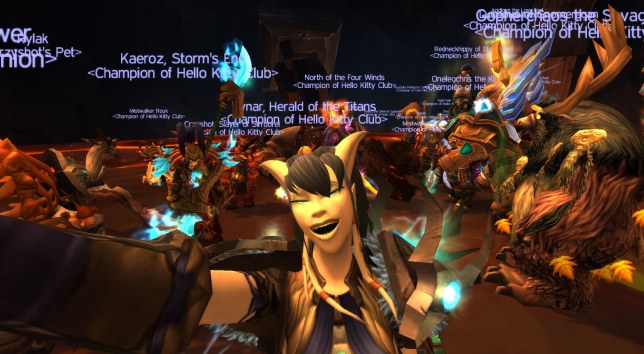
I started playing World of Warcraft sometime before the launch of Patch 2.1.0, which included the infamous Black Temple. It was my first MMO and I knew pretty much nothing about them. I had previously dabbled in Champions of Norrath online play on my PS2, and played countless single-player RPGs beforehand, but I had next to no bearings heading into Azeroth. I started playing because of my friend, and a free week trial. I got addicted, they didn’t. I learned the ropes the hard way, in a “git gud” environment. My original character was a warrior who didn’t know how to tank, and occasionally wore leather when I should have been wearing all plate. I was a mess. Eventually through coaxing, meeting good people, and joining a helpful community, I grew and became a better player. Eventually, through social networks on Akama-US, and after re-rolling to a restoration Shaman, I joined one of the top-3 raiding guilds on the server, just in time to see Black Temple and The Sunwell while they were still current. And the rest is history…well Hello Kitty Club history.
I’ve been with the same guild, more or less, ever since. Late night Ventrilo chats were replaced with late night Discord chats, but a large portion of our core remains. The guild has fallen apart in the virtual space, only to be bound back together again an expansion or two later, all the while our social ties went on through Facebook and other social media. Many people in the guild, myself included, stay in the game, and keep returning to the game, because of this community we’ve built. Many of us have met in person, or created lasting bonds outside of the game. Some of us have been friends longer than some of my friends in my “real” life. We’ve been through things together and the game wouldn’t be the same without them. “There is something deeply satisfying and bonding about over-coming a challenging mental and physical situation with someone else, especially if it requires close coordination” (Isbister 45).

Our friendships have come a long way, as all internet friendships have. In the early days of WoW and other online gaming communities, it was not unheard of to be scorned or cautioned for having web-based friends. It didn’t matter that people were connecting across the globe or with mutual interests–they were unknowns and scary. “Ubiquitous connection has dramatically changed how we communicate with one another on a day-to-day basis, shaping how we understand community and copresence. Texting, Twitter, and Facebook, email, and blogs offer countless ways to check in on someone–or on many someones. Game developers have interwoven networked communication and the sense of copresence it creates deep in the experiences that they offer players today” (109). Beyond simple communication tools, developers are including gifts for friends, friend bonuses, and other incentives to bring the social into the gaming space–to become even more invested in their worlds. Pokemon Go recently added these kinds of friendship-incentivizing features and might have helped to re-invigorate the game as a result.

Internet-based games are not the only place where the importance of social play occurs of course. Franchises like Super Smash Bros. persist in a world of web-ready content, pushing the importance of split-screen or same-room play. “When players in a room together laugh, jump, and tease each other, the power of games to drive connection, empathy, and closeness appears right before your eyes” (109). While our views of web-based communities may be shifting, the importance of an in-person all out brawl has not changed. Arguably, it’s also at the root of attending e-sports championships. There’s something to be said for the energy of cooperative or competitive gaming, that just can’t be conveyed through digital media–at least not yet.
What’s more, is that in-person gaming is something which ties itself into nostalgic memory. Four kids surrounding a singular tube-screen, facing off in Goldeneye; a group of high schoolers creating a local LAN party for a Quake tournament; a controller smashed in anger after getting run off the course in Mario Kart 64; another group huddled around a single player, waiting for their chance to hold the controller, as they progress through Final Fantasy 7. These group displays of cultural bonding and belonging are very much a byproduct of the tangible world. As much as players can join each other in the virtual space, the visceral reactions can only be fully felt alongside on another in person.

However, that doesn’t stop people from trying to catch a glimpse into other people’s gameplay habits or experiences. One of the last ways I want to consider the social realm in this series, is to consider the case of live-streams. The rise of bandwidth availability and video prevalence on the internet has helped to facilitate a surge in video game streaming. However, while videos of “talking” cats and falling toddlers, ala America’s Funniest Home Videos makes sense as a translation to the internet, live-streaming is a curious social engagement.
What distinguishes Twitch.tv from other video hosting and streaming websites with videogame content, including YouTube.com, is the presence and participation of the players and viewers…With its strong reliance on participative engagement, even single-player games become a social activity. It is difficult to find streams on Twitch.tv without, at bare minimum, an audio feed of the player, and the chat box is constantly updated with messages from eager viewers. In a mass medium most often considered inhuman, robotic, or purely digital such as videogaming, Twitch.tv has foregrounded the human element (LaRell Anderson 2017).
As LaRell Anderson discusses, Twitch.tv provides videos of games, but (and most importantly) also of players. Countless games are being played simultaneously on Twitch, and it’s a graball of personality and popularity as to who gets the most viewers for that game. From the outset, there’s a lot of potential to draw connections between live-streaming and spectator sports. However, the primary difference in Twitch streaming is the interactivity. According to LaRell Anderson, “while the chat box supplies plentiful opportunities for viewers to address the streamer/player, it does not inevitably signify an interaction between the two…[instead] the physical feedback provided by the streamer through the video stream transforms the interaction into something human and recognizably physical. The eye movements to read chat messages, the head shakes, the hand gestures, and the various non-verbal communication cues present in face-to-face communication all denote that the interaction is between people instead of from a content creator to a nameless, anonymous audience.”
While Twitch (and now YouTube) live-gaming streams do not fully replace the living room experience, it seems to help facilitate the kind of participatory nature that those experiences provided. While some streams may be as simple as helping a streamer get through a difficult puzzle, ala the group surrounding the Final Fantasy VII player, some streams even encourage playing with viewers. In this way, the boundary between virtual and real is again blended, and the engagement is intensified. A potential gamer may have no interest in playing Dead by Daylight on their own, but when faced with the possibility of earning a place to play alongside one of their favourite streamers, their opinion may altogether change.
Much like the group huddled around a single copy of Final Fantasy VII, live streaming also helps provide access to game content for those who might not otherwise be able to afford it. Living vicariously through the engagement of another player’s entertainment, may be the only way that individual can experience the content.
To this end, we must then consider the importance of monetary investment and gaming engagement [Part 4].
– Isbister, Katherine (2016) How Games Move Us
– Kolo, Castulus and Timo Baur (2004) Living a Virtual Life: Social Dynamics of Online Gaming (Game Studies)
– LaRell Anderson, Sky (2017) Watching People is Not a Game: Interactive Online Corporeality, Twitch.tv and Videogame Streams (Game Studies)


 My Life, or Something Like It