


Popular media often serve as a reflection through which we view culture. Like mirrors at a funhouse, they can distort as much as they can show true. We’ve talked about it in class, and I’ve otherwise previously discussed on this blog (here and here), how pulp magazines can be interpreted as presenting a certain way of enacting American life. A very particular way of being a ‘proper’ citizen. As much as the stories, characters, visuals, and advertisments served to train a population to see the world a certain way, so too did the stories, characters, visuals, and advertisments reflect aspects of the world that already existed.
This week, we read topics on gender and race depiction in pulp magazines. While we have discussed these themes throughout the course, this week they take primary focus.

Nathan Madison explores racism in pulp magazines thoroughly in Anti-Foreign Imagery in American Pulps and Comic Books, 1920-1960. In particular, we read about “The Yellow Peril,” or rather the representation of stereotypes and orientalism within the covers of 1919 and 1935’s pulp magazines. Some of the imagery and quotations are quite jarring and unfortunately illuminating, not only for the cultures of the time, but also how long-lasting the tropes were. Towards the end of the chapter, Madison revisits the political nature of anti-foreign (particularly Chinese) climate surrounding these magazines from 1882-1930s. Laws prohibiting inter-race marriage, revoking citizenship from American women who ‘dared’ marry a Chinese man, limits to Chinese immigration.
He states on page 83:
In such an atmosphere, what do the stories found in the pulp magazines of the 1920s and the 1930s tell us about Americans, and, specifically, about their views of Asians and foreigners in general? It is difficult, and rash, to simply assign racism to such a time period that differs from the current in so many ways. One reason for this difficulty, aside from the error of attempting to impose early twenty-first century political correctness upon those living in the early twentieth century, is the contradicting evidence of racial tolerance, and even racial acceptance, on the part of many Americans at the time. For every act of the federal government that attempted to impose immigration restrictions, there was an outcry from many denouncing the racial intolerance such acts legalized.
Continually we return to the complex nature of history and scholarship. It is not enough to simply see these works and stories as reflections of rampant racism at the time. However, as Madison points out, the tendancies were there. It is hard to judge the past based on the morals of the present, and yet in many cases, I would argue, we should. As much as it ‘was different’ in their time, it does not mean we should forgive and forget what happened. In many cases these very damaging stereotypes and racial beliefs created an indoctrinating effect on the populace which persists to this day in many, albiet sometimes more subtle, ways. Amongst the stories that perpetuated the “yellow peril” within the pulps, others did try to subvert it, even to the point of having Chinese protagonists, even if stories like these were more rare.

What concerns me about this side of pulp magazines is the overt propagandan nature of “yellow peril” narratives. Madison ends the chapter discussing how the discussion of “yellow” versus “white” races changes leading into World War II, thanks in part to a shift in a percieved gobal villain. He notes, however, that the legacy of this time continues much longer after the fact. We see the effect of orientalism repeat through a variety of funhouse mirrors throughout history, as people from the psudo-mythological East are demonized or exoticised to promote the master-narrative, especially in the contemporary U.S.A. these days. Propaganda narratives like the “yellow peril” catch like wildfire in cultural memory and have damaging effects on the landscape. When everything around you, from the news, to advertisements, to the entertainment you consume, tells a different version of the same story, it becomes increasingly difficult to fight against it.
It’s insidious as hell, and exactly why diverse opinions and representations continue to be important in media, and in scholarship.
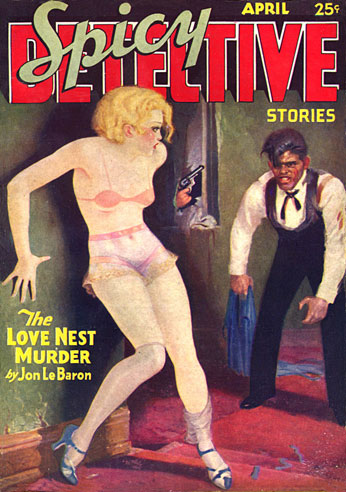 Today is International Women’s Day, and I cannot fathom closing out this post without briefly mentioning the looking glass mirrors of gender roles in pulp magazines. That being said, I’ll be brief, as I’ve talked about gender roles briefly before.
Much like racial tropes and stereotypes, the representation of gender roles and “types” of women are equally present within pulp magazines. While there are examples of women who break the mold, often women serve as narrative elements, part of the backdrop to serve the story’s progression. Object of affection, of scandal, of motherhood…representations of women in pulp magazines echo a much longer history of one dimensional or restricted depictions that women continue to fight against today. What I did find interesting in this week’s readings, however, was the fact that many of the writers and editors of the “girlie” pulp mags were in fact women themselves. While it is less shocking to read that women also made up a sizeable portion of the readership, I am curious as to the motivations of these women to participate in these kinds of narratives. I don’t care for the ‘morality’ of their involvement, but rather the desire to perpetuate stories of women they knew weren’t wholly true? Sex sells as they say, and I suppose writing as ‘an insider’ would provide that extra oompf that would rack in additional sales. Alas, as is pointed out, little about the authors and editors themselves is known, and tracking down any motivations for their involvement is unlikely.
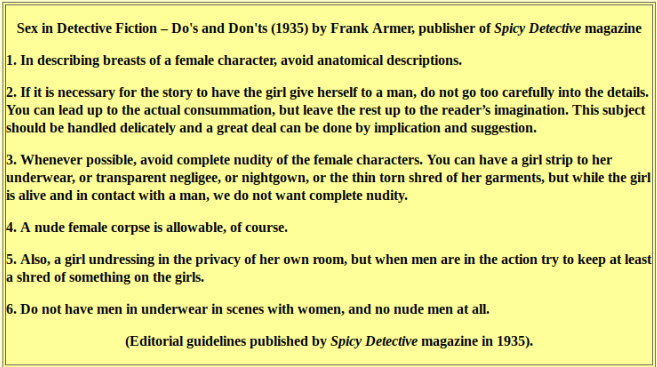
All that being said, I get a kick out of the list of “do’s and don’t’s” for writing into Spicy Detective. “A nude female corpse is allowed, of course.” Naturally.
The sad part is, while things are changing in contemporary media, they haven’t changed all that much. Here’s hoping that as consumers of media, and as scholars, we can do better, with both race and gender.
 My Life, or Something Like It