

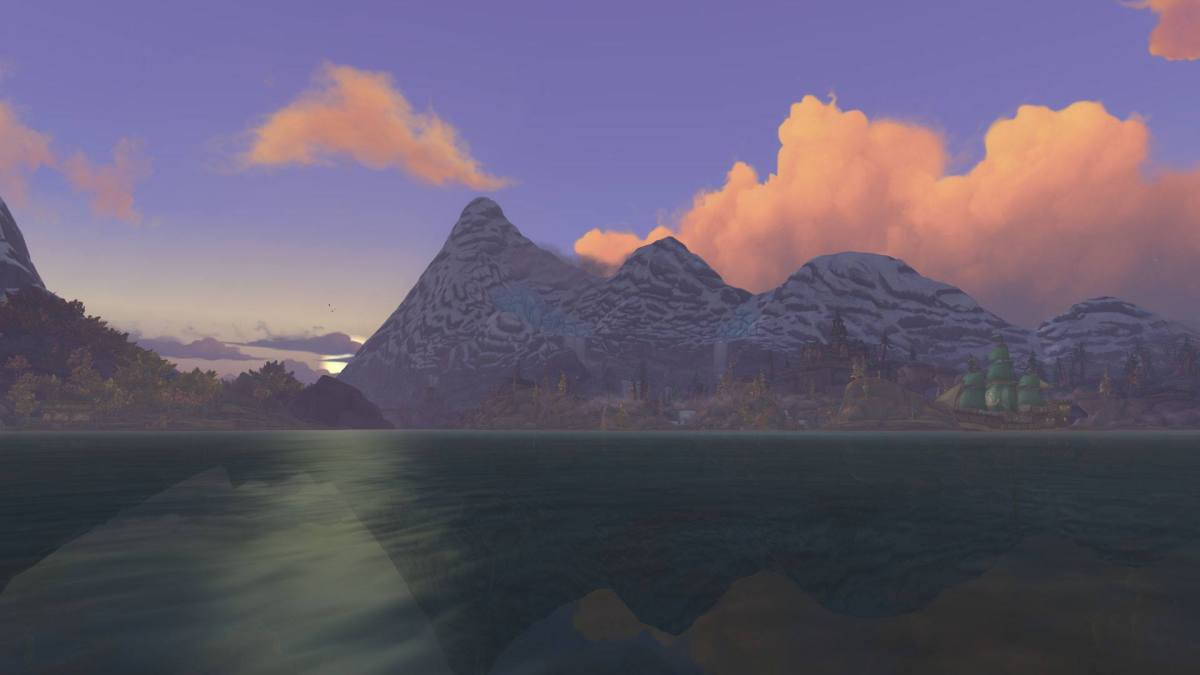
On August 13th (or 14th depending on where you were in the world) at 6pm EDT, Blizzard Entertainment released the latest expansion to World of Warcraft–the seventh expansion to be released for the nearly fourteen-year-old game. While WoW may be nearly thirteen, the Warcraft franchise itself is nearly twenty-four, as Warcraft: Orcs & Humans was released in 1994. As one of the longest-running MMOs, WoW and its universe clearly has to be doing something right.
In order to tie everything we’ve talked about so far together, I’m going to end by looking at the success of World of Warcraft not only as a game, but the ways in which they engage with their players in order to ensure success and account for the possibility of failure. Rather than only doing one or two things right, World of Warcraft is in fact, doing a lot of smaller things right, so that when failures come (*cough* Warlords of Draenor *cough*), the game continues to survive.
As I mentioned in the second content post of this series, I’ve been playing World of Warcraft since the early months of 2007. Eleven years of content, of characters, and of social situations, and yet, I continue to come back, why? Probably for the same reasons everyone else does–Blizzard has gotten me successfully engaged.
One of the first areas I noticed the depth of my emotional and psychological investment in Azeroth was when I was faced with having to switch factions last year. While I have played both sides of the faction divide over the years, I’ve always only played seriously on the Alliance. My first characters were Alliance, and most importantly, my now-main character was Alliance.
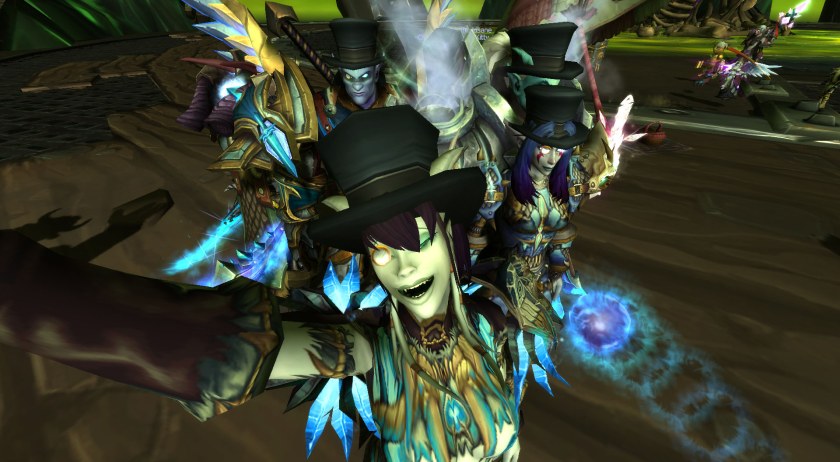
I swapped to my Draenei shaman not too long after learning the ropes of the game. By the time Patch 2.3.0 launched in November of 2007, I had gotten my bearings and was actively clearing raid content with my original guild. After we eventually got into Zul’Aman, the raid launched with 2.3.0, it became apparent that we would need a specific kind of class in order to complete it. That class was a restoration shaman. I offered to swap classes from warrior and never looked back. Suffice to say, my main character Shebalo and I have been through a lot, and she’s become an an extension of myself more than I had realized.
After re-rolling to a healer class, my ambitions soared. I got involved with more difficult content, and eventually joined Hello Kitty Club, who I’m still with today, after a lot of on-and-off periods. During one of those off-periods last year, I was part of a splinter group from HKC. We were comprised of the most ambitious and skilled of our raiders, who ultimately decided that the only way we could continue to progress through current Mythic (the highest difficulty) raid content was to swap to Horde on Akama, where there would be more bodies to recruit. Many of my peers easily made the change, quickly swapping to whatever Horde race they decided fit them best.
I, on the other hand, struggled. And naturally, thanks to running my Twitch, I recorded it. And so, for a very brief period of time, I was a Troll restoration shaman.
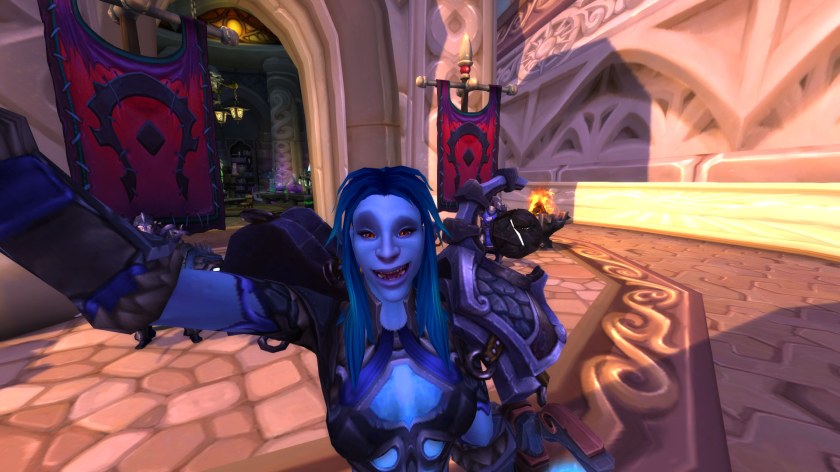
It never quite felt right, and the emotional turmoil I went through to swap sides, is visible throughout the two-hour plus highlight video. I felt my emotions welling up as I tried to transfer, bought the wrong transfer, ticketed Blizzard to get the right transfer–all the while dreading what I was about to do. It wasn’t just about leaving my guild home, it was going against my very in-game identity to become the opposite side.
In that moment, Azeroth was a very real place (Ruch 2009). It was not simply a place filled with pixels where I passed through. It was a place I “lived” in, a place I experienced the passing of time through, it was very real.
While I never really participated in roleplay within the game on Shebalo, over time, I built a headcannon about her movements through Azeroth, about her place, my place,in the community and the world. We were one in the same, and much like my aversion to playing Renegade Sheppard in Mass Effect, so too was I against playing something I didn’t feel to be me.
Despite a lack of active roleplay, I did (and continue) to consider how my character might react given in-game situations. In particular, during the last expansion Legion, players were finally able to visit Argus, the former Draenei homeworld. Naturally, when this first launched, I was still playing on the Horde and it felt as though something was missing. When Argus had been announced at a previous BlizzCon, I had already started to think about what it would be to “return home” as my character. As a Troll, this no longer applied.
What this suggests is that the avatar is neither entirely “me,” nor entirely “not me,” but a version of me that only exists in a particular mediated context. When that context, and with it the avatar, ceases to be, that part of the self dies as well. That part of the self, expressed and projected through the avatar in a shared virtual world, is as much a creation of the group as the group is a creation of the individuals within it (Pearce 119).
I went through many crises of identity while playing Horde side on my main character that truly demonstrated to me just how much I had invested not only in the game, but also who I was in the game. When I finally switched back to Alliance, everything just felt right. I quickly was able to re-select the face and attributes of the model I had used for so many years (with backup screenshots just in case).
Heading into Battle for Azeroth, I don’t think I could have had it any other way.
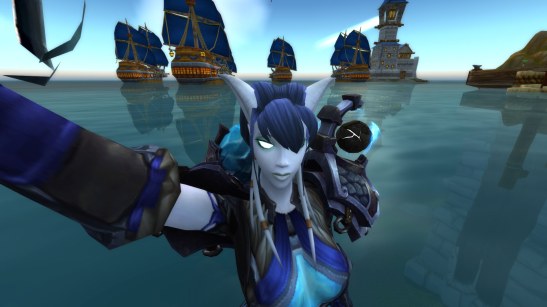
My time spent on Shebalo wasn’t just about my own relationship with my character, but also with my community. As I discussed in the previous post, I was lucky to find such long-standing friendships through Hello Kitty Club. Not only did we experience the rise and fall of our raiding progression (Juul 2013), we also spent extensive time exploring the virtual-physical world of Azeroth together, well into the late hours of the morning. Blizzard is well-known for including reclusive Easter Eggs, abandoned content, and memorials throughout their games (Gibbs et al. 2012), WoW being no exception. While we explored the world, we learned about the game and each other. We were able to interact without the chaos of raid combat, and friendships increased.
Over time, people have come and gone from our guild, but there’s a large core that’s remained the same. We interact on various social medias, and over time, have repeatedly brought each other back into the game. Beyond the itch to play, the promise of social interaction with a known group of engaged individuals, helps to keep us engaged in the content.
Our stories are not unique, and in truth, it’s probably one of the biggest features that keeps World of Warcraft so popular over time. So long as your social group stays, so too are you likely to as well. Combined with guild meetups and bringing virtual friendships into the tangible space, things become even more real and engaging. Conversely, if you only play alone, or have lost touch with the friends you used to play with, the draw to stay in Azeroth is likely lessened. The “massively multiplayer” component is not only important from a gameplay perspective, but also affects our engagement with the world. When the novelty wears off, when you can’t possibly fathom running your face into the same boss for another week in a row, friends and social experiences keep you engaged. Because of this, over the years, even in the recent Battle for Azeroth expansion, Blizzard continues to strive to increase friendship and community engagement.

World of Warcraft also succeeds at keeping players invested in line with the Sunk Cost Fallacy. After nearly fourteen years of running, it’s hard for players to turn away from their digital investments. Astonishingly, it’s also probably how World of Warcraft has retained their subscription fee, while other MMOs continue to drop theirs. Like an un-used gym membership, I have known countless people over the years who retain their WoW subscriptions, even when they play rarely-to-never, “Just in case” they want to return. It’s not even just subscription fees, the cost of accumulated expansion costs, in-game services (server transfer, faction transfer, race change, etc.), memorabilia, paratexts (novels, table books), and virtual goods (pets, mounts, etc.) are compounded into the real-world costs and fears of value loss.
To further encourage people to invest in their time with the game, Blizzard has also offered alternative sources of funding like the WoW token, which can be bought and sold with real money, for in-game currency, and vice versa. This has allowed people to invest more time into the game, by accumulating digital wealth, so that they can spend it on “real-life” costs, like subscription fees and Battle.Net currency for other Blizzard games.
Blizzard also continues to update the base value of the game, so that it is affordable for new and returning players. In July, they announced that new and returning accounts would be able to play all the way through Legion content with just a subscription. No longer are players required to buy-in to the game, or its previous expansions. Instead, the entire world of Azeroth is available to players up and until the most recent content, Battle for Azeroth. In this way, Blizzard capitalizes on existing players’ social capital, as well as WoW’s reputation as an MMO, to encourage new players or returning players to re-invest in the virtual landscape.
Finally, one of the ways in which Blizzard continues to enrapture their audience is through their extensive worldbuilding and storytelling. Not only are there the narratives which occur within the Warcraft games, but Blizzard also releases paratextual books, audiodramas, cinematics, and comics to expand their world.
World creation has become a core feature of many recent digital games, and this fits hand-in-glove with the generic features of fantasy; the carefully crafted, extensive worlds found in massively multiplayer role-playing online games such as Guild Wars, EverQuest II, and World of Warcraft offer players the opportunity to inhabit such worlds wherein they play and interact with others in the guise of heroic adventurers. It can be said that most popular cultural artifacts are reliant on intertextual features for the generation of meaning and recognition…these [contribute] to the high-fantasy ambience of the game, even if at times more quotidian aspects come to the fore, and provides in different ways the means of locating players meaningfully in the game world (Krzywinska 123-124).
Alongside the game’s paratexts, the world itself is filled with extensive quest-text, cut-scenes, cinematics, flavour text, lost pages, monuments, memorials, and Easter Eggs to discover. The cities are busy with NPCs (and ideally players as well), and increasingly lively, as Blizzard continues to make NPCs more immersive, including models, postures, and voice acting.
Further still, painstaking detail is put into not only the textural features of the world’s story, but also in its audio-visual aspects as well. Vast sweeping landscapes, digital sunsets, fanciful festivals, and haunting melodies encourage players to explore and to stay a while. There’s always the suggestion that there’s just a little bit more below the surface–some rare secret you might just get the chance to discover. There’s even an entire discord community devoted to just that prospect.
All of these contributing factors combine to keep World of Warcraft not only afloat, but sailing through the vast sea of other MMO efforts. In a genre that’s largely perceived of as dying, or at least who’s future survival is constantly questioned, Blizzard continues moving forward. In addition to the areas covered here, they also continue to innovate and improve upon game mechanics, player quality of life features, and storytelling ability. It raises the question, if all of this is not only the reason for their success, but also demanded by our current video game marketplace. The ability to hook and maintain investment of such a large segment of the globe for nearly fourteen straight years is an impressive feat.
Blizzard’s ability to continually engage with and emblaze their World of Warcraft community members is readily demonstrated through their cosplayers, Role-Players, fan-writers, community leaders, and gaming participants. How many other games do you know of that start real-life virtual protests of a fictional characters’ actions, thanks to another fictional character’s rebellious actions? Further still that the #NoHonorNoPauldron movement even charged-up players who don’t play anymore?
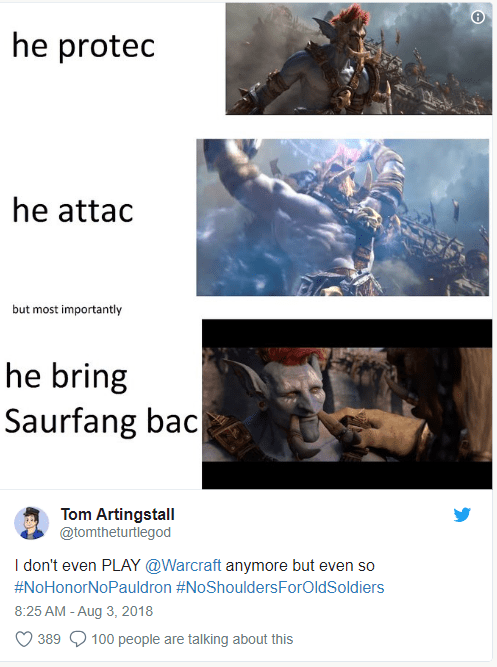
Whether it be a calculated advertising tactic, brilliant storytelling, or just dumb-luck side effects of a highly effective gameplay experience, Blizzard’s ongoing development of World of Warcraft and it’s virtual universe shows no signs of slowing down anytime soon. They’ve survived a number of setbacks, but they continue to push forward and to learn from their mistakes, thanks to their successes in encouraging multi-faceted levels of player interest and emotional investment in Azeroth.
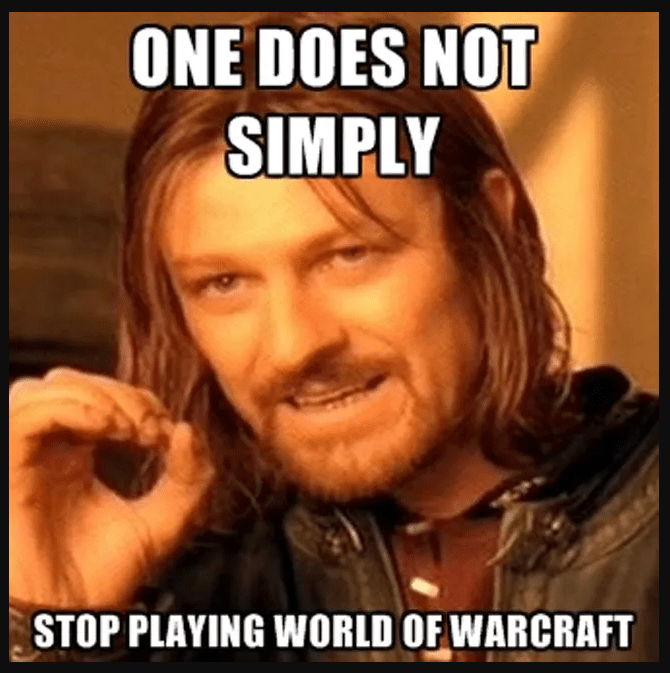
Essentially…
– Gibbs, Martin et al. (2012) Tomestones, Uncanny Monuments and Epic Quests: Memorials in World of Warcraft
– Juul, Jesper. (2013) The Art of Failure
– Krzywinska, Tanya (2008) World Creation and Lore: World of Warcraft as Rich Text in Digital Culture, Play, and Identity: A World of Warcraft Reader, Hilde G. Corneliussen and Jill Walker Rettberg eds.
– Pearce, Celia (2009) Communities of Play: Emergent Cultures in Multiplayer Games and Virtual Worlds
– Ruch, Adam (2009) World of Warcraft: Service or Space?


 My Life, or Something Like It