
Through the Looking Glass

Popular media often serve as a reflection through which we view culture. Like mirrors at a funhouse, they can distort as much as they can show true. We’ve talked about it in class, and I’ve otherwise previously discussed on this blog (here and here), how pulp magazines can be interpreted as presenting a certain way of enacting American life. A very particular way of being a ‘proper’ citizen. As much as the stories, characters, visuals, and advertisments served to train a population to see the world a certain way, so too did the stories, characters, visuals, and advertisments reflect aspects of the world that already existed.

This week, we read topics on gender and race depiction in pulp magazines. While we have discussed these themes throughout the course, this week they take primary focus.

1889n4og4e6c5jpg
A mural from BioShock Infinite, featuring racial stereotypes of ‘undesireables’ and ‘societal moochers,’ that “proper” citizens of the game’s flying city of Columbia are supposed to protect against. This echoes a general theme of racist representations throughout the game, associated with the dominant white and affluent citizen body.

Nathan Madison explores racism in pulp magazines thoroughly in Anti-Foreign Imagery in American Pulps and Comic Books, 1920-1960. In particular, we read about “The Yellow Peril,” or rather the representation of stereotypes and orientalism within the covers of 1919 and 1935’s pulp magazines. Some of the imagery and quotations are quite jarring and unfortunately illuminating, not only for the cultures of the time, but also how long-lasting the tropes were. Towards the end of the chapter, Madison revisits the political nature of anti-foreign (particularly Chinese) climate surrounding these magazines from 1882-1930s. Laws prohibiting inter-race marriage, revoking citizenship from American women who ‘dared’ marry a Chinese man, limits to Chinese immigration.

He states on page 83:

In such an atmosphere, what do the stories found in the pulp magazines of the 1920s and the 1930s tell us about Americans, and, specifically, about their views of Asians and foreigners in general? It is difficult, and rash, to simply assign racism to such a time period that differs from the current in so many ways. One reason for this difficulty, aside from the error of attempting to impose early twenty-first century political correctness upon those living in the early twentieth century, is the contradicting evidence of racial tolerance, and even racial acceptance, on the part of many Americans at the time. For every act of the federal government that attempted to impose immigration restrictions, there was an outcry from many denouncing the racial intolerance such acts legalized.

Continually we return to the complex nature of history and scholarship. It is not enough to simply see these works and stories as reflections of rampant racism at the time. However, as Madison points out, the tendancies were there. It is hard to judge the past based on the morals of the present, and yet in many cases, I would argue, we should. As much as it ‘was different’ in their time, it does not mean we should forgive and forget what happened. In many cases these very damaging stereotypes and racial beliefs created an indoctrinating effect on the populace which persists to this day in many, albiet sometimes more subtle, ways. Amongst the stories that perpetuated the “yellow peril” within the pulps, others did try to subvert it, even to the point of having Chinese protagonists, even if stories like these were more rare.

world-war-2-propaganda
World War II Propaganda Poster

What concerns me about this side of pulp magazines is the overt propagandan nature of “yellow peril” narratives. Madison ends the chapter discussing how the discussion of “yellow” versus “white” races changes leading into World War II, thanks in part to a shift in a percieved gobal villain. He notes, however, that the legacy of this time continues much longer after the fact. We see the effect of orientalism repeat through a variety of funhouse mirrors throughout history, as people from the psudo-mythological East are demonized or exoticised to promote the master-narrative, especially in the contemporary U.S.A. these days. Propaganda narratives like the “yellow peril” catch like wildfire in cultural memory and have damaging effects on the landscape. When everything around you, from the news, to advertisements, to the entertainment you consume, tells a different version of the same story, it becomes increasingly difficult to fight against it.

It’s insidious as hell, and exactly why diverse opinions and representations continue to be important in media, and in scholarship.
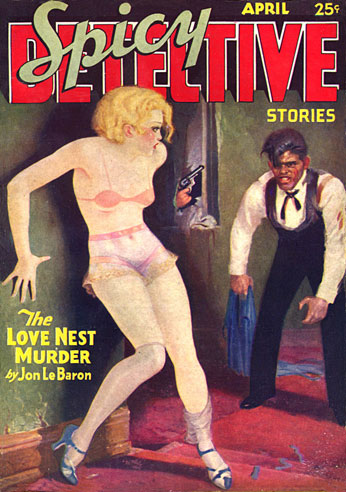

spicy-detective-stories-april-1934Today is International Women’s Day, and I cannot fathom closing out this post without briefly mentioning the looking glass mirrors of gender roles in pulp magazines. That being said, I’ll be brief, as I’ve talked about gender roles briefly before.

Much like racial tropes and stereotypes, the representation of gender roles and “types” of women are equally present within pulp magazines. While there are examples of women who break the mold, often women serve as narrative elements, part of the backdrop to serve the story’s progression. Object of affection, of scandal, of motherhood…representations of women in pulp magazines echo a much longer history of one dimensional or restricted depictions that women continue to fight against today.  What I did find interesting in this week’s readings, however, was the fact that many of the writers and editors of the “girlie” pulp mags were in fact women themselves. While it is less shocking to read that women also made up a sizeable portion of the readership, I am curious as to the motivations of these women to participate in these kinds of narratives. I don’t care for the ‘morality’ of their involvement, but rather the desire to perpetuate stories of women they knew weren’t wholly true? Sex sells as they say, and I suppose writing as ‘an insider’ would provide that extra oompf that would rack in additional sales. Alas, as is pointed out, little about the authors and editors themselves is known, and tracking down any motivations for their involvement is unlikely.

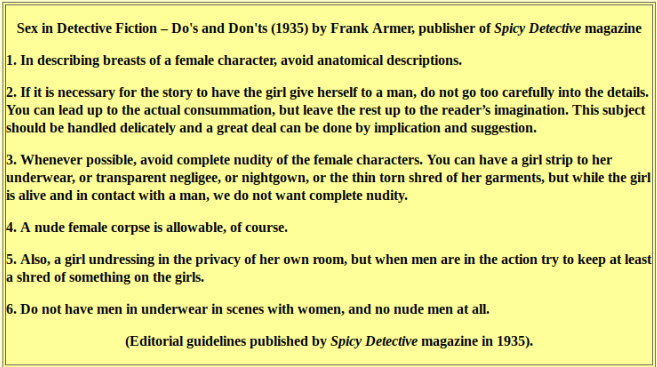
All that being said, I get a kick out of the list of “do’s and don’t’s” for writing into Spicy Detective. “A nude female corpse is allowed, of course.” Naturally.
Screenshot 2018-03-09 at 12.46.35 AM
Pulp Magazines Project – “Birth of Girlie Pulps

The sad part is, while things are changing in contemporary media, they haven’t changed all that much. Here’s hoping that as consumers of media, and as scholars, we can do better, with both race and gender.

Gendering History

If you’ve even dabbled into the discussion of gender and history, you’ve more than likely stumbled by a mention of a lack of female representation in the documented past. It’s something that’s come up in pretty much every course that deals with the past throughout university. Documentaion of women’s affect and even their presence in history is lacking because they just weren’t the ones who were writing it down.

silhoueteuropa-1050x1024

Well, that’s not entirely true. Women were writing, and they were participating in documentation, but not quite as much as their male colleagues. Additionally, it was only usually women of power or money who had any time or ability to write anything at all. We see this even as early as with Sappho, the ancient Greek poet. She was a wealthy citizen, and as a result, had the privilege to leisure time and thus was able to write. While there are very few documented female voices in history, there are even fewer of the average women who would have lived alongside their much more represented male counterparts. Even when women may have written their perspective, carved their story, or have been celebrated in their time, historians have traditionally washed away female participation from the record. Anything which presents women as vocal individuals in their own right, in their own lens, detracts from the male domination narrative you see.

It’s not all that cut and dry, however, as there are plenty of women’s studies and history classes to teach the messiness of such a subject. Where we can tackle however, is something that we discussed in class this week, namely the male-washing of the Western genre. While industrialization allowed for more and more women to gain access to reading and writing, the legacy of their participation in the literary market would go overlooked.

As we discussed in class, the Western genre in its earliest days, when looking at the pulp magazines themselves, had high female engagement. Not just in reading either. Women were writing stories too. While scholarship on Westerns focused on literary sources, skewed towards male authors, the truth remained that the Western genre developed through simultaneous and mutual involvement in the genre. It’s no surprise that in the 1950s and 60s, eras desperately trying to embolden gender roles against an influx of new thinking, that scholarship would erase the presence of female participation. Naturally, it would seem to them, women would have come to the genre only for the romance. Women didn’t want to see the guns or action stories, nay (or perhaps neigh), they only wanted to read about stories where subservient (or perhaps wild-then-tamed) women fall in love with dominent men and start a new life in the West. They couldn’t possibly be interested in the same “men” stuff *insert chest bump here*.

hbo-westworld-12Does my sarcasm read strong enough? It’s so incredibly infurating as an academic to look back and be faced with misled and unfounded historical scholarship. We are now taught to look at the entire picture. To preserve all that we can about a text or an artifact, in hopes that even if we can’t analyze the whole picture, someone, someday, might. When faced with situations like this, one cannot help but be infurated by the scholarship of dominant male authorities, which changed official analysis of history to fit their own goals. Nevermind that the female-driven/written pulps lasted longer than their guns-blazing counterparts. Nevermind that the blended magazines came first. Nevermind that women had any active role whatsoever.

I regret that I’m getting fired up about this more than I intended to, but it strike a chord with me. I have, thanks to my training through a very forward-thinking parent, I’ve always grated against imposed gender roles. Why should boys get all the fun stuff? Women have always been interested in things beyond romance and beautification, but because gender roles (albiet ever shifting) shame them for it, they either train themselves not to be interested, or find an excuse for something societally acceptable within them to like. It makes me hurt, not only for contemporary audiences and issues, but also for the women in history who have had their voices silenced or ignored–or worse yet, attributed to a male counterpart. There is a place for everyone in this analysis, in this field, and it’s up to us to go back and return life to those who we can find within these pages. To give back credit where it is due, and to change scholarship on history to better represent the truth of gender (and race) participation.

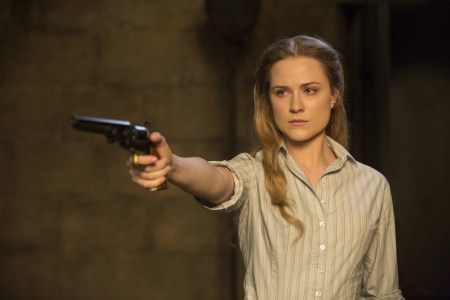
westworld-headerI’ve visually referenced Westworld twice in this post–a brilliant TV show (which if you haven’t watched it, stop, drop, and binge it all right now), created by the joint efforts of a male and a female, produced by a female, and containing an amazing cast of strong-willed, well rounded, and well-written female characters. In the sci-fi/western/drama category, it’s everything an inclusive audience should want, and it’s no wonder it was critically recieved accordingly. It deals with complex issues of romance, action, drama, abuse, artificial intelligence, ethics, free will, and consumerism (alongside so much else), against a backdrop of stunning visuals, breathtaking sets, and a moving score. It’s a show, for me, which proves that Westerns can be for everyone (well, except maybe not kids in this case). I can only imagine, that in the age of pulp magazines, a well written Western would have the same effect on its audience as Westworld has today. A good story need a blend of a variety of elements, and the best way to accomplish that would have been to incorporate blended perspectives and angles into a magazine.

If for nothing else, the lesson of male-washed Western genre scholarship calls for us to use a critical eye when looking at other pulp magazine genres, as well as literature more broadly. Just because it’s not obvious, or its been overwritten, doesn’t mean female voices aren’t there–that female participation isn’t there. Sometimes you just need to dig a little deeper, find meaning in the blank spaces, and help to try and uncover what history has tried to erase. We cannot hope to move foward in our own scholarship, if we continue to accept ingrained and perpetuated biases about the people we study.

The cycle has to end somewhere, why not with us?

Heroines of Warcraft: They Came Before Edition

In honor of Women’s History month, beginning March 8th, we’ll be running a series of editorials surveying the lore and history surrounding some of Azeroth’s most notable heroines and figures.

In honor of Women’s History month, beginning March 8th, we’ll be running a series of editorials surveying the lore and history surrounding some of Azeroth’s most notable heroines and figures.

EONAR, THE LIFE-BINDER

“No one knows when or why the first titan awoke, but legends hold that his name was Aman’Thul” – World of Warcraft Chronicle: Volume 1, 19

One of the earliest notable female figures in Azeroth’s history comes from a time before history was even known on Azeroth; possibly before even Azeroth itself. Hailing from the race of celestial wanderers, the Titans, Eonar is the only confirmed female titan. While there are some in-game and fan theories suggesting that Azeroth too may be a female, Eonar was at least the first.

Awakened by Aman’Thul, the Highfather, Eonar would become his bronze-skinned consort. She carried an alabaster staff through the cosmos as she stood vigilant as the protector of life, nature, and healing in the universe. She often kept from the field of battle, preferring a supporting role in the great Titan Pantheon. If brought to fight, she remained a fierce force who would confuse and disperse her enemies before engaging them. She stood in opposition to the dark Titan Sargeras, and aided the Pantheon in combating him until her ultimate demise at his hand.

Eonar also spent a great deal of time establishing the titanforged which would one day nurture Azeroth, in addition to empowering the naturally-occurring life which Azeroth itself created, namely, the dragons. While Eonar was defeated, her essence and gifts lived on in the populations of Azeroth. She is worshiped where her memory remains, including both the great red and green Dragonflights, which tasked themselves with combating chaos and destruction, while maintaining nature, healing, and life, within the world.

Some hypothesize a connection between Eonar and Elune, as well as the Tauren’s Earthmother, as all three share many common threads of beliefs and traits; however, at this time, we have no formal notes from Blizzard about how these entities are connected.

ALEXSTRASZA, THE LIFE-BINDER & DRAGONQUEEN

“The nurturing and ever-merciful Freya called upon her creator, Eonar, to empower the proto-dragon Alexstrasza. Known thereafter as the Life-Binder…” World of Warcraft Chronicle: Volume 1, 46

While the Titans would eventually come to create the titanforged to safeguard Azeroth, the planet had already gone about creating its own species of life, one of these were the dragons. While the Pantheon created the Keepers (better known for their appearance in-game in Ulduar) to safeguard the planet and the mechanization they had set in motion, there was nothing let to govern Azeroth’s native entities. Over time, one dragon came to overtake them all and tore about Kalimdor destroying and consuming everything in its path. His name was Galakrond. The Keepers came to decide that they would empower the smartest of the nascent species and help to take the great beast down. These would come to be known as the Dragon Aspects, of which Alexstrasza was one. The Keeper Freya had been created by Eonar and it was she who infused Alexstrasza and her dragonflight with guardianship of all life on Azeroth.

In-game, the Life-Binder can be found in many areas, including atop the Wyrmrest Temple in Dragonblight, and in the Dragon Soul raid. No longer content to step aside and watch the world in its suffering, she brought the Dragon Aspects and their flights together in order to actively defend against evils which would harm life on her beloved planet. Even in light of sacrificing her power to save the world from Deathwing, her fallen brother Neltharion, back in Cataclysm, the Dragon Mother remains the most powerful, if not the eldest dragon alive today. She is also one of the last remaining of the original Dragon Aspects.

YSERA, THE DREAMER

“Freya also beseeched Eonar to bless Alexstrasza’s younger sister, the proto-dragon Ysera, with natures influence. Ysera was charged with keeping watch over the flowering wilds of Azeroth from within the Emerald Dream.” – World of Warcraft Chronicle: Volume 1, 46

While Alexstrasza’s charge was to guard the life of the world, Ysera was in charge of its dream, the Emerald Dream, a place which held the original blueprint for Azeroth’s ordering by the Titans. All creatures would visit the Dream in their rest, but it was Ysera’s domain to watch over. Like her older sister, she would be a part of all lives on Azeroth, and would also take up arms to protect it. She fought alongside her siblings in protecting Azeroth, titanforged and native creatures alike. Ysera spent a great deal of time asleep in order to defend the Emerald Dream, waking only so often when situations were dire enough to warrant it. As a result, in-game, we bore witness to Ysera’s active role in Cataclysm throughout Mount Hyjal, as well as in the Dragon Soul raid, where she used the latent power of Eonar which made her an Aspect of the green dragonflight, in order to help stop Neltharion.

While tragedy befell her this expansion during the campaign in Val’sharah, her spirit lives on in the Emerald Dream and wanders through its purified fields, no longer a creature of both worlds.

Do you have any favourite female characters from the dawn of the world of Azeroth? Let us know in the comments below, or join in the conversation on Facebook, Twitter, or Discord!


Images © Blizzard Entertainment