
Today we continue our look into the history of horror games, this time focusing on more recent productions.
Continue reading “Ghoul On 2: The Frightening, 2011-Present”

Continue reading “Ghoul On 2: The Frightening, 2011-Present”
I challenge you to think critically the next time you look at your stuff. Things are not as simple as they seem. Everything is connected in a wide array of networks that code and translate the world around us. So when you set down your venti peppermint mocha from Starbucks next to your MacBook Air and adjust your wide-rimmed black glasses, be aware that you are sending out a number of signals to people around you about who you are, what you like, and your socio-economic status—or at least an impression of those things, whether or not any of them are actually true.
And that’s perhaps the most important part. As much as our stuff sends out a lot of signals about who we are and what we believe in, we need to be aware that those signals only tell us part of the story. These networks of understanding are imprinted on us from very early ages and are highly culturally specific. We spend our childhoods observing the world around us, learning how to speak the language(s) of our cultures in words, but also in the things we surround ourselves with.
So what if then, you find yourself sitting at Starbucks, surrounded with your paraphernalia and happen to read on the internet some blog post (much like this one) that details Starbucks stereotypical patrons. You skim the list and despite fitting the criteria of many of the people listed, you don’t fully click with any of the pictures they paint. Why is that you ask? Because you aren’t white and all these stereotypes are.
We often get so lost in the messages being transmitted around us via objects and words that we forget to read between the lines of our cultural products and see some of the messages that hide themselves in plain sight.

Take for example the phenomena we’ve seen the past few years take place on the internet about Halloween costumes. Started by a student group out of Ohio University, a campaign begun that attempted to bring down, or at least raise awareness about the insensitivity of, race or culture-based Halloween costumes.
Most of the comments and blogs posted about this campaign try to claim that people are just becoming too sensitive. That being PC has run away with itself, leaving nothing left for us to have fun with. This of course is far from the truth of what’s actually going on. These comments neglect these very same networks of understanding that permeate our cultural interactions and ignore the crossing of them that is taking place on the hem of these costumes.
In truth, the whole thing really isn’t about the costumes. When we take a deeper look at what’s happening behind this campaign and its responses, we find the interplay between social, cultural, political, racial, and historical contexts all thanks to different understandings of stuff and cultural identity.
During Halloween people generally believe that they should be able to dress up as whatever they want. In recent years these costumes have changed to incorporate more than your traditional ghouls and goblins from B reel horror movies—adding into the mix pop culture icons alongside these problematic racial guises. While inversions and dressing up as something else is nothing new—with ties dating back to Ancient Rome and the Middle Ages—the intersections of these disjunctive ideologies, contexts, and histories are bringing out latent race tensions within the population.
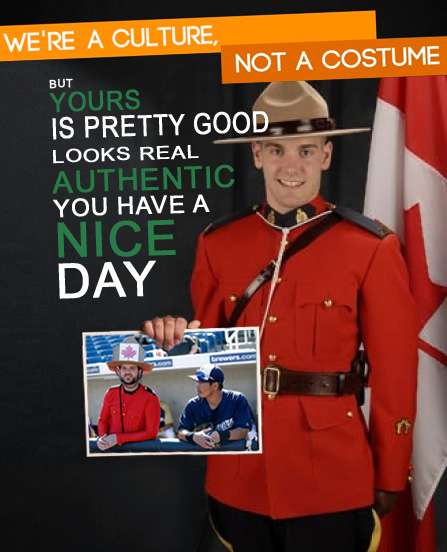
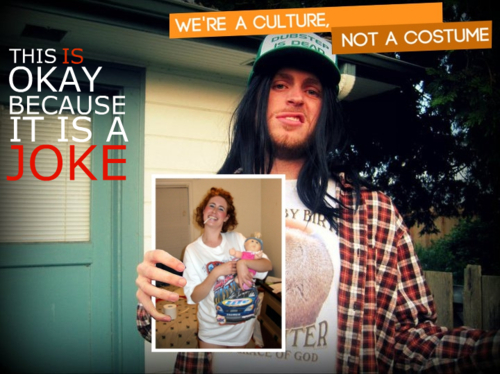 In all the posters promoted by the campaign, the offenders are always white and the wronged parties come from traditionally minority ethnic or cultural groups. The claims made against cultural adoption also follow this pattern. You’ll never find an official campaign poster showing a POC dressed up as another POC. All we find are pictures of white people metaphorically rubbing their superiority in the faces of subjugated populations, or so we’re made to believe.
In her blog post “That’s Racist,” Alex Felipe counters most of the problems raised by this debate quite succinctly:
“I don’t understand why the call is basically for White people NOT to do it Full stop. I mean why is it that we see costumes based on traditional dress racist? The usual refrain is: ‘we are a culture, not a costume.’ But if this is the case, would it not also be proper for Whites to decry costumes based on horned Vikings…or medieval knights? Now the answer to my question is obvious. It’s not the same because of the disparity in power relations.”
She continues, “When we people of colour see these costumes we are reminded of our subordinate place in society. We are reminded that our countries of origin were ravaged by colonialism, and are still exploited through modern imperialism…why do we stop at simply calling out the costume…If the costume is a symbol that offends…why do we stop at the symbol and not continue onto what it symbolizes?”
There’s no consensus on how we can deal with this situation but as an anthropologically inclined blog, my goal has been to try and draw your attention to our tricks of the trade—context. We need to be aware of how our stuff affects how we understand and live in the world not just for the good of ourselves, but also in how we can do better for others. We are limited in how we interpret the world by our own personal histories and cultures but in taking charge of that information we can start to have a dialogue with others in order to learn how to see each other’s side of the story.
Keep it all in mind, the next time you take a sip of your coffee or go to buy your next Halloween costume. It’s not all just black and white, right and wrong—the whole web is much more complicated and varied than we think. The phone or computer you’re reading this on, even now, probably says something about you just as pointedly as the status updates you post on Twitter or Facebook. And not all of it is necessarily good, so it’s probably best to keep it in check. Be aware, be conscious, and don’t let your things say more about you than your words or actions. No one wants to be reduced to what they can only see on the surface.
 My Life, or Something Like It