
This Day in Gaming History is an editorial released 2-3 days per week, that takes you on a ride in its custom-built gaming history blue box. We take a look at titles all released on the same day throughout gaming history, while also giving extra facts and anecdotes as available or appropriate. Got a favorite game that you want to learn more about, or perhaps want to see featured on TDIGH? Send angel1573 a message on the forums, or leave a comment below!
Today, we’ll be returning to some classic titles and franchises, household names, and iconic characters in gaming history. Creations of the earliest console wars, their characters continue to be used as symbols for their brands. From the early days of Sonic the Hedgehog, through to a new generation of Mario and Link, let’s adventure alongside our childhood heroes on This Day in Gaming History.
SONIC THE HEDGEHOG (SEGA GENESIS)
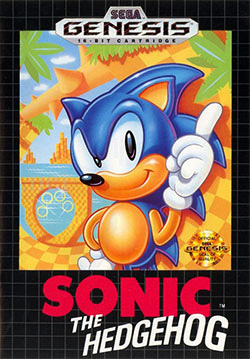
Released simultaneously in North America, Europe, and Australia on this day in 1991, Sonic the Hedgehog became the first game of the Sonic franchise. Following the game’s development in 1990, and after deciding on the anthropomorphic traits of Sonic, the team renamed themselves the “Sonic Team” to match their new character. Influenced by the Super Mario titles, Sonic the Hedgehog introduced a new technique to platforming: the ability to roll along curved scenery. Over time, this ability would evolve and become an integral part of Sonic’s gaming identity. The title itself was well received by critics, who praised its visuals, music, and pace of gameplay. The game was also commercially successful, helping to make the Sega Genesis console a key player in its era of console gaming.
In the 1991 holiday season, the Genesis outsold the Super Nintendo by a two-to-one ration, and in January of 1992, it peaked to claim 65% of the console market share. While Nintendo eventually overtook Sega, it was the first time since 1985 that Nintendo did not lead the console market. Sonic the Hedgehog has been ported to various media since, alongside clones and inspired offshoots, including various “animal with attitude” platformers like Aero the Acro-Bat, Earthworm Jim, or Crash Bandicoot.
NINTENDO 64 CONSOLE & SUPER MARIO 64

Launched alongside one another in all markets, on this day in 1996 the Nintendo 64 console and Super Mario 64 were launched in Japan. Initially codenamed “Project Reality”, the design was finalized by mid-1995, but its launch was ultimately delayed until 1996. The console primarily competed with the PlayStation and Sega Saturn, as part of the fifth generation of console gaming. Alongside Super Mario 64, the console was launched with Pilotwings 64 worldwide, and Saikyo Habu Shogi in Japan only. The console was launched in a variety of colours and designs, including limited-edition controllers and systems.
The N64 was highly anticipated and was met with great praise as a result for its power and gaming delivery–allowing for a more powerful generation of games. The system was in high demand upon release, and during its first three days on the market, retailers sold 350 000 of 500 000 available units. However, the decision for the console to use cartridges rather than discs resulted in tapered sales and more expensive games than its counterparts. Ultimately, the N64 remains one of the most iconic consoles in gaming history, not only for its own profile, but also the games released for it.
Super Mario 64 is the best selling game of all time for the Nintendo 64 console, having sold more than eleven million copies worldwide. A remake was launched on the Nintendo DS in 2004, entitled Super Mario 64 DS and features modifications to the original title. The game left a lasting legacy on 3D game design, particularly with camera design and 360 degree analog control. Super Mario 64 is lauded by critics and fans alike as one of the greatest and most revolutionary games of all time.
Countless titles which followed its released were influenced by Super Mario 64‘s design, including: GoldenEye 007, the Grand Theft Auto series, Kingdom Hearts, and countless others. Dan Houser, a prominent figure in the development of GTA, stated “Anyone who makes 3D games who says they’ve not borrowed something from Mario or Zelda [on the N64] is lying.” On May 5, 2011, Super Mario 64 was chosen as one of the 80 games to be displayed at the Smithsonian, as part of the “The Art of Video Games” exhibit which launched the following year.
PHANTOM HOURGLASS (NINTENDO DS) [JAPAN]

Much like the other two (or three if you’re going to be technical) gaming behemoths in our list today, The Legend of Zelda: Phantom Hourglass is another title in a long list of games in the Zelda franchise. An action-adventure game released on this day in 2007 in Japan, it is the fourteenth installment in the greater series, and the direct sequel to the 2002 Gamecube title Wind Waker. The game has been re-released for the Wii U via the Virtual Console in North America as of May 2016. The title features 3D cell-shaded graphics and an overhead camera perspective. Players utilize both the touchscreen and the microphone, alongside traditional controls, to progress the story.
While the title and its gameplay were generally praised upon release, Phantom Hourglass was criticized for its online features. Receiving several industry awards, the game would go on to sell 262,800 copies in its initial month in the U.S. By March of 2008, 4.13 million copies had been sold worldwide. Phantom Hourglass was praised as one of the better games to be launched on the Nintendo DS handheld. While the game changes pace and tone when compared to others like Twilight Princess on the Wii, it remained a worthy successor to Wind Waker. Several websites named it the 2007 Game of the Year for the Nintendo DS, and was listed as such in many mainstream magazines. While a point of criticism for some, the title was simultaneously praised for being the first Zelda title to successfully attract casual players.
Images © Nintendo & Sega
Some other titles released on this day:
- Phantasy Star Online: Blue Burst (PC) – 2005
- Dynasty Warriors 6 Empires (PS3) – 2009
- Pokemon Black & White Version 2 [Japan] (DS) – 2012
- Batman: Arkham Knight (PC/PS4/Xbox One) – 2015


 My Life, or Something Like It