
Curating Communities in the Digital World; Spoilers, it’s nothing new.

Over the past few months in light of the COVID-19 pandemic, I can’t help but feel like there’s been an increasing awareness paid to community. What it means to be part of one, how do we come together as one, how do we build one in an increasingly digital age?

So many questions that people are now asking themselves as though they’re waking up from a haze. For so long people have been going through the motions of life and only truly living in the wisps of what community is supposed to be. People love to blame the internet and social media for destroying historical meanings of what it meant to be part of a community—but many of these people have ceased to evolve to see what modern day communities are actually like.
hpgiu1kefus41Then COVID struck. Slowly, then encapsulating the world. With the physical spaces we used to gather no longer being accessible, people fled to the internet to try and make whole the social spaces they were deprived of. The very people who claimed that these spaces were the death of all community are now struggling to try to figure out how to use the internet as the vast saviour of all things social.

And yet, they still don’t understand.

Now that I’ve passed into the post-comps-dissertation-writing-I-swear phase of my PhD, it’s hard to not see things align in an eerily timely and useful way. While I write about gender and power dynamics for my dissertation, I’m effectively writing about how communities are built and developed online. How their ideologies are developed and perpetuated; how we make meaning in digital spaces. As my academic mantra has been for a while: People, Technology, Culture.

I’ve had the pleasure of receiving a series of graduate research scholarships to develop a community for the UW Games Institute from the ground up in a digital space—predating the COVID epidemic, but accelerated in kind by its appearance. I’ve had in-depth experience with thinking through how to build the culture we want to have, and how to reinforce the culture we already had, through an entirely virtual medium.

This has given me new perspectives not only on how simple it can be to consciously choose the framework you want a community to develop around, but equally how easy it is for people to overlook the simple things that can easily breed discontent and toxicity if overlooked.

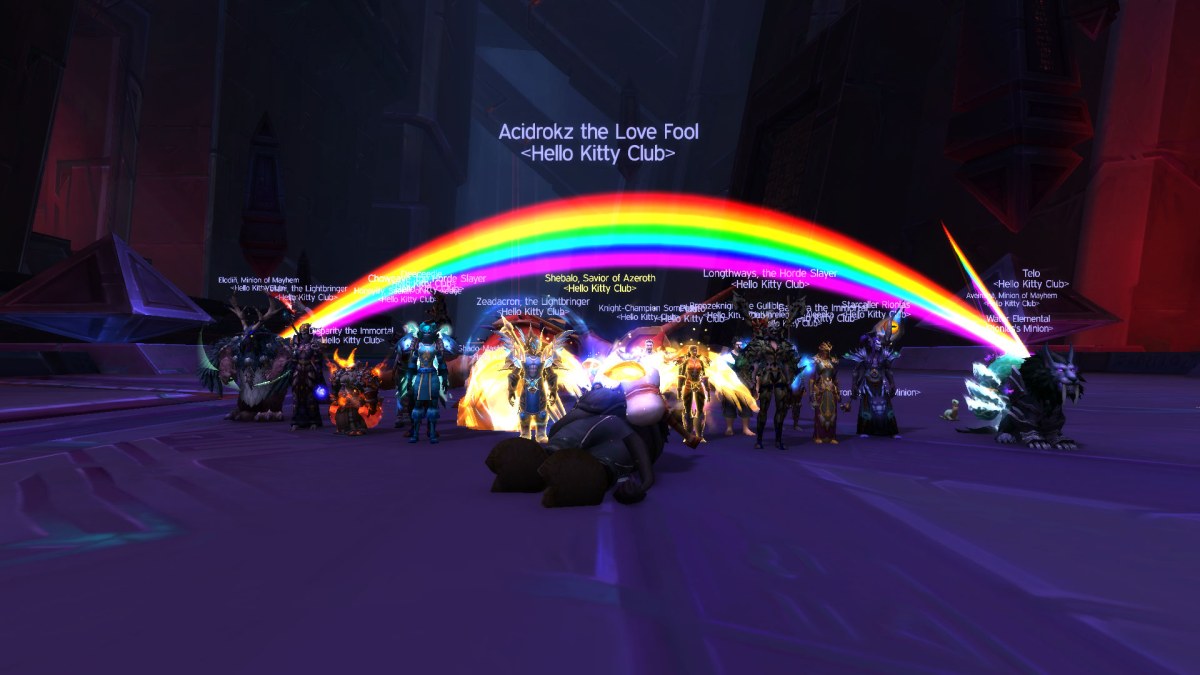
As per usual, this is going to come back to World of Warcraft (shocker, I know). I spent the morning talking to my current GM of HKC, whom I’ve known for over 13 years now. We talked about our community, the world of gaming culture, and most notably, the recent scandal with Method.

This scandal sadly has come at no surprise to me, as one who researches within and participates heavily in the competitive gamer world. The stories relayed through this news blast aren’t unique—in fact they’re far more common than many want to believe—but the more these stories come to light, the more…hopefully…we’ll come to see a change in the gaming “community.”

I’ve been lucky that I learned to navigate these worlds earlier, and have surrounded myself over time with people who support the kind of virtual space I want to be a part of, but many aren’t so lucky. That spine, was an important part of my conversation today. We have a strong and long-lasting community within Hello Kitty Club. But despite our size, we aren’t free from risk of drama (nor have we not had our share of it in the 10+ years I’ve been a part of its leadership).
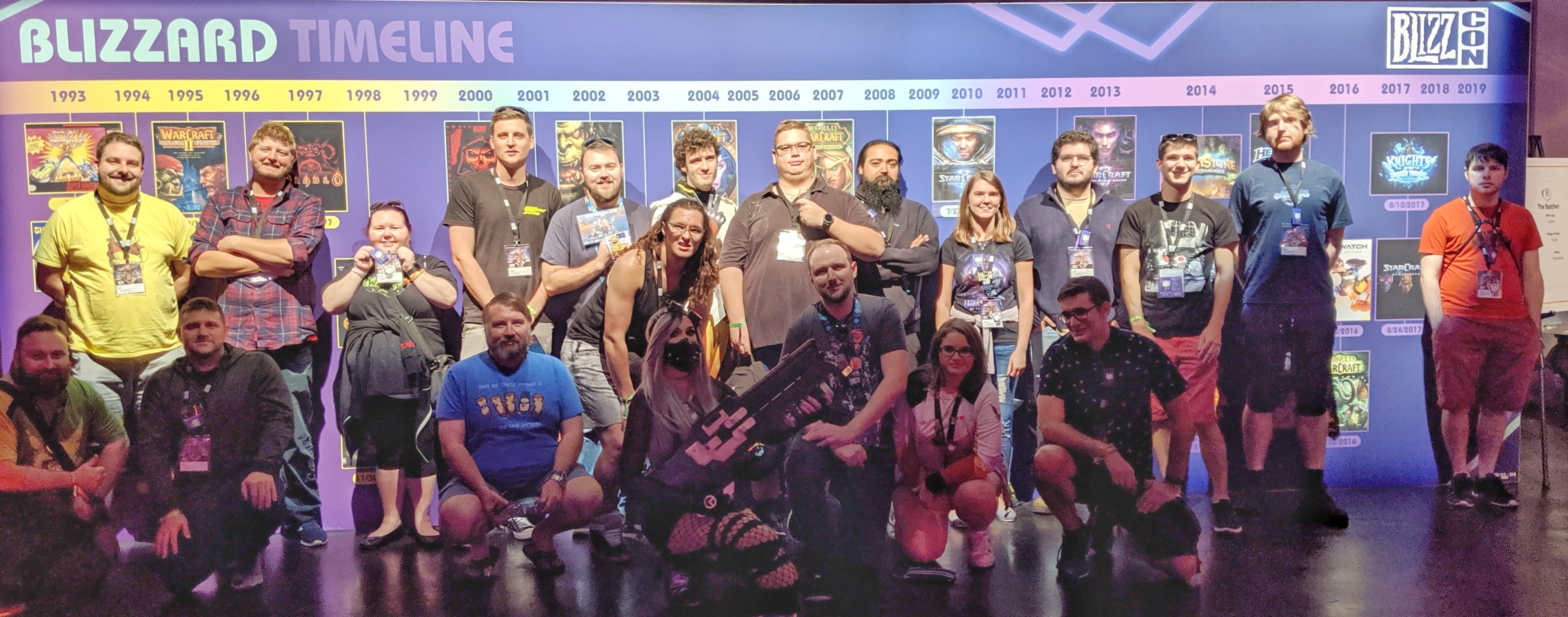
IMG_20191102_175037-01
HKC BlizzCon 2019, HKC + Friends through the years (when we each joined Blizzard, approximately)


What struck me today was the willingness to work towards creating systems to stop, acknowledge, or offer recourse for situations in the same wheelhouse as what happened with Method (and others) before they even start. We aren’t some international gaming juggernaut, and yet, the importance of creating safe spaces for all members of your community, is no less important to us.

Over the years, there’s a reason why people keep coming back to HKC. Many guilds rise and fall. People disappear without a word. But for some reason, people keep coming back to us and remember us long after we’ve parted ways (or changed servers), and I can’t help but keep coming back to the question of community. We’ve evolved over the years but there’s something about our core, our attitude, our values that seems to strike a chord with people. Something we hope to soon put to writing to ensure that that energy can continue to thrive beyond the current leadership.

I mean….let’s face it, we might leave this game eventually right? (*awkward laughter*)

In the meantime though, I’m proud to be part of who HKC is today. We acknowledge our own missteps in the past but equally are learning from them in order to build a better community in the future. Even if it’s just in our one small corner of the Discord & Azeroth universes.

MVIMG_20191102_191748
HKC BlizzCon 2019, closing ceremonies

#GamerGate, Tech industry sexual harassment leaks, #BlackLivesMatter, #MeToo, and through this current Method scandal. All of these things happen everywhere, across the globe, but they are changed systematically at the small community level.

We work together to fight intolerance and misconduct at a local level and it can have a rippling effect that spreads across the whole of the industry. It’s human nature to gravitate towards what others are doing successfully. We must continue to fight, no matter how helpless it may seem by learning about these big-news items.

All news is local news, and the biggest of scandals start with the smallest of problems.

Build your communities with care and you’ll see them grow. Let them populate unchecked and you’re just setting yourself up for disaster. I’m sure Method meant well, but at some point you need to let go of old ways, evolve, and stand up for what’s right.

Change is an individual choice. Choose to build better communities, adopt more inclusive values, choose to listen to others.

Choose a better future by acting as though it were already here.

Haecceity: How long can you alter a game, before it ceases to be the same game?

The devices we have at our disposal for keeping a game going tend to become more and more legalistic as the concept of fairness evolves into a prerequisite for playing a game well. They are there to assure that the game is fair.

We establish such devices because we discover that, as we become familiar enough with a game to get totally involved in it, we tend to become a bit untrustworthy.

You know, you get involved in the heat of the game, you want to take the game as seriously and as fully as you can, and, if given the chance, you might in the blind passion of playing find yourself more willing that you normally would be to do something that closely approximates cheating—especially if no one happens to notice.

It’s not that you’re trying to be bad or inhumane or anything like that, it’s just that you’re so deep into the game that everything you do or think tends to become a strategy.

In other words, when you really get involved in a game, you forget yourself. In fact, the fun of the game lies in the fact that you can forget yourself. But what might happen is that you forget yourself too much (Koven 30).

Imagine that you have an axe which over time starts to break down. First, the handle breaks and you replace it, continuing to use it for a while afterwards. Eventually, the head breaks too and you’re forced to switch it out for a new one. No piece of the original axe remains–is it still the same axe?

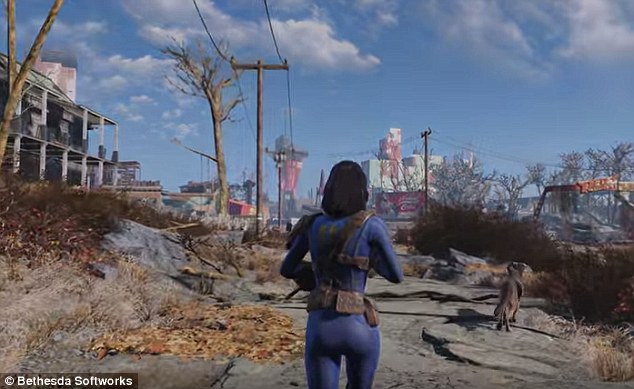
This paradox, is perhaps better known as The Ship of Theseus paradox, with a variety of different fiction and non-fiction counterparts. Essentially, this paradox questions what happens when you replace all parts of an object (or person, robot, etc.)–does it still retain its original “thisness” or haecceity? It’s precisely the problem we see when looking at the more recent legacy of Bethesda titles: namely Skyrim and Fallout 4. There have been no shortage of mods available for Bethesda games, even as early as Oblivion. In the pre-Skyrim craze era, mods were already available to do just about anything. Recently, on my news feed I saw that Bethesda has basically stated that they’ll continue porting Skyrim “as long as people keep buying it.” My first thoughts after reading that was, which version of Skyrim is that?

Although Bethesda clearly has a good sense of humour about it, the fact remains that one of the biggest parts of what has given Skyrim and many of its other titles such longevity, was thanks to its modding community. A quick search through most-popular-mod-source Nexus Mods reveals the depth and depravity of said community. Hosting mods for a wide-variety of games, including Skyrim and the Fallout series, options are sortable based on community downloads, approvals, and general popularity. The version of Skyrim/Fallout that the ‘community’ wants you to play, is often vastly different than the one originally produced by Bethesda. Mods like these come when you know the game too well, you’re in too deep, and just want to keep that world alive (Koven 30).

In addition to audio-visual overhauls, character model and NPC model updates, and minor UI tweaks, these kinds of mods also offer monumental bug fixes left hanging by Bethesda (I’m looking at you Xbox 360 Skyrim), quest design, loading screens, new user-designed quests, backstories, tutorial skips–you name it, someone probably has designed a mod for it. It’s interesting to note, that while I’m saying ‘mod’ to describe what’s available on Nexus, in truth, some of them can also be classified as cheats, and generally speaking, we’re back to the problematic division of cheats and modification, especially in the mods cycling around for Bethesda titles. How much of the game can we tweak or change before we’ve gone too far and created something altogether different?

Recently my boyfriend encouraged me to return to Fallout 4 after my last dismissal of the title, following a very disgruntled encounter with its Settlement building system. I couldn’t build what I wanted, where or how I wanted, and it all required far more investment into the game than where I was at at the time. The UI was clunky, and I just wanted to build my post-apocalyptic city in peace as a home base before continuing. After facing a critical-fail bug after an hour or two of work, I walked away from the game and never returned. My renewed interest came from the inclusion of mods, following the insistence that it would improve a lot of the issues I had, and it ended up being true. I fell into the Ibister flow and lost track of time within the game, but not for the reason of the game itself, I fell into it, because of the modding experience.

I had dabbled in Skyrim modding when I eventually made my transition from Xbox 360 to PC, predominantly due to mindnumbing bugs at every turn. Most of these mods centred on adding new customization for my character, as well as some audio-visual improvements, and UI tweaks–the usual stuff. One of these important features included adding a “real time” clock to my loading screens, as far too many hours were lost in the “just one more quest” world of Skyrim in my undergrad before that. With Fallout 4, things were different.

nexus.PNG
With a cap of 255 mods, where is the line between Fallout 4 and Fallout 4 By Jenn & Friends?

I spent an excruciatingly long time trying to get some of these mods to work in game, to work with one another, and to not generally break my ability to play the game. I made the foolish decision to start modding my game part way through an active save. While this was my first time getting this far, I didn’t feel comfortable incorporating mods or cheats that would break my “first” experience beyond the walls of Sanctuary. I would experience the “real” Fallout 4–or so I believed. It quickly became apparent that no matter what I did, I was changing the game beyond what it was “supposed to be.” A character interaction mod here, adapting how I chose my voice lines for chat interfaces, a “place anywhere” mod there, permitting my incessant need to build the perfect Settlements. My modding experience was about perfecting my experience within the Fallout space, all while trying to avoid doing as much damage to the game-as-intended as possible. It wasn’t about making it easier or harder, it was simply about improving the experience as it was–as determined by the community–like I was already so used to doing in WoW.

But I was wrong.

I made the mistake of remembering the existence of the console-command system. Alongside all the texture re-writes, the graphic overhauls, performance tweaks, and hundreds of hairstyles I had installed, I had yet to really “cheat” in my eyes, until I came to the console. Until this point, my boyfriend and I had been on the same page about what we were doing in the modvolution. Instead, I found as I got deeper into the game, that my opinions about cheating changed. I cared about the world, about my settlements, and about learning the story, but I cared less about how I went about building them or progressing through my murder sprees. I started implementing cheats for quick resources, alongside use of “killall” and “unlock” commands to get what I wanted without wasting too much time. I tried to use it sparingly, but it started to make the game feel emptier. If it weren’t for my desire to see the story or to make sprawling vaults and settlements, I don’t know if my heart would be in it. The ability to truly grind, to truly fail, to truly work for what I had given myself was missing (Juul).

2e4fa64f00000578-3312465-video_game_fans_have_rushed_out_to_get_their_hands_on_the_latest-a-31_1447179736453

With Skyrim, I had already beaten the majority of the game by the time I had started to dive into mods, and only ever did I cheat to advance my storyline the one time for my corrupted Xbox 360 save. The rabbit hole of cheating had encapsulated me, and now I was faced with trying to get clean or just commit to the deeds that I have done. Ironically, though his Fallout has the limit of mods, without cheating, my boyfriend’s Fallout may yet be more authentic than mine. A sentiment he shares, and that I might just believe.

It’s no wonder that Bethesda turns off achievements for players with modifications enabled (although with the Fallout 4 Script Editor, you can re-enable them anyway). With any number of mods enabled, even Bethesda seems to believe that having them changes the game enough that achievements are no longer valid when obtained on a modded system.

In looking back at my decisions to change Fallout 4, the how and the why, the community’s answers, and the community’s options–I can’t help but echo the idea of what “thisness” remains in the game after so many changes? Mods label themselves as vanilla or lore-friendly, suggesting that they’re closer to the game’s “thisness” than their counterparts. If the axe’s head you replace comes from the sister of the axe you already owned, does that make it closer to the same axe?

People cheat and modify these games for any number of reasons, primarily in finding new ways to establish their ideal user experience through improving identity (character, environment mods), flow (UI, ease or difficulty changes, performance enhancers), and even modifying what it means to fail. Through these changes, they reinforce community standards, while still toying around with what the developers have allowed them to change. While Fallout 4 and Skyrim allow for much larger changes to their core code than say, The Sims 4World of Warcraft, or Sonic 2, any changes beyond simple interaction with the game-as-design call into question the “thisness” of a game.

We may cheat, modify, and break games for any number of inherent human desires to do so, however, is a game only what it’s produced to be, or should we begin to consider all changes, modifications, cheats, and adaptations to be part of the ephemeral haecceity that surrounds the initial game’s code? If we can adopt house rules as a relatively standard deviation from normal rules, and if Luxury Tax gets paid out to Free Parking on the regular, maybe modding and cheating aren’t so bad. Maybe they find ways to help us make use of our game worlds just a little bit longer. Or maybe, it’s simply a way for a gaming community to participate in the development world, beyond passive engagement.

After all, Skyrim played on Xbox 360, will differ from Xbox One, from the Switch, and from P.C., before mods or cheats are even considered. Why set the limits on user experience? As Koven stated in the quotation at the beginning of this series: “I am aware that the motivation for your sudden intensity stems not as much from your concern that I have broken a rule as from your feeling that I have somehow deprived you of your opportunity to win…” (24). If cheating is just a socially agreed upon  set of rules and conditions of play, then what does it matter if no one is there to see you do it?

https://www.youtube.com/watch?v=GE2BkLqMef4


Academic References/Further Reading:

Isbister, Katherine How Games Move Us (2016)
Juul, Jesper. The Art of Failure (2013)
Koven, Bernard De. The Well-Played Game (2013)

(Video)Games: A Need to Cheat

Along with the idea of fairness comes its necessary complement: cheating. Cheating is what someone does to give him/herself a more than even chance to win. At least, that’s what we most often call cheating.

When I happen to notice you attempting to draw universal attention to my little cheat, I am aware that the motivation for your sudden intensity stems not as much from your concern that I have broken a rule as from your feeling that I have  somehow deprived you of your opportunity to win…

It is obvious that your concern with my cheating is biased in your behalf. If I’m doing something wrong, even if I’m in flagrant violation of the rules of the game, as long as you perceive yourself as winning, everything’s cool (Koven 24-25).

To what lengths will you go to win, to succeed, to overcome the technical rules of whatever game you’re playing to get a little bit of an advantage? Would it make a difference if the game enabled you to accomplish this task via embedded cheat codes? What do we make of sanctioned cheating vs. unsanctioned cheating? What if you don’t even know you’re circumventing the rules-as-intended?

When playing board or card games with friends, we already know the routine. Often “house rules” need to be established alongside “legitimate” ones, because we seem to have a predisposition to change games as they’re presented to us. We demand that our friends and family reveal their house rules before a game even begins, lest we find out mid-way through that people are actually not on the same page. What happens when you land in free parking in Monopoly? I’m sure we’d be very divided on the answer. “Wait, that’s cheating!” we’d be inclined to say, when our peers reveal themselves to be playing an entirely different game than us, while all looking at the same board. Some strange parallel reality where someone jumps up and stops you from buying a house on your second pass of “GO” in Monopoly.

phoenix-wright-objection

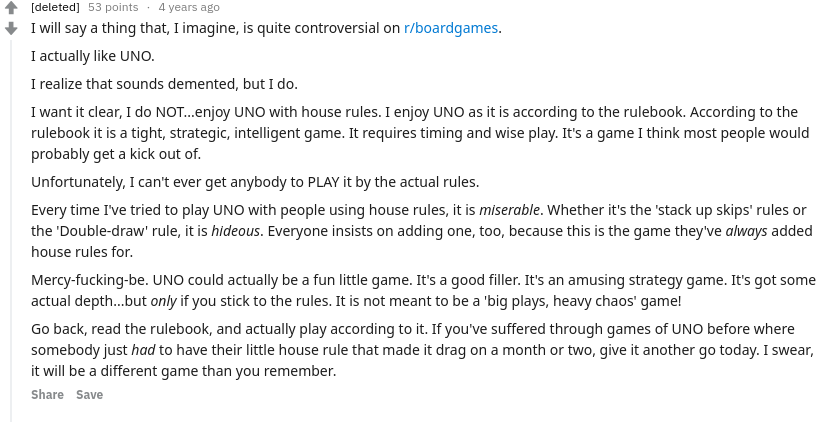
It’s not surprising that this was a heated conversation in the board games subreddit, and spawned at least one thread trying to spin the ‘positivity’ of house rules. These are things we usually only find in board and card games, because (without mods or hacking), in video games, the code simply doesn’t allow us these affordances. This is thanks to Procedural Rhetoric, where game philosophy and developer ideological visions are written into the very laws which govern how the game operates. For example, when playing UNO on the Xbox 360 (or other ports), the kinds of house rules faced by this unfortunate redditor would simply not be possible.

Screenshot 2018-07-08 at 1.10.09 AM

The code would prevent such frustrations from occuring in a the videogame version of this card classic. Even when “house rules” are allowed, they’re usually custom-made and allow only for people to enter into the game acknowledging them in advance, with no room for mid-game shifts in playstyle. Even custom games in more recent first-person shooter titles like Halo or Overwatch, lay all the custom rules upfront–people know what they’re getting into. At all stages of these custom maps or games, players are often required to choose from what the developers have already accepted as “sanctioned” deviations from the norm.

This idea of customizing game rules and house rules within board games and their video game companions brings us closer to the question of what it means to cheat in games. The implementation and adaptability of board and card game house rules are perhaps more complicated than a handful of blog entries can address, but, I think we can safely look at why and how we cheat in our games through looking at some specific videogame history and case-study-style examples via the following series:


Academic References/Further Reading from the Series:

A Blizzcon Post-Mortem: Exploring the Experience

Whether by virtual ticket, in person, or via news outlets, many of us experienced Blizzcon in our own way. In the social media craze which surrounds events like Blizzcon, can Blizzard do more to include individuals left outside of its hallowed halls?

Snapchat, Instagram, & Live Streams from the show floor are giving fans unprecedented accessibility to conventions.

Continue reading “A Blizzcon Post-Mortem: Exploring the Experience”