

The Legacy of Cheat Codes & The Game Genie

In order to truly understand the how and the why of cheating in videogames we need to look back at some of the earliest examples, namely the inclusion of cheat codes or inputs alongside off-brand cheating systems, like the Game Genie.

81hglu5s7ml-_sx342_
The original console command system.

Perhaps one of the earlier, and most well-known of these sanctioned cheat codes created by developers was the Konami code, or the Contra code, first ‘discovered’ in the original NES Contra game. This code, ↓ → → B A START, was found not only within this title, but also within other Konami games, hence earning it’s primary title as the “konami” code. Later it later became a staple of ‘gamer’ culture, appearing in non-Konami games, on clothing, and other paraphernalia. How does a code, one that gave players a mere 30 extra lives, an official cheat-system, gain such a cultural traction? It wasn’t just Contra and Konami games either that featured cheat codes like these in the earlier days of console gaming. Sonic 2, featured a level-select option within the ‘sound test’ section of the options menu, among other choices like debug mode or unlimited lives. Even games like Disney’s Aladdin featured a level-select mode on its Option menu, mirroring the style of the Konami code: A, C, A, C, A, C, A, C, B(x4).

While cheat codes were primarily instituted by game developers for playtesting purposes (having unlimited lives is a really good idea if your job is to potentially find glitches via death in Sonic), they were clearly never taken out of a wide array of games. Alongside the question of the popularity of cheat codes, we can similarly ask why these were left in at all by the developers? In the case of games like Sonic 2 or Aladdin, level-select was a very useful option for players who had beat the game a number of times and didn’t want to “work their way through” again, only to get to their favourite level. Lacking a cartridge save option, something that would be later included with Sonic 3, it made sense for players to have access to these kinds of perks, after being “in the know” to find them. That being said, Sonic 3 continued the tradition of cheat codes and still had its fair share of cheats.

It also wasn’t just thanks to the great sleuthing of early videogame fans that we found out about these codes either, in the pre-launch and early years of the internet. Participating in cheat code culture in social circles, scribblings in the back of Blockbuster rental copy game books, and even licenced game magazines like Nintendo Power, or even strategy guides, often included these to help other gamers find them. Soon after, the pseudo-mythological state of the cheat code was born, and it felt like everyone was on the lookout for the next one they could share with their friends, or fellow rentee.

Official codes weren’t the only things that players found in efforts to modify their gaming experiences at this time. The discovery of glitches, exploits, and in-game skips were also common inclusions in this realm of “cheating” and modification. I can remember playing the original Pokemon Blue and learning about the different ways I could cheat the code and glitch it into giving me things like unlimited pokeballs or items, alongside even getting a Mew super early in the game. A lot of these kinds of glitches, the Mew nonwithstanding, required access to other Gameboys or different bits of technology to get them to work. Following clever-use-of-game-mechanics (as Blizzard loves to label it), players could flash-restart, controller switch, or cartridge remove-replace their way to a whole array of new things that were very much part of the original code, even if not used as intended.

pokemon-red-blue-yellow-mew
Fancy meeting mew here.

Unlike learning that Mario can skip a bunch of worlds by dropping behind a white block in Super Mario Bros. 3 and using some fancy flute play, these kinds of glitches were off the books, even if their inclusion in the game was somewhat ‘intentional.’ We can take this to the next level at this point, to consider once again the Game Genie, and perhaps it’s odd and sanctioned cousin, Sonic & Knuckles.

The Game Genie was a 3rd party development released for a number of the early consoles, including the NES, SNES, Gameboy, and Sega Genesis. The device came with a book of codes which allowed players to cheat their way through a variety of games through the Game Genie’s bypass system. Essentially, because the device acted as a mediator between player, console, and cartridge, it allowed for the system to read the game code emitting from the cartridge differently from its actual output, allowing for the player to reap the benefits. In addition to the codes that shipped with the device, players were able to create their own codes by random generation, or even could subscribe for updates via a paid service. It was quite an era for cheating. However, it should come as no surprise that Nintendo in particular fought back hard against the system, trying to claim it infringed on copyright. The legal case settled in Game Genie’s favour, however, and their ‘unsanctioned’ cheats were safe.

In contrast, Sega was in full support of the system, as long as it didn’t provide cheats for games which allowed for saving. Sega’s approach to software circumvention adds an interesting layer to an analysis of cheating in videogames, as it again suggests that cheat codes, even unsanctioned ones, were meant to help players bypass unwanted content when saving along the way was not an option. It’s unsurprising that they followed this ideology, as Sonic & Knuckles allowed for players to have a pseudo-sanctioned version of the Game Genie already. The cartridge had a slot on the top which was intended for players to insert only Sonic games into it, allowing Knuckles to join the fray of Sonic 2 and others. Instead, it also allowed for players to have randomly-generated Chaos Emerald stages in the Sonic 3 style based on the code of nearly any Sega game that was inserted.

aqg1dwlhj9sx
Sonic & Knuckles stacked with Sonic 3 to create Sonic 3 & Knuckles

More commonly today, we see these kinds of cheats available through ROM-hacking emulators, console commands (PC), or unofficial patching/editing by the savvy game community. Further still, all of this so far has been related to software or “soft” cheating and modding of videogames, not even considering the hardware or “hard” modification, which requires going in and tweaking the actual hardware in order to run things you weren’t intended to. While there isn’t time to discuss this fully here, it’s interesting to consider again that by virtue of their design, videogames require an entirely different kind of systems for modification than their board game cousins. After all, it’s easy enough to make up your own pieces for a board game versus wanting to play N64 games on your Xbox 360. Yet again, there are also often more legal issues surrounding hardmodding, as we saw recently with Nintendo and modding chips.

While it’s becoming increasingly rare to see “official” cheat codes in video games (except in the case of games like The Sims, though more on that in a later blog), we do see the inclusion of console commands and the ability to modify games through “mods” available instead. We’ll look into this realm of modding and cheating later, but it highlights something within the gaming community: we can’t let games be. As soon as a game is released, especially for current systems, we are continually seeing them adapted, cracked, modified, and eviscerated by the community so that the original intended experience is no longer the only one we have access to. Why does there seem to be such an essential ‘need’ to cheat?


Academic References/Further Reading:

Bogost, Ian. Persuasive Games: The Expressive Power of Video Games (2010)
(Video)Games: A Need to Cheat

Along with the idea of fairness comes its necessary complement: cheating. Cheating is what someone does to give him/herself a more than even chance to win. At least, that’s what we most often call cheating.

When I happen to notice you attempting to draw universal attention to my little cheat, I am aware that the motivation for your sudden intensity stems not as much from your concern that I have broken a rule as from your feeling that I have  somehow deprived you of your opportunity to win…

It is obvious that your concern with my cheating is biased in your behalf. If I’m doing something wrong, even if I’m in flagrant violation of the rules of the game, as long as you perceive yourself as winning, everything’s cool (Koven 24-25).

To what lengths will you go to win, to succeed, to overcome the technical rules of whatever game you’re playing to get a little bit of an advantage? Would it make a difference if the game enabled you to accomplish this task via embedded cheat codes? What do we make of sanctioned cheating vs. unsanctioned cheating? What if you don’t even know you’re circumventing the rules-as-intended?

When playing board or card games with friends, we already know the routine. Often “house rules” need to be established alongside “legitimate” ones, because we seem to have a predisposition to change games as they’re presented to us. We demand that our friends and family reveal their house rules before a game even begins, lest we find out mid-way through that people are actually not on the same page. What happens when you land in free parking in Monopoly? I’m sure we’d be very divided on the answer. “Wait, that’s cheating!” we’d be inclined to say, when our peers reveal themselves to be playing an entirely different game than us, while all looking at the same board. Some strange parallel reality where someone jumps up and stops you from buying a house on your second pass of “GO” in Monopoly.

phoenix-wright-objection

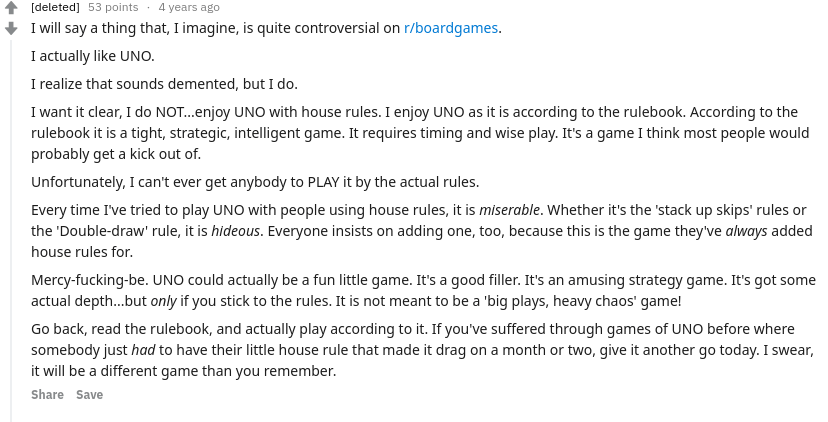
It’s not surprising that this was a heated conversation in the board games subreddit, and spawned at least one thread trying to spin the ‘positivity’ of house rules. These are things we usually only find in board and card games, because (without mods or hacking), in video games, the code simply doesn’t allow us these affordances. This is thanks to Procedural Rhetoric, where game philosophy and developer ideological visions are written into the very laws which govern how the game operates. For example, when playing UNO on the Xbox 360 (or other ports), the kinds of house rules faced by this unfortunate redditor would simply not be possible.

Screenshot 2018-07-08 at 1.10.09 AM

The code would prevent such frustrations from occuring in a the videogame version of this card classic. Even when “house rules” are allowed, they’re usually custom-made and allow only for people to enter into the game acknowledging them in advance, with no room for mid-game shifts in playstyle. Even custom games in more recent first-person shooter titles like Halo or Overwatch, lay all the custom rules upfront–people know what they’re getting into. At all stages of these custom maps or games, players are often required to choose from what the developers have already accepted as “sanctioned” deviations from the norm.

This idea of customizing game rules and house rules within board games and their video game companions brings us closer to the question of what it means to cheat in games. The implementation and adaptability of board and card game house rules are perhaps more complicated than a handful of blog entries can address, but, I think we can safely look at why and how we cheat in our games through looking at some specific videogame history and case-study-style examples via the following series:


Academic References/Further Reading from the Series:

Taking the Plunge: Leveling Up to the Silver Screen

Whether they’ve cleaned up at the box office or crashed and burned into the side of the building, video game adaptations are here to stay. What makes or breaks these adaptations?

Whether they’ve cleaned up at the box office or crashed and burned into the side of the building, video game adaptations are here to stay. What makes or breaks these adaptations?

Doom. Angry Birds, Super Mario Bros. …

https://www.youtube.com/watch?v=wtMZKYnLg5c

It’s likely you just cringed a bit…and it’s no wonder. Video game movies often get a bad rep. While the inspiration for movies and TV shows come from books at a steady pace, video game adaptations are, well…a different animal altogether. While you can have some more “faithful” versions, like Warcraft, most of the time gamers will shy away from any mention of a video game getting picked up by the non-interactive screen. Why are we so protective over our video games?

If you google most of the more well-known video game movies, you’ll come up with a relatively low bar in terms of ratings. Quite often ranging from a low 5/10 to barely stretching towards a 7/10, video games adaptations are often not rated well. Is this because video games do not easily translate well to a restricted time setting? Do we inherently expect more from video game movies than we do of book adaptations? Are video game enthusiasts just more vocal than avid book-lovers about their adaptation woes? Do the non-gamers just not take as readily to our stories?

It’s been 17 years since the original Tomb Raider films, are you ready for the new one next year?

There are countless potential questions to ask oneself about gaming movies when there has yet to be a truly breakaway success. Sure, titles like Resident Evil have made for a horse-beating franchise, but is that what governs success? It would seem to me that part of the problem with a poorer reception of video game adaptations is anticipation, and subsequently, delivery. Clearly, there’s something about these stories that television and movie producers think will yet turn a profit. With a Tomb Raider reboot on the way, alongside a The Witcher TV series in the works from Netflix, it’s hard to believe that producers are just trying to capitalize on gamer’s desires to see their games on the big screen.

Many of the video game adaptations we see made into movies are action or horror narratives. Silent HillAssassin’s CreedHitmanPrince of Persia, etc. While it may seem like the big explosion or horrific titles would garner the best reaction from audiences. Unfortunately, this has not been the case. It’s not to say that these games don’t possess the storylines to carry forward to the big screen, but perhaps it’s because their narratives are actually too big for films.

Picture this, you’ve spent 35+ hours dedicated to piecing together a video game’s storyline. Through blood, sweat, and controller-throwing tears, you’ve been an active agent in the narrative. When translated to the big screen, anticipation for this kind of experience runs too high to actually be met by any director. While some may argue that books suffer the same fate, I would suggest that while in terms of stories that are too large to be told properly on screen is true, the fact remains that there’s just something that’s missing when you’ve effectively “lived” through a game and come to see it flat on a film screen. Excited gamers often leave theaters upset that the film did not deliver the same experience in a 1.5hr timeframe that they had previously experienced in five times that at home.

Are creepy nurses as creepy when you see them on the big screen? Or more so when you have to navigate through them yourself?

Another problem often felt by video game adaptations over their literary counterparts, is that video game movies are often not judged as their own interpretation of the original storyline inspiration, but are rather criticized for their narrative liberties. Silent Hill butchered the video game’s storyline when it came to the big screen. Melding narrative elements from the first three games, and completely changing established elements in order to fit the silver screen’s demands, it was not well received by series fans.

While on its own it was not the best horror movie of the year, however, it was better than many other horror movies which were better received. The first Resident Evil was saved this critical fate either. If taken on their own without associating them to their original media sources, would they have taken less of a hit by critics? Conversely, like in Warcraft, some video game movies are criticized for assuming the audience knows too much about the video game and neglects to explain things for those who entered the theater unwittingly.

Whether writers/directors are too faithful to the original narrative, or not faithful enough, it seems as though video game adaptations just can’t catch a break. There’s some sort of je ne sais quoi that video games seem to possess that just can’t quite translate to the big screen, even when they seem as though they should. Perhaps, in the end, the timeframe is all that’s holding back adaptations from their true glory. We passionately play through our narratives for hours on end, is it any wonder that the intricacies of these stories don’t translate well to a shorter and non-interactive media?

Does The Witcher have what it takes to break the “bad video game live action” stereotype?

As The Witcher is due to be released as a series on Netflix, perhaps this will change. While many have tried to reproduce games on the big screen, fewer still have attempted live-action small screen productions. If The Witcher succeeds as a TV show, I would suspect we will see many other attempts at small screen adaptations take place. But perhaps that’s a good thing? More time to develop a narrative, and the ability to show the nuances of a game’s environment. Rather than running their heads into the same wall and hoping for different results, this time, things might actually be different.

I’m a glutton for video game movies myself, good or bad. While I don’t think many of the adaptations have been the best movies ever, I do think that they’re often not given as much credit as they deserve. I would love to see more movies cast on the big screen to see the worlds in new ways, not only to see what I already know shown in a new way. Much like what Marvel did for superhero movies, perhaps we just need someone to do it right for once, and maybe The Witcher will do just that.

If not, I’m holding out hope for a great BioShock or Mass Effect trilogy.


What do you think about video games on the live-action screen? Love them or hate them, we want to know! Join us on Discord, on our Facebook page, or Twitter and tell us your opinion.

Get in the Habit: Overwatch

The world can always use more heroes, and you’ve finally decided to become one. We’ve gathered some pro-level tips to get you on your way to saving the world in Overwatch.

The world can always use more heroes, and you’ve finally decided to become one. We’ve gathered some pro-level tips to get you on your way to saving the world in Overwatch.

Now that you’ve decided to settle in and really learn how to play Overwatch,  you realise that it’s the one-year anniversary and most of your friends have been playing for months, if not since closed beta. How do you compete? We’ve got some experienced tips and tricks to help get you caught up on everything Overwatch to get well on your way to pro.


Diversify Your Hero Roster

One of the biggest things you can do for yourself and your team is to learn as many heroes as possible, ideally one from each category (damage, defense, tank, and support). While it’s difficult to master every hero, having a selection of heroes to play will not only give you options when someone chooses your ‘main’, but will also give you an understanding of different roles required to build a proper composite group. Playing a diverse range of heroes will also help you to better understand the strengths and weaknesses of each hero and role, in addition to what some of their counters may be. Do not be afraid to play around with various heroes in a Quick Play environment in order to get a feel for which heroes you may have an affinity. Additionally, you will not likely get the swing of a given hero on your first round. It will take a few attempts before you know whether or not it’s a hero you’d like to explore. While you may find your initial set of heroes early, do be sure to return to other heroes as you learn the game more or as patches are released. You never know when you may decide you love Reaper over McCree, for example.

Learn the Maps & Modes

After you’ve played around in Quick Play or Arcade and have gotten a feel for some of the heroes at your disposal, the next step to success in-game is to really learn the maps, and I mean really learn the maps. As a flanking Reaper or Tracer, it pays to know where every health pack is and what amount of health it will give you. Healers may not always be available to top you off or even to help you survive through tough attacks, so knowing how to survive will save you during hard times. Additionally, knowing secret routes and paths to get to objectives will aid you in flanking to capture, or in preventing others from surprising you. For example, the initial objective point on Volskaya Industries has an exposed flank for highly mobile/aerial characters like Tracer, D Va, Lucio, Reaper, or Pharah to flank from. Knowing about weak points like this in your defense strategy will help you to keep eyes and potential deterrents (like turrets) from letting the enemy through. If you want the safety and time to properly explore maps, you can always make a private game for yourself and really explore things thoroughly without getting shanked from behind by Genji.

For Quick Play and Competitive gameplay, there are three main modes to learn: Payload-based, Control, and Capture. While each of these modes are simple to understand, they can take time to master. Be sure to pay attention to good groups you join in order to learn strategies for accomplishing each goal. For example, while it may be possible to attack a Capture point with two snipers, it will likely make your life more difficult than having more direct DPS in those roles. However, bear in mind that what works in Quick Play, may not hold up against Competitive teams. Reading up on game mode strategies outside of personal experience in-game can also be an asset in this regard. There are also Game Modes found exclusively in the Arcade (Capture the Flag, Brawl, 3v3, etc.), which are best encountered after learning the basics of the regular game modes, as well as after gaining experience with an array of heroes.

Customise Your Experience

After you’ve spent a great deal of time learning the heroes, maps, and game modes, you can start to customise your Overwatch experience on a more micro level. Does your mouse feel too slow when you’re playing on Tracer? Would you like a bit more control over your reticle while sniping on Widowmaker? In your heroes settings you can choose to make changes to all heroes at once, or make specific changes according to any given hero. These changes can include mouse sensitivity and keybinds, in order to make hero-switching between games or mid-match a breeze. This will also allow you to tweak character settings for one hero without damaging what you’re used to on another. While you may find that the majority of your gameplay is acceptable with a standard set of keybinds and sensitivity across the board, having access to these settings and adjusting things as necessary is an asset for mastering the game.

Tweak Your Rig

You’re wall-sliding like a pro on Lucio and tactfully setting up turrets as Trobjorn, hammering your way to glory on most of your adventures in Quick Play. When you start to feel more confident about your gameplay within the Overwatch client, it’s the time to ensure that your computer settings are giving you the best experience you can get. Tweaking both the in-game graphics and interface settings, alongside your own graphics card or game mode settings, can help get that extra little bit of response time that you may need to survive some justice from above. Take the time to read and learn what the optimal settings are for your system for Overwatch and if you have the funds available, consider investing in more performance. Overwatch is a resource-demanding game and the more power you can get out of your machine, the more immersed you’ll be able to get in the world while playing.

While not necessarily a performance-booster, if you really have money to burn and have decided to commit full-time to the game, Razer makes an entire line of Overwatch-specific peripherals that are sure to help you game in style. Not only are the peripherals cool-looking (and an upgrade to any rig), they also change colours and have different effects depending on which hero you play. Keys will also light up according to which abilities are available, or will react according to what your character is doing on-screen. Switching up the beat never looked so cool.

Stay Up to Date

Finally, you’ve learned all the skills, mastered every map, memorized every health-pack location, and have even caved and bought a fancy new Razer keyboard. Surprise, it’s patch day! Things can go haywire at a moment’s notice as heroes are changed and tweaked according to new builds that Blizzard decides to push out. Things will be buggy, overpowered, underpowered, and always frustrating at these times. Have faith and stay informed throughout the process. If you really want to stay ahead of the game (literally), keep an eye on beta news for changes that haven’t been released on the official client yet. If you have the ability, be sure to actually play on the beta test servers as well to get a feel for changes as they happen. If you feel comfortable with the game, also be sure to give constructive feedback on the characters and maps you know best in order to help maintain as much competitive fairness as can be managed. Overwatch, like many other online games today, is an ever-changing work in progress. Things will never stay static and staying on top of things will be your biggest advantage for keeping your skillset up to date. Make rumors, news, and reliable guides your best friend.


Do you have any tips and tricks for getting a head start in Overwatch? What did you find most difficult to learn when you first got started?  Let us know in our discussions and join us on Discord, on our Facebook page, or Twitter!

Why I Timewalk

Sure, the gear and vendor goods are great for a while, but what’s the real reason to keep coming back to Timewalking?

World of Warcraft has changed a lot over the past thirteen years. While some of you have been with the brand since the beginning, others have only recently come into the fold. I’ve been playing WoW since Burning Crusade, specifically, right before the “Black Temple” raid patch dropped. For a long time, I felt as though my WoW-cred was lessened for having not played since Vanilla, like so many of my compatriots, but I have increasingly been feeling my in-game age for a while, particularly thanks to Timewalking.

Longtime Azeroth citizens will likely understand this scenario. You’re going through an old raid showing a new friend your favorite encounters. While the graphics may be a little more dull, and the encounters a lot faster, you find yourself constantly spouting things like: “Well we used to have to pull the boss this way…”, “We needed four tanks for this…”, “Back in the day, you’d never get away with…”, and so on. Even running through leveling dungeons before Timewalking, I found myself making these kinds of statements, or at least conveying how much more “difficult” things used to be, be it due to player strength, gear level, or boss tuning.

Among many other things in WoW, raiding, used to feel more epic, and likely some of that was due to exclusivity. While I am all for the advancements in LFR raiding, there was something to be said for the very first time I stepped into Black Temple and stared Illidan in his blindfolded eyes. The music was building, the tensions were high, and I had no other way of seeing it than with 24 of my soon-to-be closest WoW friends. I’m glad that raiding reaches more people nowadays than it ever did, but at the same time, I can’t help but feel as though something epic about those old encounters has been lost.

Enter Timewalking. When it was released back in the expansion-that-nearly-not-be-named Warlords of Draenor during June of 2016, people were psyched. The ability to go back to old dungeons and clear them out as though we were back at level 70/80 again? Nostalgia abounded left and right, and people were lining up to get their new-old trinkets from the Timewalking vendors. As Timewalking has progressed, we’ve received the addition of Mists of Pandaria dungeons, in addition to the promise of more dungeons as the game progresses. Most recently we heard that Patch 7.2.5 will contain a new addition, Timewalking Raids, namely, Black Temple.

As fun as walking down memory lane with 4 potentially random individuals was, the prospect of Timewalking raiding is all the more enticing. While the current system allows you to queue as you would any other dungeon, Timewalking raids will behave a little differently and require a pre-formed group in order to be tackled. While I’m incredibly excited to waltz into the darkened halls of Karabor once again as my level-70 resto-shaman self, I can’t help but fear that the pre-grouping requirement will reduce the number of people running the raid during the Timewalking period, and with Timewalking only being around a limited time per month (and even more limited to get back to Burning Crusade content), it remains to be seen how Blizzard will handle the accessibility of the revisited content.

Timewalking is a unique experience unto itself in Azeroth. At once, those of us who have been a part of the story since the dawn (or nearly) of the title get to experience a wave of nostalgia through mimicked past experiences. Comparatively, new players bear witness to content long gone and yet experienced anew. Many newer players I’ve spoken with about Timewalking love the system and thoroughly enjoy being able to experience the older content at a relative difficulty, after missing it when it was “current”.

While I play for the nostalgia, and the ability to use all of my pre-Legion legendaries again, I also Timewalk to show my newer friends the “old” days, rather than just talk about it. New experiences and old memories collide in the “Halls of Stone.” I watch my group members perform old mechanics (because in Timewalking they kinda matter) in “The Shattered Halls”. I remember how much I hated doing the challenge mode version of “Shadowpan Monastery” all over again. Awash with emotion when they’re here, and all the more grateful they’re not around all the time, Timewalking dungeons are straight out of the Timeless Isle. Something ephemeral that drifts in and out of view. Shifting faces and eras as it guides us to look back and remember.

While some people run them for their normal-current raid tier box, I’m sure there are plenty of others who play like me, who relive the past through these encounters, and queue with bittersweet thoughts in mind. While the shiny loot is great, it’s the experiences that keep us coming back. Black Temple Timewalking will likely not bring me back to my bright-eyed days as a young shaman, but I can dream, and I can remember.


Why do you Timewalk? Or do you not participate at all? Let us know in the comments below, or join in the conversation on Facebook, Twitter, or Discord.

Streaming, Not Just For Shows

We stream everything else, why not stream your video games too?

We stream everything else, why not stream your video games too?

Streaming video, whether it be through YouTube, Twitch, Netflix, or Hulu, has already become a staple of most households in some fashion, whether or not you’re particularly tech-savvy or not. Smart TVs and other streaming-primed devices make slipping into a world of internet based media all the easier for the average media consumer. But what about video games?

It seems like the video game industry is trying to “Blockbuster” the brick and mortar game stores.

Digital downloads of video games are no new feature of the tech industry. We’ve been legally downloading video games since the early 2000’s when internet bandwidth finally allowed for users to access their content without taking forever. While the technology existed in the 1980’s, the downloading of video games was severely hindered by internet technology. As our bandwidths have grown, companies have increasingly transitioned to distributing their content to us via the internet.

When was the last time you bought a physical version of a non-Nintendo title? While discs are available for the newest generations of consoles, downloading of titles directly from console stores has been around for the Xbox 360/PlayStation for three years, and has only grown in popularity. So much so, that rather than downloading a game on the PS4, you are now able to stream titles from the gaming cloud.

Much like Netflix, services like PlayStation’s “PlayStation Now”, gamers will be able to stream their favorite PlayStation exclusive titles from various console generations, all for a subscription fee. What’s perhaps best of all, is that this streaming service also extends to PC gamers, effectively bridging a very wide gap for many budget-based players. Such services would allow players to enjoy PlayStation titles without having to purchase the system or game themselves.

Myself, I originally purchased an Xbox 360 in the previous generation of consoles and proceeded to trick it out with every game I came across. As a result, when the prices dropped for the PlayStation 3, after the launch of the PlayStation 4, I had limited incentive to purchase the PS3, as many of the games I desired I already owned on the Xbox 360. Exclusives are not always enough to buy an entire console for, I discovered. However, a service like PlayStation Now, would allow me to play a series like The Last of Us, that I’ve been coveting for years, in addition to older titles I may never have purchased for my now-dusty PlayStation 2. While the benefits seem endless on paper, don’t throw your discs away into the Boston Harbor or cancel your game downloads just yet.

While there are loads of great potentials to these new game delivery methods, drawbacks remain. Xbox One’s streaming service, the “Xbox Game Pass”, for example, only allows players to stream titles on an Xbox One console, losing out on one of the great features of the PlayStation Now service. Conversely, PlayStation Now currently only offers older generation games, while the Xbox Game Pass offers current-gen titles. Much like paying for different TV shows or movies from streaming media providers, perhaps differences like these are par for the course?

Gamers will likely need to seek various methods in order to gain access to the titles they want. In the same vein, there’s also the issue of streaming services removing titles. We’ve seen it happen countless times with Netflix or Hulu – your favorite show is pulled before you have a chance to binge-watch it a third time. Could you imagine the outrage a gamer would face when losing access to a game they’ve slowly picked away at, just before they finally got to get all of their achievements or to beat the game at all? I shudder to think of the technology what would be destroyed that day.

We stream everything else, why not video games?

Similarly, rage could easily settle in for gamers who face the buffering boss. While we can all accept that buffering occurs in online media streaming, are we ready to face unavoidable lag caused by streaming our games? Streaming services not only need their own networking technology up to snuff, but also require players to have solid connections on their own end. Additionally, let us not forget that some countries have data caps on their internet services, and large amounts of high-quality streaming may actually be impossible without emptying the bank over internet services.

Is it all worth it? Depending on your origin console of choice, internet access, and spare money, maybe. PlayStation Now currently offers one-month memberships, three-month memberships, and annual memberships. One month costs $19.99 US vs. $100 for the year. Comparatively, the Xbox Game Pass costs $9.99 US for unlimited access to their streaming games library. Depending on what you want out of the streaming service, it can be a great investment. However, on paper, it certainly seems like PlayStation Now has some catching up to do, at least on price-to-product value delivery purely based on the subscription fee. However, if you’re a primarily PC gamer like myself, and want to check out some PlayStation 3 games you missed out on in the previous console generation, it’s the perfect opportunity to explore.

In a world of constant connection, how does video game streaming affect those with limited internet access?

There’s a lot of potential for game streaming services as they continue to be developed on current-gen consoles. While there are a lot of kinks to work out, we can hope to see the development of Netflix-quality level distribution as time goes forward. It may be too much to hope that a single service could acquire rights for digital streaming distribution (i.e. through Steam), but we can at least hope that developers look at their competition and work to bring desirable features to their own brands.

Xbox could take a page from PlayStation’s book, and bring older titles alongside PC access for their streaming services, while PlayStation ought to lower its price and add current-gen titles to their streaming library. Either way, I’m keeping my bandwidth open, and my eyes peeled for streaming developments. And who knows, maybe the next title I get to immerse myself in will be The Last Of Us after all.

[poll id=”5″]


How do you feel about video game streaming? Let us know in the comments below, or hit us up on Discord, on our Facebook page, or Twitter!

Getting the Most from Windows 10 Game Mode

We tinker with Microsoft’s newest ‘game mode’ added to Windows 10, can it help make your gaming rig the best it can be?

We tinker with Microsoft’s newest ‘game mode’ added to Windows 10, can it help make your gaming rig the best it can be?

I’ll admit it, my system is currently still running Windows 7. Over the years since 8 was released, and now 10, I haven’t really found the need or desire to swap systems. Windows 7 has always offered everything I wanted for my gaming rig, in addition to having control over things and a lack of “apps” on a PC. That being said, Windows 10’s new ‘game mode’ has me questioning whether or not it might be time to take that leap into Microsoft’s double digits and see what the newest software can really do. Hang out a little longer to find out why.

Windows has been a long-standing staple of computer-based gaming. While some titles wander over to MacOS or Linux machines, Windows carries lion’s share of the marketplace. And while it existed before Windows 95, the interface and Windows that we have come to know and love really only started since Windows 95. If you managed to last through all the clips contained in the above-linked YouTube video (my favorite is the last one), you can see what a turning point they thought Windows 95 was to it’s more Mac-looking predecessors. A new era of gaming and Windows was born.

It’s hard to think that the Windows interface we know and love started out over 20 years ago. How far have we come?

So with just over 20 solid gamer-representin’ years under their belt, Microsoft has decided to address their lions and launch their ‘game mode’ for Windows 10. The operating system, which went live in July of 2015, has received a mixed array of comments over the months since it’s initial release, including criticism of its stealth OS upgrades which happened to a large portion of unwitting users. While a lot of that mess is behind them, Microsoft is trying to hold onto its image and keep its market favour, likely in hopes that developers don’t decide to suddenly make the gaming market a bit more even. Enter, game mode.

Back in January of this year, Microsoft announced on its developer blog that it was going to be improving the gaming and streaming tools available to its consumers, boasting increased performance, fan-requested features, and beam streaming to roll out over 2017.

“Whether you play on Xbox One, a Windows 10 PC, your mobile phone, or anywhere you sign-in with Xbox Live, we’re going to make your gaming experiences easier, more social, and better with innovative hardware and software features throughout the year.”

With all the goodies Microsoft purported to be planning for this gaming improvement, many people appeared to be rather excited. However, back in January, very little was actually said by Microsoft about what they had in store, other than “increased performance” for gaming. As users started to gain access to the fledgling mode since late January, opinions have been mixed about whether or not the mode actually helps to optimize your system for increased gaming performance. Basically, the mode is designed to turn your computer more into a console-type hardware experience, in that, it will prioritize your CPU and video card usage to focus on the game you’re playing, rather than those pesky background tasks. We all leave things like Chrome, Discord, or iTunes open while playing games (if your PC can handle it of course), and game mode purport to help make sure those programs are only taking as much juice as they absolutely need to function. Their goal at launch was to target your frame rates and provide a smoother gameplay experience, no matter what the title.

After turning on game mode, you’ll be able to pull up a very Xbox-looking interface over your currently active game UI, in order to enable or disable the improvements. As the video above describes, Microsoft was also toying with the idea of letting games turn on this mode automatically, ensuring an even more seamless user-experience. While it may not provide that much of a boost now, its current installment may help bridge the gap between playable and non-playable games, for less robust PC setups, as RandomGamingHD states in their YouTube video “Does the New Window 10 ‘Game Mode’ Improve Gaming Performance.” Microsoft themselves have said that it is exactly these lower-end systems that they want game mode to help the most.

Source: PCGamesN

RandomGamingHD’s conclusions, like many others we’ve reviewed, came to the optimistic conclusion that while game mode might not quite be where it needs to be yet, it genuinely offers an integrated potential for improving gaming, especially when you need to squeeze the last drop of power you can from an aging rig. After following Microsoft’s progression through the years, I’m excited to see what they’ve learned from console production, and operating system development, to see how they will continue to meld them together over the calendar year.

While Windows 10 gaming mode may only offer small tweaks and improvements at this time, it has Windows 10 skeptics like me intrigued about the possibility of a PC running optimally for gaming, rather than it being an afterthought. If the mode is perfected and improved upon over the coming months, you may see myself and others like me, switching to reap the benefits.

There are always countless ways to tweak your Windows performance manually, but game mode might not quite offer you the bang you’re looking for, yet. I intend to keep an eye on what Microsoft has in store for gaming and Windows, and I suggest you do too. After all, even 5 more frames, can make all the difference.

 [poll id=”4″]

Have you used Windows 10’s game mode? Will you ever? Are you a min/max gamer or do you just pray to the technology gods that your computer will turn on, let alone allow you to play anything? Join in the conversation below on Discord, on our Facebook page, or Twitter!

There’s Only So Much Time in the World (of Warcraft): AP & You

From pet battles, to PVP, to end-game raiding content, there’s always something to do in World of Warcraft. But is that becoming a problem? The new artifact power system has hindered a longstanding past-time in-game, namely, alt-play. Have you felt the burn?

It all seems well and good. Each new artifact weapon is laden with lore and excitement. You’re encouraged to explore every avenue of story (even if you don’t fully read it) as you progress your character. For lore buffs and altoholics, this makes alt-leveling seem all the more APpealing. But that, of course, is before you see the endless sea of grinding that you have to do to get them up to snuff in the current grind that is artifact power.

Hello, fellow gamers. I’m Shebalo, and I’m an altoholic.

I’ve had alts for years. Ever since Wrath of the Lich King and some untimely real-life issues, I spent a great deal of time in front of the screen. I’ve continued to roll over each of my alts to the next level cap as a new expansion became available. Some expansions have seen easier alt progression than others, but for the most part, getting them to max level and caught up to a useful amount of power wasn’t all that difficult. I have fond memories of how easy it was to gear freshly minted 90s with Mists of Pandaria‘s Timeless Isle gear. Bind on Account bundles of joy helped make even the meekest alt into, well, at least a slightly less meek creature. Some 500 days played across this one server (not including alts which have been deleted over time), and I might finally be reaching my wit’s end. As you can see, I currently have five level-110 characters, with none seriously contending for sixth place. Why is that you may ask? Namely, artifact power and catch-up difficulties.

Catch-up mechanics do exist, but they’re not as helpful as you may think.

I gained access to the highest level artifact research available pretty quickly when the option was released in Patch 7.1.5. All of my alts were happily whisked away to the land of high levels of AP gain, and it was wonderful…for a time. While the initial boost of AP gain is great for alts to catch up to basic levels of talent tree progression, the fact remains that there’s still quite a distance to be covered to get beyond the 30~ talent range (pre-7.2). Additionally, the current patch has changed such that the next set of traits and artifact knowledges decrease the incentive to grind out AP, making it even harder to catch up in a shorter period of time. While there are certain AP “chunks” available (Mythic Plus 10 or higher, some World Quests, Broken Shore special table quests, etc.), most of us are left wanting for a better method of AP acquisition before reaching to the new research levels. As of right now, in short, it just doesn’t feel worth it.

AP scaling before 7.2 source

While we wait for more artifact research to be available on our mains, many of us are finding ourselves farming for a resource with very minimal return for the time invested. While this will improve with time, there’s more going on with the AP requirements than just a lack of return for what we’re putting into it, and that’s player burnout. One of the main reasons I stopped curating my alts this expansion was the inundation of grinding I’m facing on my main. As a mythic raider, it constantly feels like I’m behind on things I need to stay on top of in order to squeeze that extra percent out of my weapon or gear. While the need to farm Mythic Plus dungeons isn’t there yet so far this patch, I know the time is coming. The fact remains that I, like so many in my guild and others that I’ve spoken with, faced that grind in the previous patches in order to attain the coveted 54th point. We slaved for weeks, for hours, often neglecting more “fun” things to do in game, in order to achieve min/max success. Was it worth it? I don’t really know. Bosses die, parses are had, but in the end, many of us look at a new grind with disdain—whether it be the new traits on our mains, or the original ones on our alts. When rolling an alt in Legion, you need to re-grind your AP (with some tome help at least if your main has high research completion), your reps, your gear, and your class campaign. While endless content is great for mains, it puts alts in a chokehold, and there’s very little to help alts out in categories outside of basic AP assistance and easily acquirable but Bind-on-Pickup items on the Broken Shore.

Some people just want to watch the world (of Warcraft) burn.

My alts, like your alts, will live on in time. While the daunting tasks of AP farming and alt catch-ups are ominous at this time, if you like alts, chances are you’ll eventually come back around to them. This could happen during the inter-expansion lull, during a guild hiatus, or even perhaps due to class-breaking changes on your main. Alts exist for a reason, and even if you may just be exploring them for the first time this expansion, there is hope. Blizzard continuously cites a desire to help alts this expansion, after repeated requests from the playerbase. Let’s hope they continue to listen, and continue to help. I have a lot of lore to soak up through my alts this expansion, and I’ll dance my way through the burnout, even if it kills me.


How are you dealing with AP requirements and burnout? Do you feel like it’s still relevant to farm, or are you biding your time doing other things until artifact research catches up? Let us know in the comments below, on Facebook, Twitter, or Discord!

Notified: Alerted or Annoyed?

Information overload is an increasingly difficult thing for contemporary individuals in our connected technologically-driven society. We each deal with this bombardment of information differently – how do you stack up?

Information overload is an increasingly difficult thing for contemporary individuals in our connected technologically-driven society. We each deal with this bombardment of information differently – how do you stack up?

Jane wants to go to the mall, Billy just liked your latest Instagram post, Barrie is going live on Twitch, and your boss just emailed you yet another schedule change. Four notifications pop up on your phone, begging you to click on their strips of information, do you? The latest news on your favorite TV show, more patch notes for World of Warcraft, or rumors of the next Google phone. So many different avenues of notifications to pop up on your phone or computer at any given time, that it stands to reason that they cannot all be equally effective in their goals at gaining our attention.

We all like to stay up to date on what’s most important to us in our daily lives. Our friends, our hobbies, our choice methods of entertainment. Apps and websites know this too. They continually throw information at us left and right, regardless of whether or not it’s something we actually want to see. Comment on that one post from that former group member you kinda became friends with? Now you’re receiving every other message someone posts on the same thread. Sometimes it’s relevant, sometimes it’s not–quite often, it’s just white noise amongst everything else.

How many screens do you need to keep up?

Many people have become adept in sifting through the news they want to hear, or at the very least, grow accustomed to the onslaught of information they receive on a daily basis, enough to figure out what they want from their personal news highway. I know for myself, it’s a constant struggle to dismiss every notification that I can justifiably get rid of. Every little motivational comment from FitBit or news about my favorite band coming to town is pretty much instantly set to automatically be blocked by my phone before I even see them.

Other applications, like Instagram, Snapchat, or Discord, are allowed to (mostly) peek their notifications on to my screen as available. I will usually swipe them away pretty quickly, however, in efforts to keep my screen clear. I never let emails or notifications on Facebook sit too long without being cleared, regardless of how thoroughly I actually read the messages upon initial opening. In the end, it’s more important for me to acknowledge that something wants my attention and file it away than it is to leave it to sit there as a constant reminder that there’s something else I could be doing.

In-game, or out of game, notifications are pretty much everywhere.

It’s not that I don’t want to address everything that comes up on my screen. I want to stay up to date and in communication with as many of the important things and people in my life as possible, but when it comes down to it, I just don’t have the time. And the not-so-surprising fact is, neither do you. I swipe away notification after notification in hopes that I will have more time to go back and treat each one individually with more depth and care than I could in that moment. Leaving it to sit on my screen for hours (days, weeks or even months as some of my friend’s trigger-worthy mailboxes sit), does not help me accomplish that goal.

I’ve spoken to many people on this subject over past few months since this topic has really started to itch itself in the back of my mind – much like that one annoying Facebook thread that you only half need to keep track of, but seems to be the most bumpin’ thing online this week. My friends and family alike have nearly, without fail, fallen into two groups: the annoyed and the alerted.

The annoyed, like myself, will do whatever they can to keep their screens clear of pop-ups and numbers, putting the brunt of the effort onto their brains to remember who to contact, what to go back to, and more. The alerted individuals, on the other hand, keep everything open until they’ve had a chance to deal with it. Most commonly this has to do with text messages, news alerts, etc. that end up showing up throughout the day. If it hasn’t been dealt with yet, it doesn’t go away. People’s inboxes grow and grow to 800+ unread emails in this category, often without blinking an eye. They still need to be looked at, right?

In the end, both camps probably absorb the same amount of information and have the same amount of response rate to those stimuli, when averaged out over large groups. My point is by no means to make one camp stand above the other, but rather to draw attention to the world in which we live, and the different coping mechanisms we have all incorporated to try and reduce the amount of information overload we receive daily.

Is “Reflect and Review” a new app I can install?

We often seek gaming as an escape from the madness of everyday life. The chance to kill something big and reap the benefits, or at the very least, to blow off some steam and chill with friends in an environment that is all our own. It’s easy to forget that these worlds are not devoid of the same information chaos we have in our real lives daily, and to forget the importance of stepping back and reassessing how we manage what information we take in in-game and IRL. Is it more important for you to live in a quieter world where you address things when you have the time, or do you need the reminder staring at you in order to address what’s important?

Where do you stand? Are you annoyed by the notifications you receive daily or are you simply alerted by them?

[poll id=”3″]

Would you have it any other way? Let us know in our discussions and join us on Discord, on our Facebook page, or Twitter!

Heroines of Warcraft: Magical Maidens Edition

This week, In honor of Women’s History month, we conclude our heroines series with two of the most powerful mages Azeroth has ever known.

This week, In honor of Women’s History month, we conclude our Heroines series with two of the most powerful mages Azeroth has ever known.

MAGNA AEGWYNN, GUARDIAN OF TIRISFAL

“I was facing dangers far worse than that little twerp of a demon when your great-grandparents were infants.” – Cycle of Hatred, 209

Aegwynn was one of five human apprentices under Guardian Magna Scavell, and was the only woman. They often goaded her, trying to dissuade her from her studies to be a wizard. She persevered, despite their antics, and went on to master the Meitre scrolls, great ancient Highborne magic documents left behind nine thousand years before Aegwynn’s classes. These scrolls were often left for human mages at the end of their training, and even most elven mages didn’t even look at the scrolls until their tenth year. This accomplishment ensured her place in line as the next Guardian of Tirisfall, following Scavell. Her peers complained, but the council insisted that she was best suited for the job. She spared no time in getting started as Azeroth’s next Guardian once she was given the powers of the Tirisfalen.

For 500 years she stood steadfast against demons and ill turns of fate for the globe before she came to meet Sargeras, or at least his avatar. In Northrend, she battled a group of demons which were attacking dragons there. Near the ashes of the burned demons, arose the avatar of Sargeras. The dragons rose to her aid, and combined, they defeated the avatar, or so she thought. Unbeknownst to her, Sargeras’ essence had sealed itself within her. This battle would come to set the many paths of Azeroth and Draenor’s denizens into the events which would ultimately comprise the Warcraft titles, as well as World of Warcraft today.

Current Legion model for the Avatar of Sargeras

Unknowingly imbued with the Dark Titan’s powers, Aegwynn grew arrogant following the historic battle. She turned her back on the council and its ways, deciding that it would be she who would determine her successor, not the council. After this decision was made, Aegwynn disappeared and became increasingly distant from human affairs. She used her magic powers to extend her life, and elude various traps and trackers set out by the council, in efforts to reel her in. Eventually, Aegwynn came to Karazhan, a tower of solace she had built and kept secret for a long time. Eventually, the mages found her, and she was forced to escape into the shattered remains of Suramar, where she would remain for over two hundred and fifty years.

About seventy years before the start of the World of Warcraft timeline, Aegwynn emerged from her solitude as she knew she would have to find a successor for her powers. Still determined to prevent the council any say in where those powers went, she ultimately chose to consort with Nielas Aran. This union would result in the birth of Medivh (Keeper of Secrets in Highborne), a well-known figure in the minds of current World of Warcraft players for his association with Karazhan dungeon/raid and the Black Morass dungeon, where players relive the opening of the Dark Portal, which brought Orcs to Azeroth from Draenor. But Medivh’s story is not our focus today.

In giving birth to Medivh, the essence of Sargeras passed into his body, freeing her from its influence alongside the loss of her Guardian abilities. When he reached maturity, Sargeras’ plan for Medivh began to reveal itself. Aegwynn tried to warn King Llane about the impending invasion by the orcs, however, now lacking the powers of a Guardian, she knew there was very little else she could do for Azeroth. She took to her refuge and intended to die away from the peoples of Azeroth – a goal which was frequently interrupted. Once, events caused her to revive her fallen son after his corruption had passed, and two, when Jaina Proudmoore located her and beseeched her help in hunting a herd of thunder lizards. In this quest, Jaina and Aegwynn were sealed away by Aegwynn’s old foe and narrowly escaped. Aegwynn sacrificed most of herself by imbuing Jaina with her essence, in order to escape the demon who trapped them. Afterward, she accepted an advisor position along Jaina’s side, under the premise that her true identity never be revealed. Some players have speculated her presence within World of Warcraft in either the characters of Pained or Tabetha.

LADY JAINA PROUDMOORE

“You can control the winds as a shaman. But the winds of war are blowing, and if we do not stop Garrosh now, many innocents will pay the price for our hesitation.” – Tides of War 

Lady Jaina Proudmoore has been a prominent figure throughout Warcraft and World of Warcraft‘s titles. Jaina is the youngest of Admiral Daelin Proudmoore of Kul Tiras, a human naval empire, and ally to Lordaeron before the First War. Jaina grew up in the ranks of human nobility and after demonstrating significant magical prowess at a young age Jaina edged her way into the student ranks at Dalaran, under Antonidas. Like Aegwynn, she too was one of the few female wizards studying at the time. Throughout her studies, she struggled to maintain focus on magic, alongside her royal responsibilities. Through these responsibilities, she would be ultimately matched with then Prince Arthas. While they maintained a friendship, their impending union was questioned by Arthas, and caused them to go their separate ways in order to focus on themselves first.

As naturally happens in tragic stories, the Third War broke out and Jaina was sent to investigate the Plague in Lordaeron’s kingdom. It is during this time that the events of Warcraft III take place, and where ultimately Arthas would be turned into the Lich King. While she fought alongside Arthas as long as she could, ultimately he was turned and she was forced to abandon his side after the events at Stratholme.

Following the events at Stratholme, Jaina found herself sent by a mysterious prophet (aka Medivh) to Kalimdor, where at first she did battle with the orcs there. When she came upon Thrall and Caine, the three were prevented from fighting upon interference from the prophet/Medivh. Due to this encounter, Thrall and Jaina became allies and would share a mutual respect for many years to come.

Eventually, Jaina would come to found the city of Theramore, one of the only Alliance points on the continent of Kalimdor, outside of the Night Elf zones. Jaina continued to be a force throughout Wrath of the Lich King as we saw her diplomacy after the events of the Wrathgate, throughout the exploration of Ulduar, and finally the battle against the Lich King. When retrieving the item “Jaina’s Locket” following the defeat of the Lich King, Jaina weeps for what was left of Arthas inside the Lich.

“You spit on mercy? Then you will have NONE. You want carnage?! Garrosh will get more blood than EVER he bargained for!” – Jaina, following destruction of Theramore

As events have continued to unfold for Jaina throughout World of Warcraft, she has continued to see defeats and betrayals on behalf of the Horde and the Kirin Tor. Following the destruction of Theramore by Garrosh Hellscream in Mists of Pandaria, Jaina was forever changed. In retaliation, she tried to urge Stormwind onto war, but they refused. The Kirin Tor of Dalaran too remained steadfast in their neutral ambitions. Her last blow was to nearly drowned Orgrimmar with her water elementals. Thrall attempted to stop her but failed and it was Kalcegos who ultimately did. While her rage was ultimately tempered, she purged the Blood Elves from Dalaran after learning that they had helped the Horde, despite the Kirin Tor’s neutrality.

This hatred and feelings of betrayal would only hasten through the events of Warlords of Draenor and early Legion. While Jaina has been missing since the early days of the most recent expansion, there remains a large amount of speculation over what her return to the story will bring alongside her. Will we see the rise of Kul Tiras? Will Jaina return to being a diplomatic figure in our eventual trip to Argus?

After so much pain and struggle in her life, much like Sylvannas, is it any wonder Jaina was finally pushed to her breaking point? It remains to be seen what will come of her in patches to come, however, she remains one of the strongest female figures still active in the game today. Let us hope, she saves herself from the darkness which has swept away Sylvannas.


What do you think about the power and stories of the mages we discussed today? How have you enjoyed our spotlight WoW women spotlight this month? Let us know your insights, theories, and comments in the comments below, on Facebook, Twitter, or our Discord.