

The Legacy of Cheat Codes & The Game Genie

In order to truly understand the how and the why of cheating in videogames we need to look back at some of the earliest examples, namely the inclusion of cheat codes or inputs alongside off-brand cheating systems, like the Game Genie.

81hglu5s7ml-_sx342_
The original console command system.

Perhaps one of the earlier, and most well-known of these sanctioned cheat codes created by developers was the Konami code, or the Contra code, first ‘discovered’ in the original NES Contra game. This code, ↓ → → B A START, was found not only within this title, but also within other Konami games, hence earning it’s primary title as the “konami” code. Later it later became a staple of ‘gamer’ culture, appearing in non-Konami games, on clothing, and other paraphernalia. How does a code, one that gave players a mere 30 extra lives, an official cheat-system, gain such a cultural traction? It wasn’t just Contra and Konami games either that featured cheat codes like these in the earlier days of console gaming. Sonic 2, featured a level-select option within the ‘sound test’ section of the options menu, among other choices like debug mode or unlimited lives. Even games like Disney’s Aladdin featured a level-select mode on its Option menu, mirroring the style of the Konami code: A, C, A, C, A, C, A, C, B(x4).

While cheat codes were primarily instituted by game developers for playtesting purposes (having unlimited lives is a really good idea if your job is to potentially find glitches via death in Sonic), they were clearly never taken out of a wide array of games. Alongside the question of the popularity of cheat codes, we can similarly ask why these were left in at all by the developers? In the case of games like Sonic 2 or Aladdin, level-select was a very useful option for players who had beat the game a number of times and didn’t want to “work their way through” again, only to get to their favourite level. Lacking a cartridge save option, something that would be later included with Sonic 3, it made sense for players to have access to these kinds of perks, after being “in the know” to find them. That being said, Sonic 3 continued the tradition of cheat codes and still had its fair share of cheats.

It also wasn’t just thanks to the great sleuthing of early videogame fans that we found out about these codes either, in the pre-launch and early years of the internet. Participating in cheat code culture in social circles, scribblings in the back of Blockbuster rental copy game books, and even licenced game magazines like Nintendo Power, or even strategy guides, often included these to help other gamers find them. Soon after, the pseudo-mythological state of the cheat code was born, and it felt like everyone was on the lookout for the next one they could share with their friends, or fellow rentee.

Official codes weren’t the only things that players found in efforts to modify their gaming experiences at this time. The discovery of glitches, exploits, and in-game skips were also common inclusions in this realm of “cheating” and modification. I can remember playing the original Pokemon Blue and learning about the different ways I could cheat the code and glitch it into giving me things like unlimited pokeballs or items, alongside even getting a Mew super early in the game. A lot of these kinds of glitches, the Mew nonwithstanding, required access to other Gameboys or different bits of technology to get them to work. Following clever-use-of-game-mechanics (as Blizzard loves to label it), players could flash-restart, controller switch, or cartridge remove-replace their way to a whole array of new things that were very much part of the original code, even if not used as intended.

pokemon-red-blue-yellow-mew
Fancy meeting mew here.

Unlike learning that Mario can skip a bunch of worlds by dropping behind a white block in Super Mario Bros. 3 and using some fancy flute play, these kinds of glitches were off the books, even if their inclusion in the game was somewhat ‘intentional.’ We can take this to the next level at this point, to consider once again the Game Genie, and perhaps it’s odd and sanctioned cousin, Sonic & Knuckles.

The Game Genie was a 3rd party development released for a number of the early consoles, including the NES, SNES, Gameboy, and Sega Genesis. The device came with a book of codes which allowed players to cheat their way through a variety of games through the Game Genie’s bypass system. Essentially, because the device acted as a mediator between player, console, and cartridge, it allowed for the system to read the game code emitting from the cartridge differently from its actual output, allowing for the player to reap the benefits. In addition to the codes that shipped with the device, players were able to create their own codes by random generation, or even could subscribe for updates via a paid service. It was quite an era for cheating. However, it should come as no surprise that Nintendo in particular fought back hard against the system, trying to claim it infringed on copyright. The legal case settled in Game Genie’s favour, however, and their ‘unsanctioned’ cheats were safe.

In contrast, Sega was in full support of the system, as long as it didn’t provide cheats for games which allowed for saving. Sega’s approach to software circumvention adds an interesting layer to an analysis of cheating in videogames, as it again suggests that cheat codes, even unsanctioned ones, were meant to help players bypass unwanted content when saving along the way was not an option. It’s unsurprising that they followed this ideology, as Sonic & Knuckles allowed for players to have a pseudo-sanctioned version of the Game Genie already. The cartridge had a slot on the top which was intended for players to insert only Sonic games into it, allowing Knuckles to join the fray of Sonic 2 and others. Instead, it also allowed for players to have randomly-generated Chaos Emerald stages in the Sonic 3 style based on the code of nearly any Sega game that was inserted.

aqg1dwlhj9sx
Sonic & Knuckles stacked with Sonic 3 to create Sonic 3 & Knuckles

More commonly today, we see these kinds of cheats available through ROM-hacking emulators, console commands (PC), or unofficial patching/editing by the savvy game community. Further still, all of this so far has been related to software or “soft” cheating and modding of videogames, not even considering the hardware or “hard” modification, which requires going in and tweaking the actual hardware in order to run things you weren’t intended to. While there isn’t time to discuss this fully here, it’s interesting to consider again that by virtue of their design, videogames require an entirely different kind of systems for modification than their board game cousins. After all, it’s easy enough to make up your own pieces for a board game versus wanting to play N64 games on your Xbox 360. Yet again, there are also often more legal issues surrounding hardmodding, as we saw recently with Nintendo and modding chips.

While it’s becoming increasingly rare to see “official” cheat codes in video games (except in the case of games like The Sims, though more on that in a later blog), we do see the inclusion of console commands and the ability to modify games through “mods” available instead. We’ll look into this realm of modding and cheating later, but it highlights something within the gaming community: we can’t let games be. As soon as a game is released, especially for current systems, we are continually seeing them adapted, cracked, modified, and eviscerated by the community so that the original intended experience is no longer the only one we have access to. Why does there seem to be such an essential ‘need’ to cheat?


Academic References/Further Reading:

Bogost, Ian. Persuasive Games: The Expressive Power of Video Games (2010)

(Video)Games: A Need to Cheat

Along with the idea of fairness comes its necessary complement: cheating. Cheating is what someone does to give him/herself a more than even chance to win. At least, that’s what we most often call cheating.

When I happen to notice you attempting to draw universal attention to my little cheat, I am aware that the motivation for your sudden intensity stems not as much from your concern that I have broken a rule as from your feeling that I have  somehow deprived you of your opportunity to win…

It is obvious that your concern with my cheating is biased in your behalf. If I’m doing something wrong, even if I’m in flagrant violation of the rules of the game, as long as you perceive yourself as winning, everything’s cool (Koven 24-25).

To what lengths will you go to win, to succeed, to overcome the technical rules of whatever game you’re playing to get a little bit of an advantage? Would it make a difference if the game enabled you to accomplish this task via embedded cheat codes? What do we make of sanctioned cheating vs. unsanctioned cheating? What if you don’t even know you’re circumventing the rules-as-intended?

When playing board or card games with friends, we already know the routine. Often “house rules” need to be established alongside “legitimate” ones, because we seem to have a predisposition to change games as they’re presented to us. We demand that our friends and family reveal their house rules before a game even begins, lest we find out mid-way through that people are actually not on the same page. What happens when you land in free parking in Monopoly? I’m sure we’d be very divided on the answer. “Wait, that’s cheating!” we’d be inclined to say, when our peers reveal themselves to be playing an entirely different game than us, while all looking at the same board. Some strange parallel reality where someone jumps up and stops you from buying a house on your second pass of “GO” in Monopoly.

phoenix-wright-objection

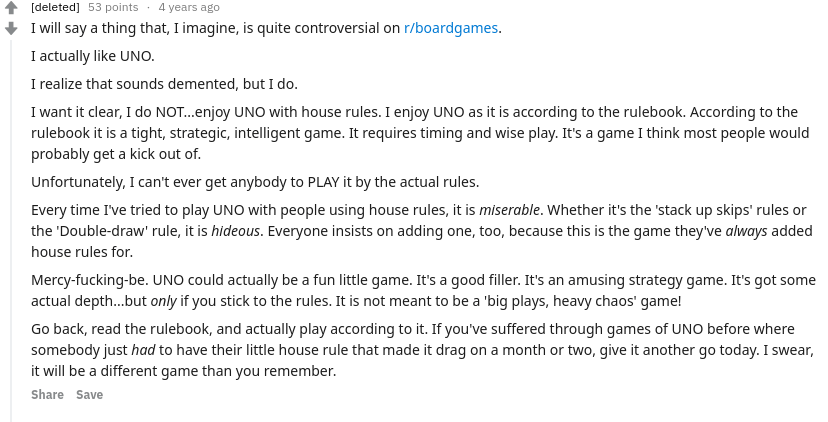
It’s not surprising that this was a heated conversation in the board games subreddit, and spawned at least one thread trying to spin the ‘positivity’ of house rules. These are things we usually only find in board and card games, because (without mods or hacking), in video games, the code simply doesn’t allow us these affordances. This is thanks to Procedural Rhetoric, where game philosophy and developer ideological visions are written into the very laws which govern how the game operates. For example, when playing UNO on the Xbox 360 (or other ports), the kinds of house rules faced by this unfortunate redditor would simply not be possible.

Screenshot 2018-07-08 at 1.10.09 AM

The code would prevent such frustrations from occuring in a the videogame version of this card classic. Even when “house rules” are allowed, they’re usually custom-made and allow only for people to enter into the game acknowledging them in advance, with no room for mid-game shifts in playstyle. Even custom games in more recent first-person shooter titles like Halo or Overwatch, lay all the custom rules upfront–people know what they’re getting into. At all stages of these custom maps or games, players are often required to choose from what the developers have already accepted as “sanctioned” deviations from the norm.

This idea of customizing game rules and house rules within board games and their video game companions brings us closer to the question of what it means to cheat in games. The implementation and adaptability of board and card game house rules are perhaps more complicated than a handful of blog entries can address, but, I think we can safely look at why and how we cheat in our games through looking at some specific videogame history and case-study-style examples via the following series:


Academic References/Further Reading from the Series:

Get in the Habit: Overwatch

The world can always use more heroes, and you’ve finally decided to become one. We’ve gathered some pro-level tips to get you on your way to saving the world in Overwatch.

The world can always use more heroes, and you’ve finally decided to become one. We’ve gathered some pro-level tips to get you on your way to saving the world in Overwatch.

Now that you’ve decided to settle in and really learn how to play Overwatch,  you realise that it’s the one-year anniversary and most of your friends have been playing for months, if not since closed beta. How do you compete? We’ve got some experienced tips and tricks to help get you caught up on everything Overwatch to get well on your way to pro.


Diversify Your Hero Roster

One of the biggest things you can do for yourself and your team is to learn as many heroes as possible, ideally one from each category (damage, defense, tank, and support). While it’s difficult to master every hero, having a selection of heroes to play will not only give you options when someone chooses your ‘main’, but will also give you an understanding of different roles required to build a proper composite group. Playing a diverse range of heroes will also help you to better understand the strengths and weaknesses of each hero and role, in addition to what some of their counters may be. Do not be afraid to play around with various heroes in a Quick Play environment in order to get a feel for which heroes you may have an affinity. Additionally, you will not likely get the swing of a given hero on your first round. It will take a few attempts before you know whether or not it’s a hero you’d like to explore. While you may find your initial set of heroes early, do be sure to return to other heroes as you learn the game more or as patches are released. You never know when you may decide you love Reaper over McCree, for example.

Learn the Maps & Modes

After you’ve played around in Quick Play or Arcade and have gotten a feel for some of the heroes at your disposal, the next step to success in-game is to really learn the maps, and I mean really learn the maps. As a flanking Reaper or Tracer, it pays to know where every health pack is and what amount of health it will give you. Healers may not always be available to top you off or even to help you survive through tough attacks, so knowing how to survive will save you during hard times. Additionally, knowing secret routes and paths to get to objectives will aid you in flanking to capture, or in preventing others from surprising you. For example, the initial objective point on Volskaya Industries has an exposed flank for highly mobile/aerial characters like Tracer, D Va, Lucio, Reaper, or Pharah to flank from. Knowing about weak points like this in your defense strategy will help you to keep eyes and potential deterrents (like turrets) from letting the enemy through. If you want the safety and time to properly explore maps, you can always make a private game for yourself and really explore things thoroughly without getting shanked from behind by Genji.

For Quick Play and Competitive gameplay, there are three main modes to learn: Payload-based, Control, and Capture. While each of these modes are simple to understand, they can take time to master. Be sure to pay attention to good groups you join in order to learn strategies for accomplishing each goal. For example, while it may be possible to attack a Capture point with two snipers, it will likely make your life more difficult than having more direct DPS in those roles. However, bear in mind that what works in Quick Play, may not hold up against Competitive teams. Reading up on game mode strategies outside of personal experience in-game can also be an asset in this regard. There are also Game Modes found exclusively in the Arcade (Capture the Flag, Brawl, 3v3, etc.), which are best encountered after learning the basics of the regular game modes, as well as after gaining experience with an array of heroes.

Customise Your Experience

After you’ve spent a great deal of time learning the heroes, maps, and game modes, you can start to customise your Overwatch experience on a more micro level. Does your mouse feel too slow when you’re playing on Tracer? Would you like a bit more control over your reticle while sniping on Widowmaker? In your heroes settings you can choose to make changes to all heroes at once, or make specific changes according to any given hero. These changes can include mouse sensitivity and keybinds, in order to make hero-switching between games or mid-match a breeze. This will also allow you to tweak character settings for one hero without damaging what you’re used to on another. While you may find that the majority of your gameplay is acceptable with a standard set of keybinds and sensitivity across the board, having access to these settings and adjusting things as necessary is an asset for mastering the game.

Tweak Your Rig

You’re wall-sliding like a pro on Lucio and tactfully setting up turrets as Trobjorn, hammering your way to glory on most of your adventures in Quick Play. When you start to feel more confident about your gameplay within the Overwatch client, it’s the time to ensure that your computer settings are giving you the best experience you can get. Tweaking both the in-game graphics and interface settings, alongside your own graphics card or game mode settings, can help get that extra little bit of response time that you may need to survive some justice from above. Take the time to read and learn what the optimal settings are for your system for Overwatch and if you have the funds available, consider investing in more performance. Overwatch is a resource-demanding game and the more power you can get out of your machine, the more immersed you’ll be able to get in the world while playing.

While not necessarily a performance-booster, if you really have money to burn and have decided to commit full-time to the game, Razer makes an entire line of Overwatch-specific peripherals that are sure to help you game in style. Not only are the peripherals cool-looking (and an upgrade to any rig), they also change colours and have different effects depending on which hero you play. Keys will also light up according to which abilities are available, or will react according to what your character is doing on-screen. Switching up the beat never looked so cool.

Stay Up to Date

Finally, you’ve learned all the skills, mastered every map, memorized every health-pack location, and have even caved and bought a fancy new Razer keyboard. Surprise, it’s patch day! Things can go haywire at a moment’s notice as heroes are changed and tweaked according to new builds that Blizzard decides to push out. Things will be buggy, overpowered, underpowered, and always frustrating at these times. Have faith and stay informed throughout the process. If you really want to stay ahead of the game (literally), keep an eye on beta news for changes that haven’t been released on the official client yet. If you have the ability, be sure to actually play on the beta test servers as well to get a feel for changes as they happen. If you feel comfortable with the game, also be sure to give constructive feedback on the characters and maps you know best in order to help maintain as much competitive fairness as can be managed. Overwatch, like many other online games today, is an ever-changing work in progress. Things will never stay static and staying on top of things will be your biggest advantage for keeping your skillset up to date. Make rumors, news, and reliable guides your best friend.


Do you have any tips and tricks for getting a head start in Overwatch? What did you find most difficult to learn when you first got started?  Let us know in our discussions and join us on Discord, on our Facebook page, or Twitter!

Why I Timewalk

Sure, the gear and vendor goods are great for a while, but what’s the real reason to keep coming back to Timewalking?

World of Warcraft has changed a lot over the past thirteen years. While some of you have been with the brand since the beginning, others have only recently come into the fold. I’ve been playing WoW since Burning Crusade, specifically, right before the “Black Temple” raid patch dropped. For a long time, I felt as though my WoW-cred was lessened for having not played since Vanilla, like so many of my compatriots, but I have increasingly been feeling my in-game age for a while, particularly thanks to Timewalking.

Longtime Azeroth citizens will likely understand this scenario. You’re going through an old raid showing a new friend your favorite encounters. While the graphics may be a little more dull, and the encounters a lot faster, you find yourself constantly spouting things like: “Well we used to have to pull the boss this way…”, “We needed four tanks for this…”, “Back in the day, you’d never get away with…”, and so on. Even running through leveling dungeons before Timewalking, I found myself making these kinds of statements, or at least conveying how much more “difficult” things used to be, be it due to player strength, gear level, or boss tuning.

Among many other things in WoW, raiding, used to feel more epic, and likely some of that was due to exclusivity. While I am all for the advancements in LFR raiding, there was something to be said for the very first time I stepped into Black Temple and stared Illidan in his blindfolded eyes. The music was building, the tensions were high, and I had no other way of seeing it than with 24 of my soon-to-be closest WoW friends. I’m glad that raiding reaches more people nowadays than it ever did, but at the same time, I can’t help but feel as though something epic about those old encounters has been lost.

Enter Timewalking. When it was released back in the expansion-that-nearly-not-be-named Warlords of Draenor during June of 2016, people were psyched. The ability to go back to old dungeons and clear them out as though we were back at level 70/80 again? Nostalgia abounded left and right, and people were lining up to get their new-old trinkets from the Timewalking vendors. As Timewalking has progressed, we’ve received the addition of Mists of Pandaria dungeons, in addition to the promise of more dungeons as the game progresses. Most recently we heard that Patch 7.2.5 will contain a new addition, Timewalking Raids, namely, Black Temple.

As fun as walking down memory lane with 4 potentially random individuals was, the prospect of Timewalking raiding is all the more enticing. While the current system allows you to queue as you would any other dungeon, Timewalking raids will behave a little differently and require a pre-formed group in order to be tackled. While I’m incredibly excited to waltz into the darkened halls of Karabor once again as my level-70 resto-shaman self, I can’t help but fear that the pre-grouping requirement will reduce the number of people running the raid during the Timewalking period, and with Timewalking only being around a limited time per month (and even more limited to get back to Burning Crusade content), it remains to be seen how Blizzard will handle the accessibility of the revisited content.

Timewalking is a unique experience unto itself in Azeroth. At once, those of us who have been a part of the story since the dawn (or nearly) of the title get to experience a wave of nostalgia through mimicked past experiences. Comparatively, new players bear witness to content long gone and yet experienced anew. Many newer players I’ve spoken with about Timewalking love the system and thoroughly enjoy being able to experience the older content at a relative difficulty, after missing it when it was “current”.

While I play for the nostalgia, and the ability to use all of my pre-Legion legendaries again, I also Timewalk to show my newer friends the “old” days, rather than just talk about it. New experiences and old memories collide in the “Halls of Stone.” I watch my group members perform old mechanics (because in Timewalking they kinda matter) in “The Shattered Halls”. I remember how much I hated doing the challenge mode version of “Shadowpan Monastery” all over again. Awash with emotion when they’re here, and all the more grateful they’re not around all the time, Timewalking dungeons are straight out of the Timeless Isle. Something ephemeral that drifts in and out of view. Shifting faces and eras as it guides us to look back and remember.

While some people run them for their normal-current raid tier box, I’m sure there are plenty of others who play like me, who relive the past through these encounters, and queue with bittersweet thoughts in mind. While the shiny loot is great, it’s the experiences that keep us coming back. Black Temple Timewalking will likely not bring me back to my bright-eyed days as a young shaman, but I can dream, and I can remember.


Why do you Timewalk? Or do you not participate at all? Let us know in the comments below, or join in the conversation on Facebook, Twitter, or Discord.

There’s Only So Much Time in the World (of Warcraft): AP & You

From pet battles, to PVP, to end-game raiding content, there’s always something to do in World of Warcraft. But is that becoming a problem? The new artifact power system has hindered a longstanding past-time in-game, namely, alt-play. Have you felt the burn?

It all seems well and good. Each new artifact weapon is laden with lore and excitement. You’re encouraged to explore every avenue of story (even if you don’t fully read it) as you progress your character. For lore buffs and altoholics, this makes alt-leveling seem all the more APpealing. But that, of course, is before you see the endless sea of grinding that you have to do to get them up to snuff in the current grind that is artifact power.

Hello, fellow gamers. I’m Shebalo, and I’m an altoholic.

I’ve had alts for years. Ever since Wrath of the Lich King and some untimely real-life issues, I spent a great deal of time in front of the screen. I’ve continued to roll over each of my alts to the next level cap as a new expansion became available. Some expansions have seen easier alt progression than others, but for the most part, getting them to max level and caught up to a useful amount of power wasn’t all that difficult. I have fond memories of how easy it was to gear freshly minted 90s with Mists of Pandaria‘s Timeless Isle gear. Bind on Account bundles of joy helped make even the meekest alt into, well, at least a slightly less meek creature. Some 500 days played across this one server (not including alts which have been deleted over time), and I might finally be reaching my wit’s end. As you can see, I currently have five level-110 characters, with none seriously contending for sixth place. Why is that you may ask? Namely, artifact power and catch-up difficulties.

Catch-up mechanics do exist, but they’re not as helpful as you may think.

I gained access to the highest level artifact research available pretty quickly when the option was released in Patch 7.1.5. All of my alts were happily whisked away to the land of high levels of AP gain, and it was wonderful…for a time. While the initial boost of AP gain is great for alts to catch up to basic levels of talent tree progression, the fact remains that there’s still quite a distance to be covered to get beyond the 30~ talent range (pre-7.2). Additionally, the current patch has changed such that the next set of traits and artifact knowledges decrease the incentive to grind out AP, making it even harder to catch up in a shorter period of time. While there are certain AP “chunks” available (Mythic Plus 10 or higher, some World Quests, Broken Shore special table quests, etc.), most of us are left wanting for a better method of AP acquisition before reaching to the new research levels. As of right now, in short, it just doesn’t feel worth it.

AP scaling before 7.2 source

While we wait for more artifact research to be available on our mains, many of us are finding ourselves farming for a resource with very minimal return for the time invested. While this will improve with time, there’s more going on with the AP requirements than just a lack of return for what we’re putting into it, and that’s player burnout. One of the main reasons I stopped curating my alts this expansion was the inundation of grinding I’m facing on my main. As a mythic raider, it constantly feels like I’m behind on things I need to stay on top of in order to squeeze that extra percent out of my weapon or gear. While the need to farm Mythic Plus dungeons isn’t there yet so far this patch, I know the time is coming. The fact remains that I, like so many in my guild and others that I’ve spoken with, faced that grind in the previous patches in order to attain the coveted 54th point. We slaved for weeks, for hours, often neglecting more “fun” things to do in game, in order to achieve min/max success. Was it worth it? I don’t really know. Bosses die, parses are had, but in the end, many of us look at a new grind with disdain—whether it be the new traits on our mains, or the original ones on our alts. When rolling an alt in Legion, you need to re-grind your AP (with some tome help at least if your main has high research completion), your reps, your gear, and your class campaign. While endless content is great for mains, it puts alts in a chokehold, and there’s very little to help alts out in categories outside of basic AP assistance and easily acquirable but Bind-on-Pickup items on the Broken Shore.

Some people just want to watch the world (of Warcraft) burn.

My alts, like your alts, will live on in time. While the daunting tasks of AP farming and alt catch-ups are ominous at this time, if you like alts, chances are you’ll eventually come back around to them. This could happen during the inter-expansion lull, during a guild hiatus, or even perhaps due to class-breaking changes on your main. Alts exist for a reason, and even if you may just be exploring them for the first time this expansion, there is hope. Blizzard continuously cites a desire to help alts this expansion, after repeated requests from the playerbase. Let’s hope they continue to listen, and continue to help. I have a lot of lore to soak up through my alts this expansion, and I’ll dance my way through the burnout, even if it kills me.


How are you dealing with AP requirements and burnout? Do you feel like it’s still relevant to farm, or are you biding your time doing other things until artifact research catches up? Let us know in the comments below, on Facebook, Twitter, or Discord!

Heroines of Warcraft: Magical Maidens Edition

This week, In honor of Women’s History month, we conclude our heroines series with two of the most powerful mages Azeroth has ever known.

This week, In honor of Women’s History month, we conclude our Heroines series with two of the most powerful mages Azeroth has ever known.

MAGNA AEGWYNN, GUARDIAN OF TIRISFAL

“I was facing dangers far worse than that little twerp of a demon when your great-grandparents were infants.” – Cycle of Hatred, 209

Aegwynn was one of five human apprentices under Guardian Magna Scavell, and was the only woman. They often goaded her, trying to dissuade her from her studies to be a wizard. She persevered, despite their antics, and went on to master the Meitre scrolls, great ancient Highborne magic documents left behind nine thousand years before Aegwynn’s classes. These scrolls were often left for human mages at the end of their training, and even most elven mages didn’t even look at the scrolls until their tenth year. This accomplishment ensured her place in line as the next Guardian of Tirisfall, following Scavell. Her peers complained, but the council insisted that she was best suited for the job. She spared no time in getting started as Azeroth’s next Guardian once she was given the powers of the Tirisfalen.

For 500 years she stood steadfast against demons and ill turns of fate for the globe before she came to meet Sargeras, or at least his avatar. In Northrend, she battled a group of demons which were attacking dragons there. Near the ashes of the burned demons, arose the avatar of Sargeras. The dragons rose to her aid, and combined, they defeated the avatar, or so she thought. Unbeknownst to her, Sargeras’ essence had sealed itself within her. This battle would come to set the many paths of Azeroth and Draenor’s denizens into the events which would ultimately comprise the Warcraft titles, as well as World of Warcraft today.

Current Legion model for the Avatar of Sargeras

Unknowingly imbued with the Dark Titan’s powers, Aegwynn grew arrogant following the historic battle. She turned her back on the council and its ways, deciding that it would be she who would determine her successor, not the council. After this decision was made, Aegwynn disappeared and became increasingly distant from human affairs. She used her magic powers to extend her life, and elude various traps and trackers set out by the council, in efforts to reel her in. Eventually, Aegwynn came to Karazhan, a tower of solace she had built and kept secret for a long time. Eventually, the mages found her, and she was forced to escape into the shattered remains of Suramar, where she would remain for over two hundred and fifty years.

About seventy years before the start of the World of Warcraft timeline, Aegwynn emerged from her solitude as she knew she would have to find a successor for her powers. Still determined to prevent the council any say in where those powers went, she ultimately chose to consort with Nielas Aran. This union would result in the birth of Medivh (Keeper of Secrets in Highborne), a well-known figure in the minds of current World of Warcraft players for his association with Karazhan dungeon/raid and the Black Morass dungeon, where players relive the opening of the Dark Portal, which brought Orcs to Azeroth from Draenor. But Medivh’s story is not our focus today.

In giving birth to Medivh, the essence of Sargeras passed into his body, freeing her from its influence alongside the loss of her Guardian abilities. When he reached maturity, Sargeras’ plan for Medivh began to reveal itself. Aegwynn tried to warn King Llane about the impending invasion by the orcs, however, now lacking the powers of a Guardian, she knew there was very little else she could do for Azeroth. She took to her refuge and intended to die away from the peoples of Azeroth – a goal which was frequently interrupted. Once, events caused her to revive her fallen son after his corruption had passed, and two, when Jaina Proudmoore located her and beseeched her help in hunting a herd of thunder lizards. In this quest, Jaina and Aegwynn were sealed away by Aegwynn’s old foe and narrowly escaped. Aegwynn sacrificed most of herself by imbuing Jaina with her essence, in order to escape the demon who trapped them. Afterward, she accepted an advisor position along Jaina’s side, under the premise that her true identity never be revealed. Some players have speculated her presence within World of Warcraft in either the characters of Pained or Tabetha.

LADY JAINA PROUDMOORE

“You can control the winds as a shaman. But the winds of war are blowing, and if we do not stop Garrosh now, many innocents will pay the price for our hesitation.” – Tides of War 

Lady Jaina Proudmoore has been a prominent figure throughout Warcraft and World of Warcraft‘s titles. Jaina is the youngest of Admiral Daelin Proudmoore of Kul Tiras, a human naval empire, and ally to Lordaeron before the First War. Jaina grew up in the ranks of human nobility and after demonstrating significant magical prowess at a young age Jaina edged her way into the student ranks at Dalaran, under Antonidas. Like Aegwynn, she too was one of the few female wizards studying at the time. Throughout her studies, she struggled to maintain focus on magic, alongside her royal responsibilities. Through these responsibilities, she would be ultimately matched with then Prince Arthas. While they maintained a friendship, their impending union was questioned by Arthas, and caused them to go their separate ways in order to focus on themselves first.

As naturally happens in tragic stories, the Third War broke out and Jaina was sent to investigate the Plague in Lordaeron’s kingdom. It is during this time that the events of Warcraft III take place, and where ultimately Arthas would be turned into the Lich King. While she fought alongside Arthas as long as she could, ultimately he was turned and she was forced to abandon his side after the events at Stratholme.

Following the events at Stratholme, Jaina found herself sent by a mysterious prophet (aka Medivh) to Kalimdor, where at first she did battle with the orcs there. When she came upon Thrall and Caine, the three were prevented from fighting upon interference from the prophet/Medivh. Due to this encounter, Thrall and Jaina became allies and would share a mutual respect for many years to come.

Eventually, Jaina would come to found the city of Theramore, one of the only Alliance points on the continent of Kalimdor, outside of the Night Elf zones. Jaina continued to be a force throughout Wrath of the Lich King as we saw her diplomacy after the events of the Wrathgate, throughout the exploration of Ulduar, and finally the battle against the Lich King. When retrieving the item “Jaina’s Locket” following the defeat of the Lich King, Jaina weeps for what was left of Arthas inside the Lich.

“You spit on mercy? Then you will have NONE. You want carnage?! Garrosh will get more blood than EVER he bargained for!” – Jaina, following destruction of Theramore

As events have continued to unfold for Jaina throughout World of Warcraft, she has continued to see defeats and betrayals on behalf of the Horde and the Kirin Tor. Following the destruction of Theramore by Garrosh Hellscream in Mists of Pandaria, Jaina was forever changed. In retaliation, she tried to urge Stormwind onto war, but they refused. The Kirin Tor of Dalaran too remained steadfast in their neutral ambitions. Her last blow was to nearly drowned Orgrimmar with her water elementals. Thrall attempted to stop her but failed and it was Kalcegos who ultimately did. While her rage was ultimately tempered, she purged the Blood Elves from Dalaran after learning that they had helped the Horde, despite the Kirin Tor’s neutrality.

This hatred and feelings of betrayal would only hasten through the events of Warlords of Draenor and early Legion. While Jaina has been missing since the early days of the most recent expansion, there remains a large amount of speculation over what her return to the story will bring alongside her. Will we see the rise of Kul Tiras? Will Jaina return to being a diplomatic figure in our eventual trip to Argus?

After so much pain and struggle in her life, much like Sylvannas, is it any wonder Jaina was finally pushed to her breaking point? It remains to be seen what will come of her in patches to come, however, she remains one of the strongest female figures still active in the game today. Let us hope, she saves herself from the darkness which has swept away Sylvannas.


What do you think about the power and stories of the mages we discussed today? How have you enjoyed our spotlight WoW women spotlight this month? Let us know your insights, theories, and comments in the comments below, on Facebook, Twitter, or our Discord.

Heroines of Warcraft: The Windrunners Edition

In honor of Women’s History month, we are running a series surveying the lore and history surrounding some of Azeroth’s most notable heroines and figures. This week, we look into one of the most prominent and skillful ranger families in Azeroth’s history.

In honor of Women’s History month, we are running a series surveying the lore and history surrounding some of Azeroth’s most notable heroines and figures. This week, we look into one of the most prominent and skillful ranger families in Azeroth’s history.

Whether you play Horde or Alliance, you’ll know the surname Windrunner, notably attached to Lady Sylvanas. The current Warchief of the Horde, and long-standing Banshee Queen of the Undead, Sylvanas is but one of three sisters from the Windrunner family. A high-elf family of high repute, the Windrunner dynasty touts one of the most tragic familial stories in Warcraft lore. Now spread between the Alliance and the Horde, the family’s legacy for producing the best rangers in Azoerth’s history lives on in its surviving members.

ALLERIA WINDRUNNER

“There is no problem. The Alliance wants every orc dead. So do I. We can work together on that.” ~ Alleria in Beyond the Dark Portal

Alleria is the oldest of the three Windrunner sisters and has served both the High Elf faction, as well as the Alliance throughout her longstanding career as a ranger. As early as the Second War, she aided Lordaeron and its King in defending the city against the invasion of the Horde. Alleria held the belief that the Horde would be a threat to the kingdom of Quel’Thalas, unlike many of her kind, leading her to send rangers to Southshore to help bolster defenses there. She continued helping the Alliance, working closely with Khadgar and Turalyon in the defense of Silvermoon.

She fought alongside her sister Sylvanas and successfully protected their home city. Unfortunately, this battle saw a change in Alleria, and she came to see Orcs as vermin. As a result, she hunted down as many of the Bleeding Hollow clan as she could find. She pursued them all the way through the Dark Portal. The conflict on the other side of the Dark Portal resulted in large-scale destruction in Outland, in their efforts to protect Azeroth. They successfully closed the portal from Draenor but were forced to leap into the Twisting Nether in order to avoid dying with the planet. While many survived this leap, and journeyed to Honor Hold or were able to return to Azeroth, Alleria was not heard of in-game until she was uncovered in the Broken Isles, alongside her husband Turalyon.

Before leaving to fight in Outland, Alleria had her prize necklace (a gift from her parents containing a ruby, an emerald, and a sapphire) broken down and split between herself and her two sisters, giving the ruby to Vareesa, and the sapphire to Sylvanas. While she was presumed dead for many years, her memory lived on throughout the cultures of both Outland and Azeroth, and in both the factions. In Stormwind, there remains a statue of Alleria, inscribed:

“Renowned Troll Hunter of Quel’Thalas. Lead Scout and Intelligence Agent for the Alliance Expedition that marched into the orc homeworld Draenor. Presumed deceased. Your Heart flew straight as any arrow upon the wind, sister. You were the brightest of our Order. You were the most beloved of our kin. – Sylvanas Windrunner – Ranger General of Quel’Thalas.”

VERESSA WINDRUNNER

Vereesa Windrunner, much like her eldest sister, continues to fight alongside the Alliance. The youngest of the Windrunner sisters, she helped Rhonin in destroying the Demon Soul and freeing Alexstraza–a mission which would bring Vereesa and Rhonin together in love. She also served as Alliance Ambassador, touring the Alliance and reminding them of fears beyond orcs. She was one of the few well-known survivors of the plague which destroyed Lordaeron, Dalaran, and Quel’Thalas after the rise of Arthas as the Lich King.

“Quel’Thalas is as much my home as it is yours and I would not see it fall to our ancient enemy.” ~ With my bow, I have shot orcs dead at a hundred yards. I have battled trolls, demons, and more. I have nearly traveled the length and breadth of Azeroth…yes my love, I think I can handle the situation until Jalia arrives.” ~ Vereesa in War of the Ancients 1: The Well of Eternity

Many years later, Vereesa would also help Jaina Proudmoore in the defense of Theramore in the days before its destruction by Garrosh Hellscream using what he dubbed the Mana Bomb. In this battle, Vereesa lost Rhonin, as he sacrificed himself to save Jaina as the future of the Kirin Tor. His actions also spared Kalecgos, Vereesa, Shandris Feathermoon, and a number of scouting parties.

Before Garrosh’s betrayal, Vereesa could be found in the Violet Citadel of Northrend’s Dalaran, alongside Rhonin, as the leader of the Silver Covenant. The militant high elf group stood in opposition to the inclusion of the blood elves into the Kirin Tor at the time. She has been actively involved in player quests within World of Warcraft ever since, including the uncovering of Alleria’s whereabouts. Most recently, she aided in the founding of the Unseen Path, the Hunter order hall, in Legion.

LADY SYLVANAS WINDRUNNER, THE BANSHEE QUEEN

The middle of the Windrunner sisters, Sylvanas is probably the most well-known to Warcraft players, even outside of World of Warcraft. She featured prominently in Warcraft III and has ever since been a tragic tale within the game series’ lore. In Warcraft III, players experience both Sylvanas’ time as Ranger-General of Silvermoon, a military leader of all high elf forces, but also her fall to Arthas in the city’s defense. This failure would lead to her corruption by the Lich King into the Banshee Queen, a creature under his thrall for a long duration of the war.

Eventually, the Lich King began losing control over his minions, and in this time Sylvanas regained her free will. She plotted against him with the help of other Undead who had regained their free will, alongside the Nathrezim. While she failed at her attempted assassination of the Lich King, she eventually took over what was left of Lordaeron for herself, renaming it “The Undercity”.

During this time, an official story had been touted by the elves of Silvermoon – namely that Sylvanas had perished in the great fire which had ensorcelled most of the city during the attack by the Scourge. After breaking free from the control of the Lich King, she eventually founded a dark order of rangers and began building the Forsaken and collecting other minions which would serve her along the way.

Even in death, Sylvanas still considers herself to be a protector of Quel’Thalas. When the Blood Elves came to World of Warcraft, in Burning Crusade, she opened the Undercity to them when the Alliance refused. She brokered their admission into the Horde shortly thereafter, despite the fears of the Blood Elves after so many years detesting the faction.

Sylvanas has been involved a lot of questionable behaviors since Wrath of the Lich King and many lore enthusiasts find themselves questioning her end-goals and background motivations. Following events like the “Battle for the Undercity”, the production of the Forsaken Blight, and most recently, her attempt to enslave a Val’kyr in Stormheim, Sylvanas continues to be a character of intrigue.

While she is now Warchief of the Horde, her story is filled with tragedy and bloodshed – both within her family and without. While her love for her family remained, she has struggled to maintain any degree of relationship with them, Vereesa in particular. At one point, she and Vereesa plotted to assassinate former Warchief Garrosh, lacing his meal with an untraceable poison. Following this Vereesa debated joining her sister in the leadership of the Forsaken, despite leaving her children behind to do so. However, Sylvanas realized that the Forsaken would not accept a living creature in their leadership, and began planning to murder her sister in order to raise her as an Undead. Vereesa eventually relented and warned the Alliance of the attempted poisoning, thus severing ties with her sister once more. This betrayal affected Sylvanas greatly.

Lore enthusiasts and in-game characters alike have also begun questioning Sylvanas’ behavior as of late, as she continues to be further changed. Following a battle against Gilneas, Sylvanas is killed by Lord Godfrey. She was ushered to Shadowfang Keep where three of her Val’kyr sacrifice themselves in order to raise her, ultimately leading to Sylvanas’ plan for a new Forsaken future. This was the second time Sylvanas has died since becoming the Banshee Queen, the first being her suicide following the death of the Lich King, by throwing herself from Icecrown Citadel. Here too, she was raised by Val’kyr–ones which sought a place by her side. After each foray with death, and finding that it will find her no comfort, she has become markedly more selfish, vicious, and cold as the story moves forward.

While an entire article can be written on Sylvanas and her story, she is without a doubt one of the most tragic and formidable women in Warcraft’s history. It’s hard to imagine that if any of us were faced with what she has, that we would not choose the same paths for ourselves. “The Forsaken’s ruthless leader is a formidable champion of her people. But with the Burning Legion invasion, the stakes for the Dark Lady have never been higher. Should Sylvanas perish, her demise will be the beginning of her eternal damnation. All that stands between her and this doom are her Val’kyr, yet few of these spirit guardians remain. As her fate edges closer to the abyss, Sylvanas must decide how far she’ll go to protect her people and whether they’re more precious to her than her soul.” ~ World of Warcraft official website “Heroes & Villains: A World Divided”


What do you think about the Windrunner sisters? Is Sylvanas as shady as she seems these days or is there more we have yet to uncover? Do you believe she’s still sympathetic or has simply gone off the rails after visiting death one too many times? Let us know in the comments below or join in the conversation on Facebook, Twitter, and in our Discord.

Heroines of Warcraft: Around the Well of Eternity Edition

This week, we visit the Well of Eternity…

In honor of Women’s History month, beginning March 8th, we’ll be running a series of editorials surveying the lore and history surrounding some of Azeroth’s most notable heroines and figures. This week, we visit the Well of Eternity…

In World of Warcraft: Chronicle Volume 1, we were told that the night elves came about as a race descendant from dark trolls who found their way to the Well of Eternity. At the Well, they discovered Elune and would be forever changed. Through the twisting powers of the arcane font, the trolls were transformed into Night Elves, or Kal’dorai “Children of the Stars”. From that race would be born many strong leaders and figures who have come to make their mark on World of Warcraft lore, good and evil alike. Their notoriety has reached beyond just Warcraft and has found its way into countless tie-in novels, and other Blizzard titles. Let’s take a closer look.

QUEEN AZSHARA

“It was during this era of unprecedented growth that the night elves’ most prolific leader came to power. Her name was Queen Azshara. Through her unbridled ambition, she would elevate her peolpe to extraordinary new heights…and sow the seeds of their destruction” – World of Warcraft Chronicle: Volume 1, 94

Many people have known and been defeated by the Burning Legion. Queen Azshara, however, is the only one (that we’re aware of) to look at them as an opportunity to find greater power, and an equal in the Dark Titan Sargeras.

It’s not surprising given Queen Azshara’s position within the Kal’dorei world. They adored her—perhaps a little too much to be considered outside the realm of a spell. She was powerful and people fell at her feet. Those who disobeyed were met with exile and steep punishment. She was born with golden eyes, something the Kal’dorei believed would predict greatness in her. While her greatness and ambition brought about the War of the Ancients (and the initial attack of the Burning Legion 10,000 years before the game starts), her fate was not sealed that day.

As the Well of Eternity exploded at the hands of rebellious Night Elves during the Great Sundering and the water rushed around her, the Old Gods whispered to her and offered her more power. More importantly, the power to survive. Azshara accepted and was twisted into a Naga along with her followers. She would continue her efforts for power and domination secretly below the waves of Azeroth’s tremulous seas.

A grand sorceress even before the Old Gods gave her more power, Azshara’s motives remain unknown at this time. She pops up briefly during our trip through Azuna, but we’ve seen little direct contact with their agents since Cataclysm. It raises the question of what she may be up to, now that her would-be consort Sargeras has come knocking on Azeroth’s door?

TYRANDE WHISPERWIND

“For her part, the priestess Tyrande emerged as one of the greatest members of the Sisterhood of Elune…In time, Tyrande would be come the high priestess of Elune, the revered leader of her sacred Sisterhood.” – World of Warcraft Chronicle: Volume 1, 100

Born of the same generation as Azshara, Tyrande remains the modern-day Night Elf faction leader of what remained after the Great Sundering. A former general for the sentinels, she has remained in power ever since Azshara fell below the waves. Along with her mate Malfurion Stormrage, she helped to transform the Night Elf people and their ways, in efforts to repair their civilization, and to purge it from behaviours which they believed had drawn the Burning Legion to Azeroth in the first place: Arcane magics.

As part of this, Tyrande was forced to ban Arcane magics used within the Night Elf civilization. This population of scattered elves was comprised of the victorious rebels under Tyrande’s forces, as well as those who had seen the light after following Azshara, and wished for things to return to normal. Many of Azshara’s former followers had been grand masters of the arcane and struggled with leaving the spell-type behind. They began practicing their arts in secret, but were eventually uncovered. Initially their sentence was death, but Tyrande proved slightly more lenient and instead exiled them. This group would eventually become the High Elves, and later the Blood Elves we know today.

Tyrande has been a major feature in pretty much every major battle since the Great Sundering, including in the original Warcraft III title. She was paramount in the Battle of Mount Hyjal, in helping with the Scourge Invasion, and is an ongoing presence in the struggle for Azeroth’s survival since the launch of World of Warcraft. Most recently, after the events in Val’sharah, Tyrande has aided players in taking back the Nightborne city of Suramar in the questlines leading to the launch of the Nighthold raid.

Despite so much tragedy, Tyrande stands as a beacon for her people—as steadfast as a sentinel, and beaming with the light of Elune. Few characters have seen as much as she in 10,000 years, and further few still who would continue to push forward in faith of a better tomorrow for Azeroth and their people.


GRAND MAGISTRIX ELLISANDE 

“Grand Magistrix Elisande, feared that the Legion did not have the Highborne’s best interests in mind. The monstrous demons had already destryoed much of the night elves’ glorius empire and poisoned the surounding land with their fel magics. Elisande’s distrust of the Legion only deepened…” – World of Warcraft Chronicle: Volume 1 – 103

We see very little of Grand Magistrix Elisande in comparison to the others on this list. While Queen Azshara herself has graced the pixels of World of Warcraft even less than Elisande, her presence and her story were more widely spread. Unsurprising given her legacy. Elisande, on the other hand, has an equally important story to tell.

When we see Elisande in the most recent expansion, she is pushed to the edge. Having rebelled 10,000 years ago in order to save her people, she sealed herself and her followers away in a prison of their own making. Saved from the Legion and the Great Sundering, yet forced to live in a never-ending cycle of what they had already built. No room to expand, no fresh water, or fresh food to sustain themselves, they were forced to live from the Nightwell’s energies alone and changed into the Nightborne. While her initial actions came out of a distrust of Azshara’s motives and the Burning Legion, she ultimately found herself in much the same position she originally rebelled against. After 10,000 years in solitude, Gul’dan breached the barrier surrounding the city with little effort. Shaken, Elisande was given three days to chose whether to allow the Legion in or face destruction. By now, I’m sure you know the rest.

When you face Elisande in the Nighthold raid, however, she is remorseful at the end of the battle. Rather than kill her, she offers us her aid in defeating the Legion. Having taken the only course she believed would save her people, much like she had done before the Great Sundering, Elisande becomes a sympathetic character. She was not out for power, nor for taking the Nightwell for herself. Like Tyrande, she was only interested in saving what she could before the Legion took everything else. She succeeded to some degree, but at what cost? We have an expansion to learn what help Elisande may or may not provide in fighting the Legion as time goes on from our encounter with her.


Do you have any favourite Night Elves, Nightborne, or Highborne? Let us know in the comments below, or join the conversation on Facebook, Twitter, or our forums!

Heroines of Warcraft: They Came Before Edition

In honor of Women’s History month, beginning March 8th, we’ll be running a series of editorials surveying the lore and history surrounding some of Azeroth’s most notable heroines and figures.

In honor of Women’s History month, beginning March 8th, we’ll be running a series of editorials surveying the lore and history surrounding some of Azeroth’s most notable heroines and figures.

EONAR, THE LIFE-BINDER

“No one knows when or why the first titan awoke, but legends hold that his name was Aman’Thul” – World of Warcraft Chronicle: Volume 1, 19

One of the earliest notable female figures in Azeroth’s history comes from a time before history was even known on Azeroth; possibly before even Azeroth itself. Hailing from the race of celestial wanderers, the Titans, Eonar is the only confirmed female titan. While there are some in-game and fan theories suggesting that Azeroth too may be a female, Eonar was at least the first.

Awakened by Aman’Thul, the Highfather, Eonar would become his bronze-skinned consort. She carried an alabaster staff through the cosmos as she stood vigilant as the protector of life, nature, and healing in the universe. She often kept from the field of battle, preferring a supporting role in the great Titan Pantheon. If brought to fight, she remained a fierce force who would confuse and disperse her enemies before engaging them. She stood in opposition to the dark Titan Sargeras, and aided the Pantheon in combating him until her ultimate demise at his hand.

Eonar also spent a great deal of time establishing the titanforged which would one day nurture Azeroth, in addition to empowering the naturally-occurring life which Azeroth itself created, namely, the dragons. While Eonar was defeated, her essence and gifts lived on in the populations of Azeroth. She is worshiped where her memory remains, including both the great red and green Dragonflights, which tasked themselves with combating chaos and destruction, while maintaining nature, healing, and life, within the world.

Some hypothesize a connection between Eonar and Elune, as well as the Tauren’s Earthmother, as all three share many common threads of beliefs and traits; however, at this time, we have no formal notes from Blizzard about how these entities are connected.

ALEXSTRASZA, THE LIFE-BINDER & DRAGONQUEEN

“The nurturing and ever-merciful Freya called upon her creator, Eonar, to empower the proto-dragon Alexstrasza. Known thereafter as the Life-Binder…” World of Warcraft Chronicle: Volume 1, 46

While the Titans would eventually come to create the titanforged to safeguard Azeroth, the planet had already gone about creating its own species of life, one of these were the dragons. While the Pantheon created the Keepers (better known for their appearance in-game in Ulduar) to safeguard the planet and the mechanization they had set in motion, there was nothing let to govern Azeroth’s native entities. Over time, one dragon came to overtake them all and tore about Kalimdor destroying and consuming everything in its path. His name was Galakrond. The Keepers came to decide that they would empower the smartest of the nascent species and help to take the great beast down. These would come to be known as the Dragon Aspects, of which Alexstrasza was one. The Keeper Freya had been created by Eonar and it was she who infused Alexstrasza and her dragonflight with guardianship of all life on Azeroth.

In-game, the Life-Binder can be found in many areas, including atop the Wyrmrest Temple in Dragonblight, and in the Dragon Soul raid. No longer content to step aside and watch the world in its suffering, she brought the Dragon Aspects and their flights together in order to actively defend against evils which would harm life on her beloved planet. Even in light of sacrificing her power to save the world from Deathwing, her fallen brother Neltharion, back in Cataclysm, the Dragon Mother remains the most powerful, if not the eldest dragon alive today. She is also one of the last remaining of the original Dragon Aspects.

YSERA, THE DREAMER

“Freya also beseeched Eonar to bless Alexstrasza’s younger sister, the proto-dragon Ysera, with natures influence. Ysera was charged with keeping watch over the flowering wilds of Azeroth from within the Emerald Dream.” – World of Warcraft Chronicle: Volume 1, 46

While Alexstrasza’s charge was to guard the life of the world, Ysera was in charge of its dream, the Emerald Dream, a place which held the original blueprint for Azeroth’s ordering by the Titans. All creatures would visit the Dream in their rest, but it was Ysera’s domain to watch over. Like her older sister, she would be a part of all lives on Azeroth, and would also take up arms to protect it. She fought alongside her siblings in protecting Azeroth, titanforged and native creatures alike. Ysera spent a great deal of time asleep in order to defend the Emerald Dream, waking only so often when situations were dire enough to warrant it. As a result, in-game, we bore witness to Ysera’s active role in Cataclysm throughout Mount Hyjal, as well as in the Dragon Soul raid, where she used the latent power of Eonar which made her an Aspect of the green dragonflight, in order to help stop Neltharion.

While tragedy befell her this expansion during the campaign in Val’sharah, her spirit lives on in the Emerald Dream and wanders through its purified fields, no longer a creature of both worlds.

Do you have any favourite female characters from the dawn of the world of Azeroth? Let us know in the comments below, or join in the conversation on Facebook, Twitter, or Discord!


Images © Blizzard Entertainment

Blizzard Previews SC2 Patch 3.11 “Dead of Night”

Not even space is safe from a zombie-like horde; StarCraft II is about to become infected with their own breed of shambling horrors.

It seems as though zombies have been everywhere these days, ever since the uprising of shows like The Walking Dead and iZombie, alongside games like Left4Dead. In their next patch, Blizzard will be adding a zombie-like survival invasion to a new co-op mission in StarCraft II.

Dubbed “Dead of Night”, the new mission will emulate popular arcade game Left2Die, and will assault players with an endless stream of infested baddies. Throughout the night, players must coordinate which places to hold the enemy at bay, as well as where reinforcements are to be sent, in order to keep back the relentless assault. During the day, the infested creatures are unable to mobilize, giving a window for players to strike back. Oscillation between defense and attack throughout the day/night cycle will be crucial for players’ successes on the battlefield.

“On the fringes of the Dominion, an unsuspecting world has become the target of a rapid zerg infestation. Even if evacuation efforts began immediately, they would not be fast enough to ferry the majority of the planet’s inhabitants to safety.” – Blizzard’s official preview release

In addition to traditional shambling-type mobs, there will be special infested which are genetically engineered to tear your defenses to shreds. These will include a Spotter, a Choker, a Hunterling, and a Kaboomer—and yes, he does much what his name would suggest. There will also be a number of bosses which will hinder your survival, including Stank, who is resistant to daylight and will ultimately make your tactical daylight retaliations more than just a cakewalk.

Team up to help Lieutenant Morales burn away the zerg infestation before it’s too late!

While there has yet to be an official date released for the 3.11 patch for StarCraft II and the “Dead of Night” mission, you can be rest assured that Blizzard will have it Soon™.