You receive your 1936 Sci-Fi pulp fiction magazine in the mail at last.
With only minor (and careful) flipping through of the issue, I’m very excited to get engaged with it. I think we made a good choice.
Also, there’s a literal story about “gaslighting.” However, it’s quite literally about the history of Gas Lighters (by the looks of things). And let’s not forget the existence of a circa 1930’s science questionnaire. I’m hyped.
Things got a little more lively this week as we started to really get into thinking about how to analyze pulp magazines. Class discussion was fruitful and I was very engaged with how much people pulled from the day’s readings. While we covered both Christine Bold’s introduction to The Oxford History of Popular Print Culture Vol. 6: U.S. Popular Print Culture 1860-1920 and the introduction to Mussell’s Nineteenth-Century Press in the Digital Age, we spent the majority of our discussion working through an anatomical study of Popular Magazine, where people got really into things.
Something that came out of our discussions, which I really carries forward from my initial topic area last week, is the problematic history of pulp magazines. In class last week we discussed the origins of pulp magazines in Dime and Nickel magazines, which were predominantly of a “dangerous” and “sensational” variety, governed by a white and male master narrative.
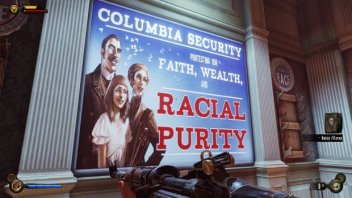
One of the many areas where racial tensions are highlighted in an alternative history setting in BioShock Infinite.
Pulp magazines, coming out of this tradition, had to struggle to establish themselves as a quality source of reading material, away from the juvenility of the Dime mags. As we see in pulp magazines however, this was not entirely possible to get away from, as a lot of the master narrative elements continued. This is something that is picked up in BioShock Infinite, a game that explores issues of race and class extensively, mirroring issues of the pulp magazine era, while forcing us to analyze our own cultural perspectives (e.g. as explored more fully by Waypoint or HowManyPrincesses).
For now I’d like to hold off on the contemporary comparisons to pulps, and instead focus on the analysis of pulps themselves. As demonstrated by Bold, pulps historically fell into a low culture motif, despite their attempt to remove themselves from the Dime and Nickel days.
While this worked, somewhat, to elevate their cultural status, the dichotomous approach to culture remained a dominant force in their ‘place’ in the world — including in academic study. While ‘high’ culture is as much culture as ‘low’ culture, the social elites have continued to try to defame ‘low’ culture in order to keep social groups separate. This has been a problem for academic study in particular, as often ‘low’ cultural elements have trouble being studied in any depth–believed to be lacking any cultural relevance. Naturally, this is far from the truth.
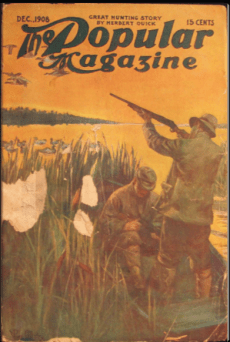
With a large surge of literate Americans and ease of access to printing via the industrial revolution, pulp magazines became a tool of expression for the public at large. This was not without some sort of control however, that as much as pulps were avenues of expression for the non-elites (especially as more sub-genres developed), so too did they serve to normalize and establish a desirable master narrative of Americana. We saw this clearly when we performed an “anatomical study” on The Popular Magazine from December of 1908.
In this early pulp magazine we found a steady theme of adventure…but only so far. Quite frequently the stories in the magazine conveyed a sense that adventure can be found anywhere for the everyman–even just outside of the city. It is oriented towards this everyman, who is capable of reaching his own potential, if only he tries hard enough (read like traditional Americana or what). The advertisements (at this time) reinforce this theme, with promotions of becoming a better business man, family values, as well as patriotism and nationalism, naturally. This is quite literally laid out at the end of the magazine, where “A Chat With You” leads potential writers into how they should tailor their stories for the magazine. Underpinning these normative performances, we also see simplified and stereotypical representations of People of Colour and immigrants–quite often negative ones at that.
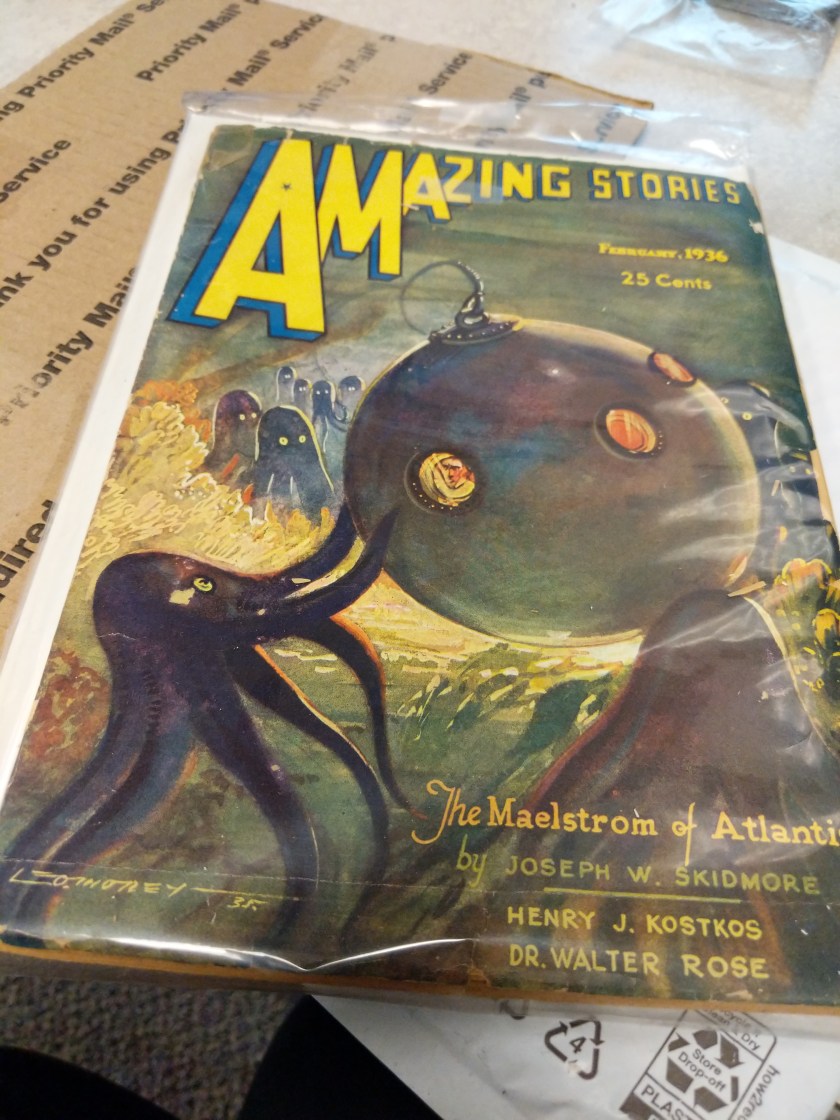
Finally, we took to buying our very own pulp magazines. Searching the e-racks of Ebay, we tried to find an authentic, interesting, and affordable magazine to call our own, and to document for the rest of the term. As a group, we readily decided on a sci-fi theme, as the stories they promised were sure to be entertaining, if only just to see how people saw the future. Luckily, we had a lot of potential options, and settled on a copy of “Amazing Stories” from the mid-1930’s. Sadly we weren’t able to get a synopsis of any of its contents but its cover alone was enough to draw us in. Some sort of squid people rolling people in a Christmas-ornament style orb–what isn’t to love? Here’s hoping its as interesting as its cover suggests–but wasn’t that the hope of all pulp cover art? To draw you in? Well, this one surely has us hooked, and luckily, it follows a nautical theme with “The Maelstrom of Atlantis.”
I have always been a fan of detective fiction, mystery, and sci-fi novels. This has extended to movies and video games that delve into these topics from a variety of levels. For me, pulp fiction magazines highlight some ways in which these genres came to be developed in a different, more easily digestible, way.
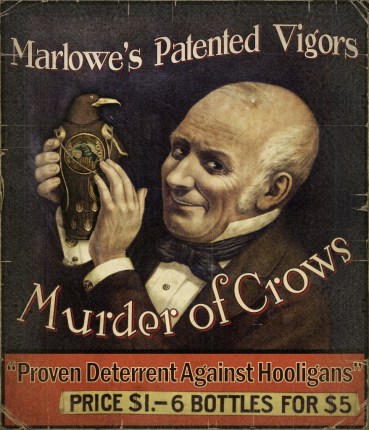
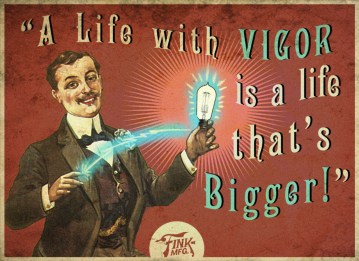
Advertisement from BioShock Infinite
In particular, some of my favourite games feature art, themes, and graphical styles based on the same styles seen in pulp magazines (BioShock series, Fallout, etc.), and there’s a
real movement towards narration or satire based on the themes originated in pulp. I would love to trace how some of these things are enacted and developed in pulp magazines, versus how they are manifest in video game contexts. I am curious to see if the tropes and imagery are blatantly pulled from these precursors, or if they are used and adapted to fit the motivations of the game. I know in many cases the themes are adapted, but I am sure there are places that are near recreations of pulp-styles. It’s also interesting to consider how pulp motifs play out in a video game setting, that is often the opposite of quick and digestible.
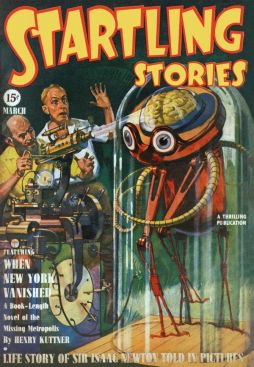
In considering this possibility, I spent a great deal of time pouring over various magazine covers from thePulp Magazine Project (PMP), and doing a visual overview of various art and media messages found in the BioShock and Fallout series. It was of no surprise that there were a lot of similarities in advertising and message. There are a ton of background advertising stills, videos, and audio clips played throughout both the BioShock and Fallout universes–aimed at creating a very specific type of atmosphere. It is at once ‘nostalgic’ but also a little surreal as they both take what’s familiar (Art Deco, 1950’s suburbia, etc.) and twist them to fit the worlds they want to represent. We buy in because we recognize these cultural markers, but we are carried along by how those markers are shifted and inverted to show us entirely new and often self-reflexive perspectives.
One of the things that I enjoy so much about these worlds, and why I find them so important for informing my study of pulp magazines, is that the visual motifs used from these video games are derived quite deliberately from the eras that pulps come from. Not only do they play on nostalgia, but they outright present alternative history representations of the same visual style.
“[Developers] also [make] use of a game’s atmosphere to support narrative–the architecture of the cities, the ambient conversations of the citizens, the advertising of the time period” (Fast Company).
In developing BioShock Infinite, the third BioShock in the series, creator Ken Levine “…was drawn to the time between the Civil War and World War I, a time of scientific progress that saw the development of electricity and the telephone but also religious belief and nationalism. Specifically, he cited, ‘Devil in the White City, which is a great book about the 1893 World’s Fair, and then certain movies give you a feel–There Will Be Blood gave me the weird vibe of revivalism and frontierism'” (Fast Company). As Levine highlights, movies like There Will Be Blood or tv shows like Downton Abbey sensationalize and stylize the eras these pulp magazines represent. They create a feeling–a feeling that I experience simply by looking at the real covers in the PMP. I’m curious if that feeling is because of the pre-conceived cultural understandings I have of those eras, or if any impression is at all factual.
From a more technical angle, I’ve always been interested in typography and layout in magazines, print media, and advertising of all kinds. I would also be interested in exploring how pulp developed their genre visually and typographically. What threads exist between sub-genres, and how do those tie into larger visual symbols.
While we ultimately discussed in class that advertising could not necessarily be tied to a sub-genre of pulp magazine due to mass-sales of advertising space across a publishing company, it remains interesting to see what kinds of advertising entered into pulps at all. What did companies think the readers of pulp wanted to buy? What did they want them to buy? What can we learn from their sales attempts (including how advertisements are placed throughout a magazine, etc.).


 In this early pulp magazine we found a steady theme of adventure…but only so far. Quite frequently the stories in the magazine conveyed a sense that adventure can be found anywhere for the everyman–even just outside of the city. It is oriented towards this everyman, who is capable of reaching his own potential, if only he tries hard enough (read like traditional Americana or what). The advertisements (at this time) reinforce this theme, with promotions of becoming a better business man, family values, as well as patriotism and nationalism, naturally. This is quite literally laid out at the end of the magazine, where “A Chat With You” leads potential writers into how they should tailor their stories for the magazine. Underpinning these normative performances, we also see simplified and stereotypical representations of People of Colour and immigrants–quite often negative ones at that.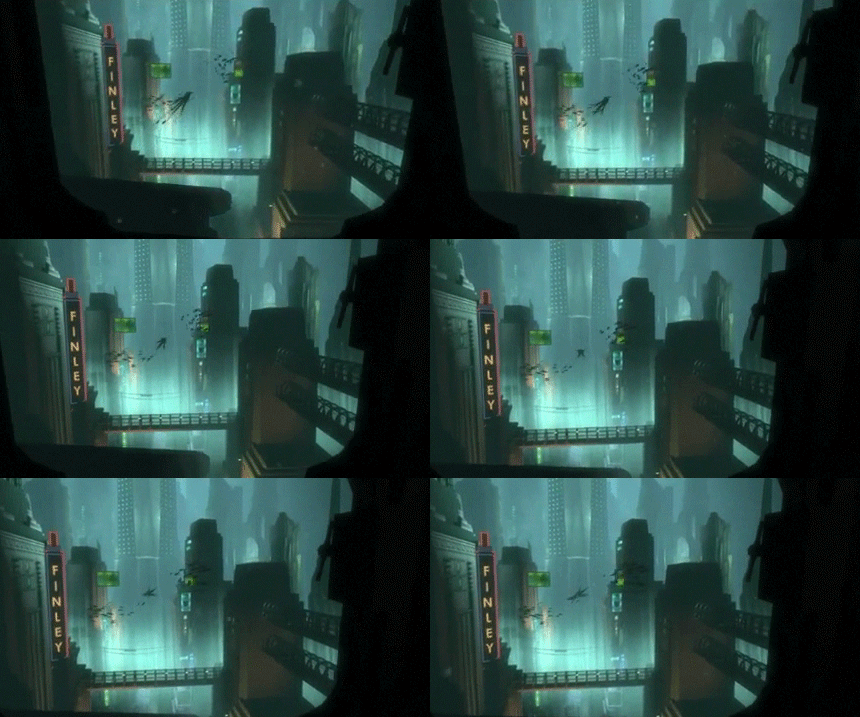

 My Life, or Something Like It