

Gone are the days of mythological cheat codes and glitches now that we constantly share and update gaming strategies through YouTube, GameFAQs, and more. Yet, the need to cheat was there at the beginning, and so does the trend seem to continue through our contemporary gaming market, even in the wake of leadership boards and achievements. Thus we return to the primary question of this post: why are we doing it?
Perhaps we can revisit the idea that original cheat codes were meant to help playtesters in their intentional bug-finding failures for an answer. Jesper Juul spends a good deal of time breaking down our relationship with failure and videogames in The Art of Failure. Juul (2013) comments that while we generally avoid failure in our daily lives, we often seek out games that ultimately provide some kind of failure, even though we would otherwise avoid it (33). “[E]ven though players appear to dislike failure, we tend to believe that games should make players fail, at least some of the time” (34, emphasis added). He continues on to liken videogame experiences of failure with art, and most importantly, that our videogame failures offer us compensation somehow (like the exhilaration of finally achieving a difficult task), and that we don’t always seek them out for pleasure. “The most important thing in life is not the triumph, but the fight; the essential thing is not to have won, but to have fought well” (The Olympic Creed, as quoted by Juul, 43).
Interestingly, we often fail to remember that cheating, modding, and hacking videogames can be either to make games easier or harder. Up and until this point, I have even focused on cheating as that which makes the game easier, but there are plenty of examples of the opposite, including ROM Hacks and code-changing to give games that extra edge gamers desire to really “prove” themselves. Arguably, in these cases, players are actively seeking the possibility and likelihood of failure, so that when they finally do succeed, it’s that more momentous. Some games even have this built-in, as Juul discusses later on. GLaDOS seems to take joy in taunting the player in their ‘ineptitude’ while progressing through the Portal series (50), particularly when she is a potato. These taunts push us to excel and to feel better despite this sanctioned kind of ‘abuse.’
Katherine Isbister explores how videogames work actively and intentionally on our emotions within her book How Games Move Us and might be able to help shed some insight here too:
To the human brain, playing a game is more like actually running a race than watching a film…When I run, I make a series of choices about actions I will take that might affect whether I win. I feel a sense of mastery or failure depending on whether I successfully execute the actions…My emotions ebb and flow as I make these choices and see what happens as a result. In the end, I am to blame for the outcomes, because they arise from my own actions (3).
Sound familiar? GLaDOS taunts the player forward so that the player continues, but also because it helps to convince the player to be emotionally invested. This emotion is derived not only from the content of the game, but also through its design (again, via Procedural Rhetoric). You are required to be the active agent that makes decisions and makes the game progress. Games that centre around this “flow” as Isbister calls it, “[t]he ability to choose and control your actions” that cause players to ‘get in the zone,’ “…time seems to melt away and personal problems disappear. Well-designed games, with the control they offer users over actions in a novel world, readily engage players in a flow state” (4). She goes on to cite the necessity of goals, action and awareness, challenging activities, loss of self-control, and altered sense of time as features of this flow. What’s interesting for our discussion of cheating and modding, is that in some cases, these features remain. The very act of modding, as we’ll see later with Skyrim and Fallout 4, can be as emotionally engaging as the game’s content itself.
So if cheating to make things harder follows Juul and Isbister, what can we say about when games are made easier through cheating and modification? What happens when the risk of failure is reduced, if not removed altogether?
Juul spends a great deal of time discussing the different types of failure we encounter when playing videogames. However, I would like to suggest that modding (of some kinds) and cheating to make things easier on the one hand makes failure nearly impossible in-game, but actually equates to “failing” in the real world. By neglecting to play the game “as intended,” you ultimately circumvent any real engagement with the content and ultimately fail before you even begin. While you may feel no guilt or remorse for cheating, you will always be aware that you cheated, even if it was only once. The entire experience of that game is now attached to your decision to cheat. It will never be “the same” as if you had progressed naturally. In this way, it becomes nearly impossible to avoid failure altogether when playing videogames, as when cheating to make things easier, you might only be cheating yourself out of an authentic experience.
But alas, things are never quite so simple. There are plenty of ways to cheat that can be legitimized–not all console commands are created equally. While this leads us into our upcoming discussion of The Sims and World of Warcraft, I will end off on my own anecdote about utilizing cheat codes at my disposal.
When I first started playing Skyrim on my Xbox 360 I got lost in the ‘flow’ and wasted a good number of hours in the woodland mountains. As I type now, I’m even listening to the world nighttime music of the game. I was seriously invested. After more hours than possible to reset, I encountered a game-breaking bug where I was unable to progress the main storyline of the faction I wanted to join. Vehement that I could not join the opposing faction, I found a way to port my save file to a USB before plugging it into my computer and converting it to a PC game file, and console-command progressing my character along the questline I needed, past the bug. I then reconverted the file to an Xbox 360 save, plugged it back into my system, and continued being the Dragonborn.
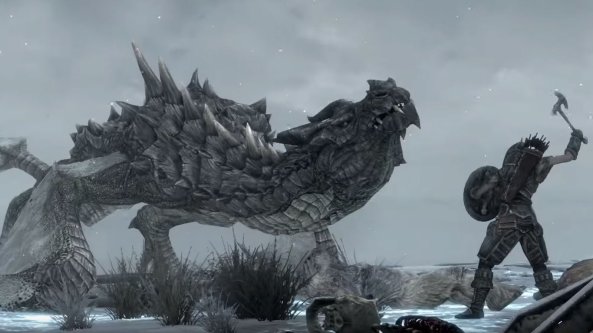
Do I feel guilty about this? Does it taint my memories of the game? Well, no, not really, but I’ll always know I did it. While I felt justified in my reasoning behind progressing my save, and while my Xbox 360 achievements never blinked an eye, I was still saddened that it was something I was forced to do. While toying with Bethesda bugs is something the modding community is well-invested in (something else we’ll tackle in a later post), there’s something to be said for cheating justification in our gaming–and that’s not even something that’s just from the developers. What’s acceptable to modify or how one chooses to cheat within the gaming community is vastly different depending on what kind of game it is (solo vs. multiplayer, online vs. offline, to name a few). Even the pedigree and age of a game can affect how players see any sort of deviation from the scripted norm. There are countless and fascinating areas worth looking into and studying when dealing with this area, and I regret I’m only able to touch on so few.
The next few posts will look at cheating and modification in action as viewed through The Sims (series), World of Warcraft, Skyrim and Fallout 4. Buckle in, it ain’t over yet.
Academic References/Further Reading:
Bogost, Ian. Persuasive Games: The Expressive Power of Video Games (2010)
Isbister, Katherine How Games Move Us (2016)
Juul, Jesper. The Art of Failure (2013)
 My Life, or Something Like It
2 thoughts on “Videogames: What makes us cheat?”