

SOCCER (NES)

Sports games have been around pretty much since the dawn of gaming. Even PONG is supposed to represent table tennis (and was originally styled after a 1950’s mainframe game called Tennis for Two)! Produced by Intelligent Systems in 1985, Soccer was launched in both Japan (on this day) and the US in 1985, and hit Europe two years later. It was also made available more recently on the Virtual Console–in case kicking around pixelated soccer balls is your jam. With it’s simplistic yet very entertaining gameplay, players’ objective is to kick the ball into the opponent’s goal, much like the real thing. The game also features 8bit cheerleaders and the ability to choose between 15, 30, and 45-minute halves. While the game was said to have limited visual pixel appeal, it is said to have made up for it in pure entertainment value. The long list of soccer games has grown extensively since 1985, but sometimes it’s good to go back and see where the genre has come from.
BURNOUT 2: POINT OF IMPACT (GameCube)

Let’s face it, as much as we try to avoid it, spinning out and crashing happens in pretty much every style of racing game–often much to our chagrin. The Burnout series more broadly recognized this and turned it into a successful franchise designed around racing, but also rewarding you, and even encouraging you, to smash cars together. Sequel to the original title in the series, Burnout 2: Point of Impact was initially released in September of 2002 on the Playstation 2 console. On this day in history in 2003, however, it was released for the Gamecube and just under a month later for the original Xbox. Developed by Criterion Games and Published by Acclaim Entertainment, Burnout 2 follows it’s predecessor quite closely in gameplay; allowing players to race circuit tracks with a smashing twist. This title features more traffic, complex junctions, and more obstacles–making the crashing stakes even higher. While forcing other cars to crash grants you boost to go faster, crashing into objects or totaling your car altogether results in a loss in boost, forcing players to have to toe the destructive line. There is also a mode dedicated purely to crashing, where players earn points exclusively by crashing vehicles. This mode is not randomized and is considered to be a puzzle-like environment where strategy as well as trial and error must be bound together to achieve a maximum score. The Xbox version, released in May of 2003, features a “Developer’s Cut” and has 21 new car skins, 15 more ‘Crash’-mode tracks, and an Xbox Live online leader board. This was the first use of Xbox Live in any Burnout title.
SUPER PAPER MARIO
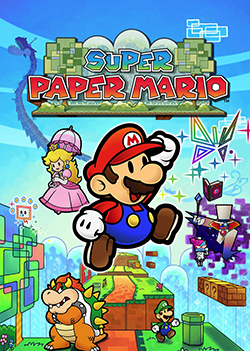
Taking it’s own spin on the original concepts from the Paper Mario legacy, Super Paper Mario (2007) maintains side scrolling, platforming gameplay, and roleplay components while giving Mario the ability to ‘flip’ between 2 and 3 dimensions. This ability must be used to maneuver around obstacles that would be otherwise insurmountable. The game also features control of Princess Peach, Bowser, and Luigi as the story develops. The game was designed to capture the spirit of the original Paper Mario titles, but also develop a new style of game mechanics. Originally announced for the GameCube at E3 in 2006, the game was later shifted over to the Wii console instead. Developed by Intelligent Systems and Nintendo SPD, the main objective of the game is to collect 8 “Pure Hearts,” one from each level, in order to prevent the main antagonist from destroying the universe (naturally). All characters have their own abilities, but Mario is the only one who can flip between dimensions. The game also features a points system where the player can accumulate EXP and level up to be able to hit harder and take more damage. Dialogue prompts are also important here, as when the player takes too much damage, or improper dialogue options are chosen too many times, the game will end and unsaved progress lost. Finally, the game departs from a turn-based battle structure and instead utilizes direct combat.
ROLLERCOASTER TYCOON 4 (MOBILE)

Oh RollerCoaster Tycoon, how many hours of building ridiculous rides for doomed Peeps over the years have you given us–or was that just me? Regardless, RollerCoaster Tycoon 4 Mobile was launched just two years ago on this day by Atari and On 5 Games. Much like the earlier games in the series, the Tycoon-player builds rides throughout their theme park (carousels, bumper cars, ferris wheels, etc.) as well as other buildings like: food stands (ice cream, pizza, hot dogs, etc.), ticketing booths, full-sized restaurants, daycare centers, souvenir shops, etc. to provide greater income. The player must ensure their park is constantly up-to-date with the latest and craziest of death-machines in order to attract Peeps. If the buzz level of your clientele drops too much, the park’s patronage drops along with it. The game also features reward quests, a leveling system, and unlockable rides. The game is still being developed and earlier this year two new coasters and the option of building more parks were added. There is also a campaign mode more akin to the previous titles in the series. RollerCoaster Tycoon 4 has unfortunately received fairly bad reviews due to its micro-transactions (despite not being free to play), excessive wait times, and reduced series-regular features.
Some other titles released on this day in gaming history:
- Leisure Suit Larry III: Passionate Patti in Pursuit of the Pulsating Pectorals – PC – 1989
- Midnight Club II – PS2 – 2003
- Ikaruga – Xbox360 – 2008
Burnout 2 Box Art: Fair use
Super Paper Mario Box Art: Fair use
RollerCoaster Tycoon 4 Mobile: By Source, Fair use
 My Life, or Something Like It


